illustration only
illustration only |
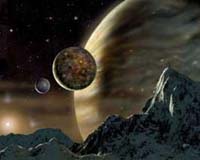
Both objects have masses similar to those of extra-solar giant planets, but they are not in orbit around a star - instead they appear to circle each other. The existence of such a double system puts strong constraints on formation theories of free-floating planetary mass objects, called planemos.
Ray Jayawardhana of the University of Toronto in Canada and Valentin D. Ivanov of ESO report the discovery in the Aug. 3 issue of Science Express, the rapid online publication service of the journal Science.
"This is a truly remarkable pair of twins - each having only about 1 percent the mass of our Sun," said Jayawardhana. "Its mere existence is a surprise, and its origin and fate a bit of a mystery."
Roughly half of all Sun-like stars come in pairs. So do about one-sixth of brown dwarfs - failed stars that have less than 75 Jupiter masses and are unable to sustain nuclear fusion in their cores. During the past five years, astronomers have identified a few dozen of even smaller free-floating planemos in nearby star forming regions. Oph 162225-240515, or Oph1622 for short, is the first planemo found to be a double.
The researchers discovered the companion candidate in an optical image taken with ESO's 3.5-m New Technology Telescope at La Silla. They decided to take optical spectra and infrared images of the pair with ESO's 8.2-m Very Large Telescope to make sure that it is a true companion, instead of a foreground or background star that happens to be in the same line of sight.
Follow-up observations confirmed that both objects are young, at the same distance and much too cool to be stars. This suggests the two are physically associated.
By comparing to widely used theoretical models, Jayawardhana and Ivanov estimated that the companion is about seven times the mass of Jupiter, while the more massive object comes in at about 14 times Jupiter's mass.
The newborn planemos, barely 1-million years old, are separated by about six times the distance between the Sun and Pluto and are located in the Ophiuchus star-forming region approximately 400 light-years away.
Planets are thought to form out of discs of gas and dust that surround stars, brown dwarfs and even some planemos, but "it is likely that these planemo twins formed together out of a contracting gas cloud that fragmented, like a miniature stellar binary," Jayawardhana said.
"We are resisting the temptation to call it a double planet, because this pair probably didn't form the way that planets in our solar system did," Ivanov said.
Oph1622B is only the second or third directly imaged planetary mass companion to be confirmed spectroscopically, and the first one around a primary that is itself a planetary mass object.
Its existence challenges a popular theoretical scenario, which suggests brown dwarfs and planemos are embryos ejected from multiple proto-star systems. Becausethe two objects in Oph1622 are so far apart and only weakly bound to each other by gravity, they would not have survived such a chaotic birth.
"Recent discoveries have revealed an amazing diversity of worlds out there. Still, the Oph1622 pair stands out as one of the most intriguing, if not peculiar," Jayawardhana said.
"Now we're curious to find out whether such pairs are common or rare. The answer could shed light on how free-floating planetary-mass objects form," Ivanov added.
Related Links
 Three-Telescope Interferometer Shows Patchy Red Giants Common Fate Of Sun-Like Stars
 Kamuela HI (SPX) Jul 21, 2006
| The content herein, unless otherwise known to be public domain, are Copyright 1995-2006 - SpaceDaily.AFP and UPI Wire Stories are copyright Agence France-Presse and United Press International. ESA PortalReports are copyright European Space Agency. All NASA sourced material is public domain. Additionalcopyrights may apply in whole or part to other bona fide parties. Advertising does not imply endorsement,agreement or approval of any opinions, statements or information provided by SpaceDaily on any Web page published or hosted by SpaceDaily. Privacy Statement |