|
 |
 |
 |
 |
 |
 |
 |
 |
 |

| . |  |
. |
Astronomers Find Grains Of Sand Around Distant Stars
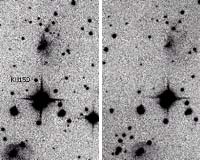
Houston TX (SPX) Mar 14, 2008 In a find that sheds light on how Earth-like planets may form, astronomers this week reported finding the first evidence of small, sandy particles orbiting a newborn solar system at about the same distance as the Earth orbits the sun. The report will be published online this week by the journal Nature. "Precisely how and when planets form is an open question," said study co-author Christopher Johns-Krull, assistant professor of physics and astronomy at Rice University. "We believe the disk-shaped clouds of dust around newly formed stars condense, forming microscopic grains of sand that eventually go on to become pebbles, boulders and whole planets." In previous studies, astronomers have used infrared heat signals to identify microscopic dust particles around distant stars, but the method isn't precise enough to tell astronomers just how big they become, and whether the particles orbit near the star, like the Earth does the sun, or much further away at a distance more akin to Jupiter or Saturn. In the new study, Johns-Krull and co-authors in the United States, Germany and Uzbekistan used reflected light from the sand itself to confirm the Earth-like orbit of grainy particles around a pair of stars called KH-15D in the constellation Monoceros. The stars are about 2,400 light years from Earth in the Cone Nebula, and they are only about 3 million years old, compared to the sun's 4.5 billion years. "We were attracted to this system because it appears bright and dim at different times, which is odd," Johns-Krull said. The researchers found that the Earth has a nearly edge-on view of KH-15D. From this perspective, the disk blocks one of the stars from view, but its twin has an eccentric orbit that causes it to rise above the disk at regular intervals. "These eclipses let us study the system with the star there and with the star effectively not there," Johns-Krull said. "It's a very fortuitous arrangement because when the star is there all the time, it's so bright that we can't see the sand." The team conducted both photometric and spectrographic analyses of data collected during the past 12 years from a dozen observatories, including the McDonald Observatory in west Texas, the Keck Observatory in Hawaii and the VLT on Mount Paranal in Chile. "Because of how the light is being reflected there are opportunities to make observations about the chemical composition of these sand-like particles," said co-author William Herbst, an astronomer at Wesleyan University in Middletown, Conn. "That's very exciting because it opens up so many doors for new type of research on this disk." Community Email This Article Comment On This Article Related Links Rice University Lands Beyond Beyond - extra solar planets - news and science Life Beyond Earth
 The Planets In Planetary Nebulae
 Rochester NY (SPX) Mar 13, 2008
Astronomers at the University of Rochester, home to one of the world's largest groups of planetary nebulae specialists, have announced that low-mass stars and possibly even super-Jupiter-sized planets may be responsible for creating some of the most breathtaking objects in the sky. |
|
|

| The content herein, unless otherwise known to be public domain, are Copyright 1995-2007 - SpaceDaily.AFP and UPI Wire Stories are copyright Agence France-Presse and United Press International. ESA Portal Reports are copyright European Space Agency. All NASA sourced material is public domain. Additional copyrights may apply in whole or part to other bona fide parties. Advertising does not imply endorsement,agreement or approval of any opinions, statements or information provided by SpaceDaily on any Web page published or hosted by SpaceDaily. Privacy Statement |