
. Military Space News .
Astronomers Search For Orphan Stars Using Newly Upgraded Telescope

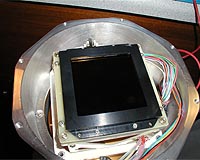
Image of the new CCD sitting in the cryogenic dewar.
by Staff Writers
Cleveland OH (SPX) May 20, 2008
Using new charge coupled device (CCD) instrumentation, Case Western Reserve University astronomers can now view the night sky wider and deeper than before.

While the vast reaches of intergalactic space may appear dark and empty, a new camera installed on the university's Burrell Schmidt telescope at Kitt Peak National Observatory in Tucson, Ariz., will bring into clear view the faint sea of orphan stars strewn throughout the nearby Virgo cluster of galaxies.

The design and installation of the new camera system was led by Case Western Reserve astronomer Paul Harding, who also serves as the observatory manager.

A CCD -- a larger and more sensitive version of the imaging technology found in everyday digital cameras -- will enable the astronomers to determine the ages of these stars and unravel the secrets of their origins.

This faint orphan starlight, dubbed "intracluster light," is formed when galaxies collide with one another inside titanic clusters of galaxies. During these collisions, stars are ripped away from their parent galaxies and strewn throughout the cluster by the gravitational forces at work.

Originally discovered in the Virgo cluster three years ago by Case astronomer Chris Mihos and his collaborators, this intracluster light holds the key to understanding how galaxy clusters form and evolve.

The primary reason for upgrading the telescope's camera is to determine the color of these stars, according to Mihos and Harding. "Typically younger stars are bluer," Harding says, "so if we can measure the color of the intracluster light, we can learn about its age."

Younger ages for the stars would suggest that the Virgo cluster formed relatively recently, over the past few billion years. But because the stars are very faint in the blue, to measure the stellar colors the existing camera needed to be upgraded to be image a wider portion of the sky with even greater sensitivity.

The telescope's upgraded camera images an area of the sky 1.5 degrees on a side -- twice as big as the old camera, and enough to fit nine full moons in the field of view. "By imaging twice as much sky, we can collect twice as much light at once," Mihos says, "and that lets us detect this faint starlight even in the blue where it is extremely faint."

Harding likens the new CCD to a camera that has been retrofitted to increase its film size from 35 mm to a large format film size of several inches.

"It's the same camera but bigger film," Harding explained. The CCD itself, a thin wafer of silicon measuring three inches on a side, was fabricated by the Imaging Technology Laboratory at the University of Arizona and cost approximately $100,000.

Community
Email This Article
Comment On This Article

Share This Article With Planet Earth
del.icio.usdel.icio.us DiggDigg RedditReddit
YahooMyWebYahooMyWeb GoogleGoogle FacebookFacebook


Related Links
Case Western Reserve University
Stellar Chemistry, The Universe And All Within It


Memory Foam Mattress Review
Newsletters :: SpaceDaily :: SpaceWar :: TerraDaily :: Energy Daily
XML Feeds :: Space News :: Earth News :: War News :: Solar Energy News


Weird Stellar Pair Puzzles Scientists
Washington DC (SPX) May 16, 2008
Astronomers have discovered a speedy spinning pulsar in an elongated orbit around an apparent Sun-like star, a combination never seen before, and one that has them puzzled about how the strange system developed.


  • Outside View: Russia at war -- Part 2
  • Walker's World: Building with BRICs
  • US warns China of 'technological isolation'
  • China's new naval base triggers US concerns

  • US says it is 'stepping up cooperation' on disarming NKorea
  • SKorea nuclear envoy heads for talks in Washington
  • World powers work out details of new offer to Iran
  • Russia's Medvedev inspects nuclear missiles

  • Boeing Completes Six Years Of On-Time Minuteman III Missile Guidance Set Deliveries
  • Boeing Receives Contract To Further Develop Dual-Role Missile
  • Successful NetFires Precision Attack Missile Flight Test
  • Pakistan test-fires nuclear-capable cruise missile: military

  • BMD Watch: Japan changes space policy
  • US offer on missile defence unsatisfactory: Poland PM
  • Japan Plans Missile Defense Warning Satellites
  • No permanent foreign inspectors in US-Czech radar talks: minister

  • China's new jumbo-jet firm no threat to Airbus, Boeing: state media
  • China unveils new jumbo jet company: report
  • NASA And JAXA To Conduct Joint Research On Sonic Boom Modeling
  • Analysis: Can airplanes go green?

  • Prototype UAV Tested At Northern Edge
  • Eurocontrol Addressing Integration Of UAS Into European Airspace
  • Raytheon Teams With Swift Engineering To Offer KillerBee UAS
  • EU satellite imagery experts will seek to solve Georgia drones row

  • Deployment plans keep US forces in Iraq level into 2009: Pentagon
  • Key architect of Iraq war defends case for US-led invasion
  • Feature: U.S. cites attacks despite truce
  • Features: More graves found

  • Royal Netherlands Air Force CH-47F Helicopters Equipped With Missile Warning Systems
  • Boeing-SAIC Team And FCS Program Play Key Roles In Joint Expeditionary Force Experiment 2008
  • Analysis: China copter deal -- Part 3
  • Analysis: Russia spies on German firms

  • The content herein, unless otherwise known to be public domain, are Copyright 1995-2007 - SpaceDaily.AFP and UPI Wire Stories are copyright Agence France-Presse and United Press International. ESA Portal Reports are copyright European Space Agency. All NASA sourced material is public domain. Additional copyrights may apply in whole or part to other bona fide parties. Advertising does not imply endorsement,agreement or approval of any opinions, statements or information provided by SpaceDaily on any Web page published or hosted by SpaceDaily. Privacy Statement