
. Military Space News .
STELLAR CHEMISTRY
Astronomers discover 2,000-year-old remnant of a nova
by Staff Writers
Gottingen, Germany (SPX) May 01, 2019

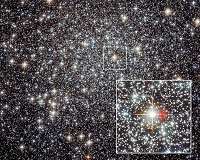
Near the centre of the globular cluster Messier 22, the team of scientists discovered the remains of a nova.

For the first time, a European research team involving the University of Gottingen has discovered the remains of a nova in a galactic globular cluster. A nova is an explosion of hydrogen on the surface of a star which makes it much brighter.

The remains have formed a glowing nebula. The remnant is located near the centre of the globular cluster Messier 22 and has recently been observed using modern instruments. The results will be published in the journal Astronomy and Astrophysics.

"The position and brightness of the remains match an entry from 48 BC in an ancient collection of observations by Chinese astronomers," says first author Fabian Gottgens of the Institute for Astrophysics at the University of Gottingen.

This is research carried out for his PhD in the Stellar Astrophysics research group lead by Professor Dreizler. "They probably saw the original nova in the same place." This means modern measurements confirm one of the oldest observations of an event outside the solar system.

Globular clusters are large, spherical clusters of several hundreds of thousands of very old stars that orbit together around their home galaxy. There are 150 known globular clusters orbiting our galaxy, the Milky Way. Messier 22 is one of these star clusters, it lies in the constellation Sagittarius in the direction of the centre of the Milky Way.

It was observed together with two dozen other globular clusters with the instrument MUSE at the Very Large Telescope of the ESO in Chile. The MUSE instrument was developed with the participation of the Institute for Astrophysics, which was funded by the BMBF.

It does not only produce images, it also simultaneously splits starlight by colour, measuring the brightness of stars as a function of colour. This makes it particularly suitable for finding nebulae that often only glow in a certain colour - usually red.

The newly discovered remains of the nova form a red shining nebula of hydrogen gas and other gases, which has a diameter of about 8,000 times the distance between Earth and Sun. Despite its size, the nebula is relatively light, with a mass about 30 times that of Earth, because the gas was dispersed by the explosion.


Related Links
University of Gottingen
Stellar Chemistry, The Universe And All Within It


Thanks for being here;
We need your help. The Space Media Network continues to grow but revenues have never been harder to maintain.

With the rise of Ad Blockers, and Facebook - our traditional revenue sources via quality network advertising continues to decline. And unlike so many other news sites, we don't have a paywall - with those annoying usernames and passwords.

Our news coverage takes time and effort to publish 365 days a year.

If you find our news sites informative and useful then please consider becoming a regular supporter or for now make a one off contribution.
SpaceMediaNetwork Contributor
$5 Billed Once


credit card or paypal
SpaceMediaNetwork Monthly Supporter
$5 Billed Monthly


paypal only


STELLAR CHEMISTRY
What a dying star's ashes tell us about the birth of our solar system
Tucson AZ (SPX) May 01, 2019
A grain of dust forged in the death throes of a long-gone star was discovered by a team of researchers led by the University of Arizona. The discovery challenges some of the current theories about how dying stars seed the universe with raw materials for the formation of planets and, ultimately, the precursor molecules of life. Tucked inside a chondritic meteorite collected in Antarctica, the tiny speck represents actual stardust, most likely hurled into space by an exploding star before our ... read more

Comment using your Disqus, Facebook, Google or Twitter login.


Share this article via these popular social media networks
del.icio.usdel.icio.us DiggDigg RedditReddit GoogleGoogle

STELLAR CHEMISTRY
Lockheed awarded $13.9M for work on AEGIS Speed to Capability cycles

Lockheed Martin's AEHF-4 on-orbit tests successful

Lockheed awarded $9.1M for AEGIS work in Romania, Poland

Navy executes successful test of AEGIS Virtual Twin software in missile test

STELLAR CHEMISTRY
Missile contracts surge as US exits arms treaty: study

Raytheon receives $419 million for Sidewinder missiles, parts

Boeing, Lockheed contracted for Apache work, Hellfire missiles for Saudi Arabia

Turkey says understands NATO concerns over Russian missile deal

STELLAR CHEMISTRY
Iris Automation offers turnkey collision-avoidance solution for commercial drones

Ballard Launches Turnkey Fuel Cell Solutions to Power Commercial Unmanned Aerial Vehicles

Europe's First Hydrogen Drone Doubles Flying Times with AMS Cylinders

Ascent AeroSystems Announces New Industrial Grade Drone and Launch Customer

STELLAR CHEMISTRY
Boeing awarded $605M for Air Force's 11th WGS comms satellite

SLAC develops novel compact antenna for communicating where radios fail

US Army selects Hughes for cooperative effort to upgrades NextGen Friendly Forces System

United Launch Alliance launches WGS-10 satellite for USAF

STELLAR CHEMISTRY
With Insights from Integration Exercise, SubT Challenge Competitors Prepare for Tunnel Circuit

Marines to field enhanced handheld targeting system later this year

Marines to replace LAV with new armored vehicle in next decade

GenDyn awarded $125M for MK80, BLU-109 bomb components

STELLAR CHEMISTRY
US military spending up for first time in 7 years: Sipri

Acting Defense Secretary Patrick Shanahan cleared in ethics probe

Inquiry opens into leaked classified 'French weaponry in Yemen' note: sourcesw/ll

Israeli defence sales topped $7.5 bn in 2018: ministry

STELLAR CHEMISTRY
Japan rings in new era as Naruhito becomes emperor

Xinjiang crackdown at the heart of China's Belt and Road

End of an era as Japan's emperor abdicates

Moscow 'thinking' of simplifying nationality process for all Ukraine: Putin

STELLAR CHEMISTRY
Fast and selective optical heating for functional nanomagnetic metamaterials

2D gold quantum dots are atomically tunable with nanotubes

Harnessing microorganisms for smart microsystems

AD alloyed nanoantennas for temperature-feedback identification of viruses and explosives


The content herein, unless otherwise known to be public domain, are Copyright 1995-2024 - Space Media Network. All websites are published in Australia and are solely subject to Australian law and governed by Fair Use principals for news reporting and research purposes. AFP, UPI and IANS news wire stories are copyright Agence France-Presse, United Press International and Indo-Asia News Service. ESA news reports are copyright European Space Agency. All NASA sourced material is public domain. Additional copyrights may apply in whole or part to other bona fide parties. All articles labeled "by Staff Writers" include reports supplied to Space Media Network by industry news wires, PR agencies, corporate press officers and the like. Such articles are individually curated and edited by Space Media Network staff on the basis of the report's information value to our industry and professional readership. Advertising does not imply endorsement, agreement or approval of any opinions, statements or information provided by Space Media Network on any Web page published or hosted by Space Media Network. General Data Protection Regulation (GDPR) Statement Our advertisers use various cookies and the like to deliver the best ad banner available at one time. All network advertising suppliers have GDPR policies (Legitimate Interest) that conform with EU regulations for data collection. By using our websites you consent to cookie based advertising. If you do not agree with this then you must stop using the websites from May 25, 2018. Privacy Statement. Additional information can be found here at About Us.