|
 |
 |
 |
 |
 |
 |
 |

| . |  |
. |

|
|
. |

 by Staff Writers New York NY (SPX) Oct 12, 2011
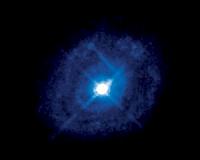
Astrophysicists have found evidence of black holes destroying stars, a long-sought phenomenon that provides a new window into general relativity. The research, reported in the latest issue of the Astrophysical Journal, also opens up a method to search for the possible existence of a large population of presently undetectable "intermediate mass" black holes which are hypothesized to be precursors to the super-massive black holes at the centers of most large galaxies. Cosmologists have calculated that, on occasion, a star's orbit will be disturbed in such a way that it passes very near the super-massive black hole at the center of its galaxy-but not so close that it is captured whole. Such a star will be torn apart by the extreme tidal forces it experiences: the force of gravity on the near side of the star is so much stronger than that on the far side that the gravitational force holding the star together is overwhelmed, causing the star to simply come apart. While some of the star's matter falls into the black hole, much of it continues in chaotic orbits, crashing into itself and producing intense radiation lasting days to months. These phenomena are called stellar tidal disruption flares, or TDFs. Although discovering evidence of TDFs has been a high priority of astrophysicists for many years, and several possible examples have been found using X-ray and UV satellites, discovering TDFs in a large-scale, systematic survey using ground-based optical telescopes as has now been achieved, is critical to controlling bias and avoiding misidentifications. The difficulty in detecting TDFs is largely due to the challenge of distinguishing them from more common types of flares such as supernovae. (For every TDF there are about 1000 supernovae.) In addition, some super-massive black holes have an "accretion disk" surrounding them-gas and dust, often left from an earlier merger with another galaxy-which is continuously feeding the hole. Such accreting black holes are usually evident from the bright emission they produce and are known as quasars or Active Galactic Nuclei (AGN). However, a hiccup in the accretion of an undetected active black hole could produce a flare that might be mistakenly identified as a TDF. The researchers on the Astrophysical Journal study uncovered sound evidence for the presence of two TDFs through a rigorous analysis of archival data from the Sloan Digital Sky Survey (SDSS). To do so, they sifted through voluminous SDSS data, in which more than 2 million galaxies were repeatedly observed over 10 years. By very carefully registering the images and looking at differences between consecutive images, they obtained a sample of 342 intense and well-measured flares. Of these, almost all could be classified into supernovae and AGN flares. However, two cases were left that did not fit either classification. By relying on multi-year observations, the researchers could see that the two flares' host galaxies showed no other flaring activity, as would be the case if the flares came from a hidden variable AGN. This means the possibility these two flares were produced by undetected AGNs is extremely small. In addition, the researchers located these flares at the nucleus of their galaxy with high precision, which reduces the likelihood that they are supernovae to less than 1 percent since supernovae are randomly distributed through galaxies. Finally, the properties of these flares are very different from flares of AGNs and supernovae-and their spectra are unlike any supernovae observed to date. Supernovae flares are characteristically very blue at first but become red as they cool and rapidly decay, whereas the TDF flares are very blue throughout-slowly decaying without changing color. This behavior is consistent with expectations for a TDF-the debris from the star should rapidly form an accretion disk and look like a short-lived AGN. Sjoert van Velzen, the study's lead author, was a Dutch first-year graduate student who came to NYU to work under the direction of Glennys Farrar, a Professor of Physics at NYU and senior scientist of the project. Van Velzen is now completing his Ph. D. in Holland. About his first encounter with real scientific work, van Velzen says, "Searching through 2.6 million galaxies was actually a lot of fun-there is so much to discover! Based on our search criteria and observing two TDFs that met those criteria, the rate of TDFs is about once per 100,000 years, per galaxy. It's quite thrilling to have been able to make such a measurement." "The next step is to develop models to explain in detail the flares' properties and duration, and address the question of whether TDFs could be responsible for producing Ultrahigh Energy Cosmic Rays, whose sources have been elusive up to now," says Farrar. "It is very exciting that we are on the verge of obtaining a large and better-observed sample of TDFs to study-though a more sensitive search of SDSS archival data and the new generation of transient surveys which will observe more flares in real-time and with multi-wavelength follow-up. A large sample will be invaluable to understanding many outstanding questions in astrophysics." The study was carried out primarily by Glennys Farrar and Sjoert van Velzen at New York University's Center for Cosmology and Particle Physics, and also included the following researchers: Suvi Gezari of Johns Hopkins University's Department of Physics and Astronomy; Linda Ostman of Spain's Universitat Autonoma de Barcelona; Nidia Morrell of the Las Campanas Observatory in Chile; Dennis Zaritsky of the University of Arizona; Matthew Smith of South Africa's University of Cape Town; Joseph Gelfand of NYU-Abu Dhabi; and Andrew Drake of Caltech. Van Velzen is currently a doctoral candidate at Radboud University in the Netherlands.
New York University Understanding Time and Space
|
. |
|
| The content herein, unless otherwise known to be public domain, are Copyright 1995-2011 - Space Media Network. AFP and UPI Wire Stories are copyright Agence France-Presse and United Press International. ESA Portal Reports are copyright European Space Agency. All NASA sourced material is public domain. Additional copyrights may apply in whole or part to other bona fide parties. Advertising does not imply endorsement,agreement or approval of any opinions, statements or information provided by Space Media Network on any Web page published or hosted by Space Media Network. Privacy Statement |

 del.icio.us
 Digg
Digg Reddit
 Google