|
 |
 |
 |
 |
 |
 |
 |
 |
 |

| . |  |
. |
Atom Research May Help Detect Volcanoes And Oceans
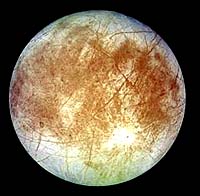
Pasadena - Jul 24, 2002 Breakthrough research on waves of ultra-cold atoms may lead to sophisticated atom lasers that might eventually predict volcanic eruptions on Earth and map a probable subsurface ocean on Jupiter's moon Europa. The atoms were manipulated to form tidy bundles of waves, called solitons, which retained their shape and strength. They were created in a laboratory at Rice University, Houston, under a grant from NASA's Biological and Physical Research Program through the Jet Propulsion Laboratory, Pasadena, Calif. Normally, when a wave forms -- whether in water, light or atoms -- it tends to spread out as it travels. Not so with a soliton wave. It maintains its perfect shape without spreading. In the Rice University research, the solitons are localized bundles of atom waves. Atom-wave solitons could be used in advanced lasers, which use atoms instead of light photons. Dr. Randall Hulet, the Rice University physics and astronomy professor who led the research team, said atom lasers may have many applications, some not yet envisioned. "Forty years ago, no one imagined that lasers would be used to play music in our cars or scan our food at the grocery store checkout," said Hulet. "We're getting our first glimpse of a wondrous and sometimes surprising set of quantum phenomena, and there's no way to know exactly what may come out of it." Hulet said atom lasers might improve instruments that study gravity variations to locate and measure underground water, minerals, oil, caves and volcanic magma on Earth. "Eventually, atom-wave lasers may enhance sensors for studying Earth and various bodies in the solar system," said Dr. Lute Maleki, principal investigator for the Quantum Gravity Gradient Project at JPL. "With these advanced sensors, we'll be able to produce a 3-D map of underground features. By measuring levels of underground magma, for example, scientists may be able to predict volcanic eruptions. This technology could be used on a spacecraft to map the ocean believed to lie beneath Europa's icy crust." In addition, atom lasers may yield extremely precise gyroscope navigation for air and space travel. Computers would run faster if atom lasers were used to write directly onto computer chips. The first recorded observation of a soliton wave was in 1834, when a man in Scotland saw a barge stop suddenly in a canal. This created a large bow wave, which traveled at about 8 miles per hour without shrinking or spreading. The man followed the wave on horseback for about a mile until he lost sight of it in the windings of the canal. Scientists now know that this soliton water wave formed because of particular relationships between the depth and width of the canal. In their laboratory, Hulet and his team confined lithium atoms within magnetic fields, cooled them with lasers to one billion times colder than room temperature, and confined them in a narrow beam of light that pushed them into a single file formation. The atoms formed a type of matter called a Bose-Einstein condensate, a quantum state where classical laws of physics go out the window and new behaviors govern the atoms. Instead of hitting each other and bouncing off like bumper cars, the atoms join together and function as one entity. The team actually observed a "soliton train" of multiple waves.
Hulet co-authored a paper on the research, which appeared in the May 9 issue of the journal Nature, with Rice University graduate students Kevin Strecker and Guthrie Partridge, and Dr. Andrew Truscott, formerly a post-doctoral researcher at Rice and currently on the faculty at Australian National University in Canberra. Related Links Biological and Physical Research Program SpaceDaily Search SpaceDaily Subscribe To SpaceDaily Express  Orbital Selected for $39 Million Contract to Build NASA EO Bird
 Dulles - July 24, 2002
Orbital Sciences Corporation has been selected for a contract, valued at approximately $39 million, by the Jet Propulsion Laboratory (JPL), a division of the California Institute of Technology, to design, manufacture and support mission operations of a new National Aeronautics and Space Administration (NASA) atmospheric science satellite. |
|
|

| The content herein, unless otherwise known to be public domain, are Copyright 1995-2006 - SpaceDaily.AFP and UPI Wire Stories are copyright Agence France-Presse and United Press International. ESA PortalReports are copyright European Space Agency. All NASA sourced material is public domain. Additionalcopyrights may apply in whole or part to other bona fide parties. Advertising does not imply endorsement,agreement or approval of any opinions, statements or information provided by SpaceDaily on any Web page published or hosted by SpaceDaily. Privacy Statement |