|
 |
 |
 |
 |
 |
 |
 |
 |
 |

| . |  |
. |
Atomic Clock Signals May Be Best Shared By Fiber-Optics
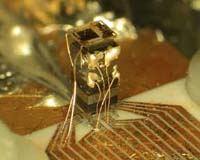
Boulder CO (SPX) Mar 06, 2007 Time and frequency information can be transferred between laboratories or to other users in several ways, often using the Global Positioning System (GPS). But today's best atomic clocks are so accurate-neither gaining nor losing one second in as long as 400 million years-that more stable methods are needed. The best solution may be to use lasers to transfer data over fiber-optic cables, according to scientists at JILA, a joint institute of the National Institute of Standards and Technology (NIST) and the University of Colorado at Boulder. The use of fiber-optic channels to transfer time signals allows accurate comparisons of distantly located atomic clocks of different types. This could lead, for example, to enhanced measurement accuracy in experiments to determine whether so-called "constants of nature" are in fact changing. Sharing of clock signals via fiber also will enable synchronization of components for advanced X-ray sources at linear accelerators, which may power studies of ultrafast phenomena in chemistry, biology, physics and materials science; or link arrays of geographically distributed radio telescopes to produce the power of a giant telescope. Three state-of-the-art techniques for distributing ultra-stable time and frequency signals over fiber are described in a new review article* by NIST Fellow Jun Ye's group at JILA. Fibers can be far more stable, especially when efforts are made to cancel molecules along the transmission path, than the paths through free-space used by GPS, which requires days of measurement averaging to accurately compare today's best frequency standards. Moreover, considerable fiber-optic infrastructure already exists. For instance, the new paper is based largely on research performed on a 3.45-km fiber link installed in underground conduits and steam tunnels between JILA and NIST laboratories in Boulder. Microwave frequency signals such as from NIST's standard atomic clock can be distributed over fiber using a continuous-wave (cw) laser. Another method can transfer more accurate optical frequency references such as NIST's mercury ion clock or JILA's strontium clock with a cw laser and disseminate signals to both optical and microwave users using an optical frequency comb. As a third option, microwave and optical frequency references can be transmitted simultaneously using a frequency comb. Noting that gravitational effects may eventually limit ground-based atomic clocks, the paper suggests someday creating a network of optical atomic clocks in space, which might be used to make flawless distance measurements, transfer clock signals to different locations, and accurately map the Earth's gravity distribution. * S.M. Foreman, K.W. Holman, D.D. Hudson, D.J. Jones, and J. Ye. Remote transfer of ultrastable frequency references via fiber networks. Invited Review, Review of Scientific Instruments. Vol. 78, No. 228. Published on-line Feb. 28, 2007. Email This Article
Related Links  Pasadena CA (SPX) Mar 06, 2007
By analyzing the COSMOS field, the largest field of galaxies ever observed with the Hubble space telescope, an international team of scientists led by researchers from the California Institute of Technology (United States) and researchers from the associated laboratories of the CNRS and the CEA, made the first three-dimensional map of dark matter in the Universe using gravitational lensing effects. |
|
|

| The content herein, unless otherwise known to be public domain, are Copyright 1995-2006 - SpaceDaily.AFP and UPI Wire Stories are copyright Agence France-Presse and United Press International. ESA PortalReports are copyright European Space Agency. All NASA sourced material is public domain. Additionalcopyrights may apply in whole or part to other bona fide parties. Advertising does not imply endorsement,agreement or approval of any opinions, statements or information provided by SpaceDaily on any Web page published or hosted by SpaceDaily. Privacy Statement |