Subscribe free to our newsletters via your
. Military Space News .


SOLAR SCIENCE
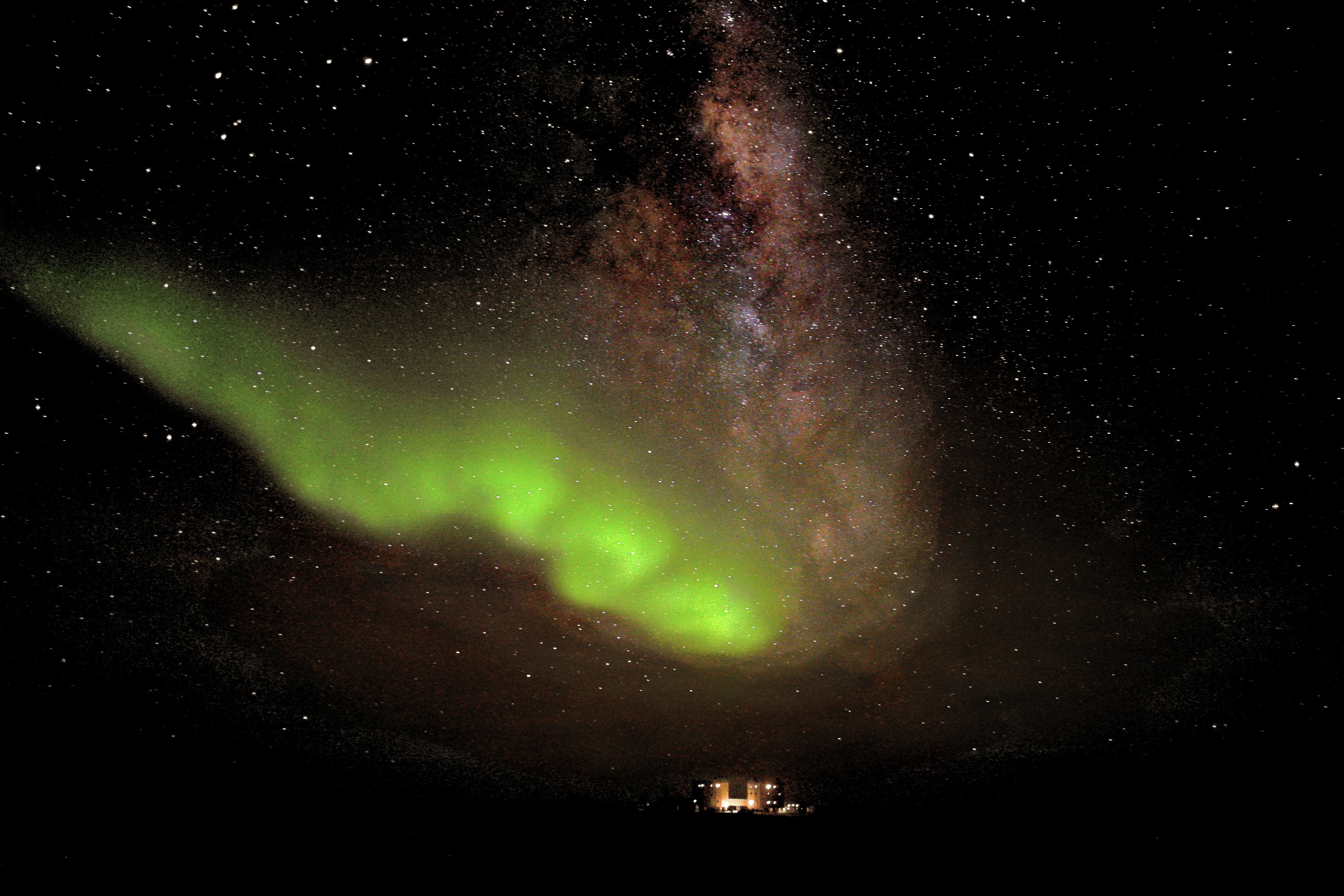
Aurora Australis over Concordia station 18 July
by Staff Writers
Paris, France (ESA) Jul 25, 2012


The ethereal green glow of Aurora Australis high over Concordia station on 18 July 2012. It was taken by ESA-sponsored scientist Alexander Kumar and his colleague Erick Bondoux from about 1 km from the station, located in the Antarctic at -75 degrees S latitude. Credits: ESA/IPEV/ENEAA/A. Kumar and E. Bondoux. For a larger version of this image please go here.

A stunning image showing Aurora Australis - the Southern Lights - glowing over Concordia station in the Antarctic, one of the remotest places on Earth, on 18 July 2012. It was taken by ESA-sponsored scientist Alexander Kumar and his colleague Erick Bondoux from about 1 km from the station, located in the Antarctic at 75 degrees S latitude.

The French-Italian Concordia station's programme of research includes glaciology, human biology and the atmosphere. ESA uses the base to prepare for future long-duration missions beyond Earth.

During the winter, Concordia is under almost total darkness, with an average temperature of -51 degrees C and a record low of -85 degrees C. It is an ideal place to study the effects on small, multicultural teams isolated for long periods in an extreme, hostile environment.

Auroras occur frequently over both the North and South polar regions, but are often difficult to see from populated areas. During periods of increased solar activity, the lights sometimes extend to populated latitudes.

This year has seen unusually high solar activity; most recently, on 14 July, Northern Lights could be seen as far south as Duluth, Minnesota, USA.

Solar activity remains unusually high
On 17 July, the ESA/NASA SOHO mission captured an image of a spectacular solar flare, which unfolded over a period of several hours. It was an M1-class flare, and produced a coronal mass ejection that will reach the region of Venus on 19 July and may deliver a glancing blow to Earth on 20 July.

The effects at Earth are expected to be minor, but could include some effects on satellites in orbit or interference in high-frequency radio communications.

And still more...
Yet another flare occurred on 19 July, when solar active region NOAA AR 1520 produced an M7.7-class flare around 05:58 GMT. The flare generated a coronal mass ejection that is directed to the west and will most likely not reach Earth.

However, a rapid increase in proton particles has been detected, and these have some effects on satellites.

Tracking space weather
"It is important to monitor, track and assess space weather events such as solar flares and especially the solar energetic particle events and coronal mass ejections sometimes associated with them," says Juha-Pekka Luntama, manager of the space weather segment in ESA's Space Situational Awareness programme office.

"Such events are capable of affecting space-based telecommunications, broadcasting, meteorological observations and navigation through to power distribution and terrestrial communications, especially at northern latitudes."

.


Related Links
Concordia
Solar Science News at SpaceDaily


Comment on this article via your Facebook, Yahoo, AOL, Hotmail login.

Share this article via these popular social media networks
del.icio.usdel.icio.us DiggDigg RedditReddit GoogleGoogle


SOLAR SCIENCE
Heliophysics Nugget: Riding the Plasma Wave
Greenbelt MD (SPX) Jul 20, 2012
Throughout the universe more than 99 percent of matter looks nothing like what's on Earth. Instead of materials we can touch and see, instead of motions we intuitively expect like a ball rolling down a hill, or a cup that sits still on a table, most of the universe is governed by rules that react more obviously to such things as magnetic force or electrical charge. It would be as if your cup was ... read more


SOLAR SCIENCE
US plans $4.2 bn Patriot missile sale to Kuwait

Lockheed Martin Receives Contract For PAC-3 MSE Production

US building missile defense station in Qatar: report

Raytheon reveals new missile defense system architectural analysis capability

SOLAR SCIENCE
Lockheed Martin Receives U.S. Army Contract For Guided MLRS Rockets

Boeing Receives US Navy Contracts for SLAM ER and Harpoon Missiles

Lockheed Martin Completes First LRASM Captive Carriage Test

Ukraine jails two N. Koreans for missile spying

SOLAR SCIENCE
Britain and France sign two deals on drone cooperation

US drone strike kills 10 militants in Pakistan

Insitu ScanEagle set for Australia's navy

Northrop Grumman, AUVSI Partner to Develop Unmanned Systems Engineers

SOLAR SCIENCE
US Army awards Raytheon contract to upgrade Advanced Field Artillery Tactical Data System

Boeing-built Legacy UHF Payload Operating on MUOS-1 Satellite

Lockheed Martin Completes On-Orbit Testing of First US Navy MUOS Satellite

Northrop Grumman's RC-12X Airborne Signals Intelligence System Completes 1,000th Mission

SOLAR SCIENCE
Boeing F-15E Radar Modernization Program Begins Second Low Rate Initial Production Phase

Northrop Grumman Awarded contract for Continuing BACN Mission Support

Northrop Grumman Delivers First B-1 Radar Modification Kit

12 die in Brunei helicopter crash

SOLAR SCIENCE
Amnesty petitions White House over UN arms treaty

Israel's IAI signs Italian deals worth $1B

Colorado gun sales soar after mass shooting: report

'Word by word' arguments at UN over arms trade treaty

SOLAR SCIENCE
US to station forces in Poland for first time

Obama defends his foreign policy ahead of Romney trip

Gun culture thrives despite US massacre

EU should step up joint defence drive, France says

SOLAR SCIENCE
Researchers Create Highly Conductive and Elastic Conductors Using Silver Nanowires

Silver nanoparticle synthesis using strawberry tree leaf

UK nanodevice builds electricity from tiny pieces

Ferroelectricity on the Nanoscale


The content herein, unless otherwise known to be public domain, are Copyright 1995-2014 - Space Media Network. AFP, UPI and IANS news wire stories are copyright Agence France-Presse, United Press International and Indo-Asia News Service. ESA Portal Reports are copyright European Space Agency. All NASA sourced material is public domain. Additional copyrights may apply in whole or part to other bona fide parties. Advertising does not imply endorsement,agreement or approval of any opinions, statements or information provided by Space Media Network on any Web page published or hosted by Space Media Network. Privacy Statement