
 |
 |
 |
 |
 |
 |
 |
 |
 |
 |

| . |  |
. |

Tel Aviv, Israel (SPX) Sep 23, 2010 Titan, one of Saturn's moons, is the only moon in the solar system with an atmosphere - ten times denser than the atmosphere of Earth. Five years ago, the Cassini-Huygens mission to Saturn, a collaboration between the European Space Agency and NASA, sent a probe through Titan's atmosphere, revealing that Titan is home to a landscape that includes hills, valleys and most notably lakes. A researcher involved with the mission, Prof. Akiva Bar-Nun of Tel Aviv University's Department of Geophysics and Planetary Sciences, has now determined the composition of these lakes. Taking into account the chemical components of Titan's atmosphere, he has demonstrated that the lakes are not composed of water but contain liquid hydrocarbons like ethane and methane, which are also found in oil and gas wells on Earth. His in-depth analysis of the chemical composition of Titan's atmosphere and lakes was recently published in the Journal of Geophysical Research - Planets.
Gases turned to rain "Upon reaching the cold surface, they liquefy, raining down, flowing through the gullies and accumulating into lakes - but you wouldn't want to jump into them on a summer holiday," he continues. Further solar irradiation of these hydrocarbons in the atmosphere also produces tiny globules of polymers, or aerosols, which give Titan its famed orange glow. The chemical processes on Titan are different than those on Earth because there is no water vapor in Titan's air, leading to hydrocarbon-based lakes unlike those seen on our planet. Because of this, the frequent claims that Titan could be a laboratory for the investigation of life's emergence on Earth are unfounded, he says.
From Titan to Siberia? The Cassini-Huygens mission also confirmed a prediction that Prof. Bar-Nun and his fellow researchers made in 1999 regarding the height of mountains on Titan. Titan's water-ice crust, he explains, has similar properties to the permafrost found in Siberia. Being partly fluid, permafrost permits hills and mountains to rise no higher than 1,900 meters, or approximately 6,200 feet. And indeed, no hill or mountain on Titan's surface exceeds that height, the researchers found.
Share This Article With Planet Earth
Related Links American Friends of Tel Aviv University Explore The Ring World of Saturn and her moons Jupiter and its Moons The million outer planets of a star called Sol News Flash at Mercury

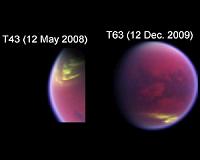 Spring On Titan Brings Sunshine And Patchy Cloud
Rome, Italy (SPX) Sep 23, 2010 Titan's northern hemisphere is set for mainly fine spring weather, with polar skies clearing since the equinox in August last year. Cassini's VIMS instrument has been monitoring clouds on Titan continuously since the spacecraft went into orbit around Saturn. Now, a team led by Sebastien Rodriguez (AIM laboratory - Universite Paris Diderot) has used more than 2000 VIMS images to create the ... read more |
|
|
| The content herein, unless otherwise known to be public domain, are Copyright 1995-2010 - SpaceDaily. AFP and UPI Wire Stories are copyright Agence France-Presse and United Press International. ESA Portal Reports are copyright European Space Agency. All NASA sourced material is public domain. Additional copyrights may apply in whole or part to other bona fide parties. Advertising does not imply endorsement,agreement or approval of any opinions, statements or information provided by SpaceDaily on any Web page published or hosted by SpaceDaily. Privacy Statement |


 del.icio.us
 Digg
Digg Reddit
 YahooMyWeb
 Google
 Facebook


