
 |
 |
 |
 |
 |
 |
 |
 |
 |
 |

| . |  |
. |

Cardiff, UK (SPX) Mar 11, 2011 Cardiff University astronomers believe that a young star's long "napping" could trigger the formation of a second generation of smaller stars and planets orbiting around it. It has long been suspected that the build up of material onto young stars is not continuous but happens in episodic events, resulting in short outbursts of energy from these stars. However, this has been largely ignored in models of star formation. Now, by developing advanced computer models to simulate the behaviour of young stars, Cardiff University Astrophysicists Dr Dimitris Stamatellos and Professor Anthony Whitworth, along with Dr David Hubber from the University of Sheffield, have offered a new insight in star formation. While stars are young they are surrounded by discs of gas and dust, and grow by accreting material from these discs. The discs may break-up to give birth to smaller stars, planets and brown dwarfs - objects larger than planets but not large enough to burn hydrogen like our Sun. "We know that young stars spend most of their early lives sleeping," said Dr Dimitris Stamatellos. "After they have their lunch, a large chunk of dust and gas from their discs, they take a nap that lasts for a few thousand years. During this nap their brightness is very low. "As they sleep, their discs grow in mass, but they remain relatively cool, despite the presence of stars right at their centres. Eventually, these discs become unstable and fragment to form low-mass stars and substellar objects, like brown dwarfs and planets." To date, research has suggested that the radiation from the parent star could heat and stabilize the disc, suppressing its breaking up. However, the researchers discovered that there is ample time in between outbursts to allow the disc to break up and give birth to a new generation of low-mass stars, brown dwarfs, and planets. The new theory provides an explanation for the formation and the properties of stars with masses below a fifth of that of our Sun, which are estimated to constitute more than 60% of all stars in our Galaxy. "Our findings suggest that disc fragmentation is possible in nature," says Dr Stamatellos. "It is important now to investigate whether this is the dominant mechanism for the formation of low-mass stars and brown dwarfs," he adds. The research was funded by the Science and Technology Facilities Council (STFC) and the Leverhume Trust, and published in the Astrophysical Journal.
Share This Article With Planet Earth
Related Links Cardiff University Stellar Chemistry, The Universe And All Within It

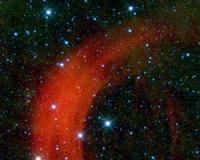 Speed Demon Creates A Shock
Pasadena CA (JPL) Mar 11, 2011 Just as some drivers obey the speed limit while others treat every road as if it were the Autobahn, some stars move through space faster than others. NASA's Wide-field Infrared Survey Explorer, or WISE, captured this image of the star Alpha Camelopardalis, or Alpha Cam, in astronomer-speak, speeding through the sky like a motorcyclist zipping through rush-hour traffic. The supergiant star ... read more |
|
|
| The content herein, unless otherwise known to be public domain, are Copyright 1995-2010 - SpaceDaily. AFP and UPI Wire Stories are copyright Agence France-Presse and United Press International. ESA Portal Reports are copyright European Space Agency. All NASA sourced material is public domain. Additional copyrights may apply in whole or part to other bona fide parties. Advertising does not imply endorsement,agreement or approval of any opinions, statements or information provided by SpaceDaily on any Web page published or hosted by SpaceDaily. Privacy Statement |


 del.icio.us
 Digg
Digg Reddit
 YahooMyWeb
 Google
 Facebook


