|
 |
 |
 |
 |
 |
 |
 |
 |
 |

| . |  |
. |
Back in the space race: Russian revival raises new questions
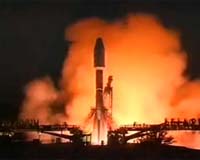
Baikonur, Kazakhstan (AFP) Oct 17, 2007 The Soyuz rocket, carrying an American, a Malaysian and a Russian, was a study in world peace as it thundered toward the stars on the latest mission to the International Space Station. "The more people in space the better it is for human beings," declared American reserve astronaut Michael Fincke as he drank toasts with Russian colleagues at a dilapidated viewing platform at Baikonur cosmodrome, on the arid Kazakh steppe. But while American officials sang their Russian counterparts' praises after the October 10 blast-off, some experts are questioning Russia's future role in space. Experts warn that US-Russian post-Cold War space cooperation could crumble as Moscow recovers its economic and diplomatic strength, while tensions grow over Washington's missile defence plans in eastern Europe. Some also feel time may be running out for the iconic Baikonur cosmodrome, which has been at the centre of Moscow's space programme for half a century and saw the first ever satellite launch and the first human space launch. The United States is looking to Russia to ramp up its launches to the International Space Station (ISS), which is a platform for scientific research and a testing ground for more ambitious ventures by humans into space. It wants Russia's help as the troubled US Space Shuttle is due to be taken out of service in 2010 and a replacement is not due before 2014. Moscow says it is happy to comply. It plans to double the number of Soyuz launches from 2009 to four a year and could carry out 10 launches a year by 2015 with the planned production of a six-seater vehicle, says a top official with spacecraft producer RKK Energiya, Alexander Derechin. "The most exciting thing for us now is the new generation of manned vehicles," he told AFP. Russia has also hailed another deal with the United States that suggests Moscow is getting over its humiliation of the 1990s, when Washington stepped in to help dispose of the Soviet-built Mir space station. Under an accord signed this month Russia will provide equipment for rovers that will scan for water on the Moon and Mars. Project director Igor Mitrofanov says the equipment, already used in the oil industry, is based on space and nuclear science and asserts "the Russian space industry is now recovering very fast." US space officials are keen to emphasise friendship with Russia amid strains over American plans to place missile defence systems in Poland and the Czech Republic, countries once controlled by Moscow. "When we had the Columbia tragedy and the Shuttle couldn't fly, the Russians rose to the occasion and helped," said a senior official with US space agency NASA, Bill Gerstenmaier, referring to the 2003 loss of the Columbia Shuttle. "We're very much the same team pulling for the same thing," he told AFP. But space writer and former NASA engineer James Oberg detects an element of wishful thinking and says there are risks to becoming dependent on Russia and Baikonur. Russia rents Baikonur, which lies in the Central Asian state of Kazakhstan, a former Soviet dominion, under an opaque deal due to last until 2050. -- Defense at Baikonur to keep out camels, not people -- Oberg is unimpressed by a counter-terrorism exercise that Russia conducted at Baikonur last month and believes the site may be vulnerable. He points among other things to the reputed fondness for bribes of the territories' checkpoint guards. "If some terrorist groups want to shut down the ISS they could do so with a threat to Baikonur.... Defence there is to keep camels out not people," he said by telephone from the United States. Oberg adds that Russia's space programme is hampered by a dearth of young talent and a return to secrecy and may not be helped by concentrating on human launches. Other observers say that the Russian presence at Baikonur could end well before 2050 as Moscow reconfigures its space infrastructure in ways that may not fit neatly with US plans. While Russia and Kazakhstan say they are committed to the Russian presence, Moscow is already withdrawing its military as well as launches of military satellites. Haggling between the two countries over environmental compensation after the crash last month of a cargo rocket fuelled by a highly toxic propellant will have reinforced the inconvenience of the site for Moscow, says Kazakh opposition activist Amirzhan Kosanov. While accusing Kazakh authorities of playing down the environmental risk, Kosanov concedes that "there is no guarantee" Russia will stay at Baikonur. "Russia is in a good position. It has alternatives," said Kosanov, a leader of the Social Democratic Party, which has no seats in Kazakhstan's one-party parliament. One such alternative is a proposed launch pad in far eastern Russia. Another is the Kourou spaceport in French Guiana, on the north coast of South America, from where Russia is to launch an upgraded Soyuz next year in cooperation with the European Space Agency. Kourou, though far from Russia, has the advantage that closeness to the equator enables heavier payloads, while Moscow also gains from working with the Europeans, says British-based rocketry expert and entrepreneur Paul Lavin. He speculates that Baikonour may be "headed for retirement" and says that while the work at Kourou may not be bad for the relationship with Washington, increasing the number of Soyuz launches will prove easier said than done. The timetable, he said, "will slip. We're talking about human endeavour here.... You just can't turn it on and off." The risk of political tensions interfering in cooperation is also real, he adds. "Rockets as well as being technical are also political. As a piece on that board they can be shoved around," Lavin said. In the city of Baikonur, Russian residents are cautiously optimistic as funding has improved after the collapse of the early 1990s. A museum tour guide likened what Baikonur had gone through to "the siege of Leningrad." Community Email This Article Comment On This Article Related Links Station and More at Roscosmos S.P. Korolev RSC Energia Russian Space News
 Moscow-Astana Space Symbiosis
 Moscow, Russia (RIA Novosti) Oct 12, 2007
Kazakhstan and Russia have few reasons for discord, but Russian rocket launches are an increasingly sore point between them. In Kazakhstan's opinion, they often fall on its territory causing significant environmental damage. |
|
|

| The content herein, unless otherwise known to be public domain, are Copyright 1995-2006 - SpaceDaily.AFP and UPI Wire Stories are copyright Agence France-Presse and United Press International. ESA PortalReports are copyright European Space Agency. All NASA sourced material is public domain. Additionalcopyrights may apply in whole or part to other bona fide parties. Advertising does not imply endorsement,agreement or approval of any opinions, statements or information provided by SpaceDaily on any Web page published or hosted by SpaceDaily. Privacy Statement |