|
 |
 |
 |
 |
 |
 |
 |
 |
 |

| . |  |
. |
 by Staff Writers Boulder CO (SPX) Sep 07, 2017
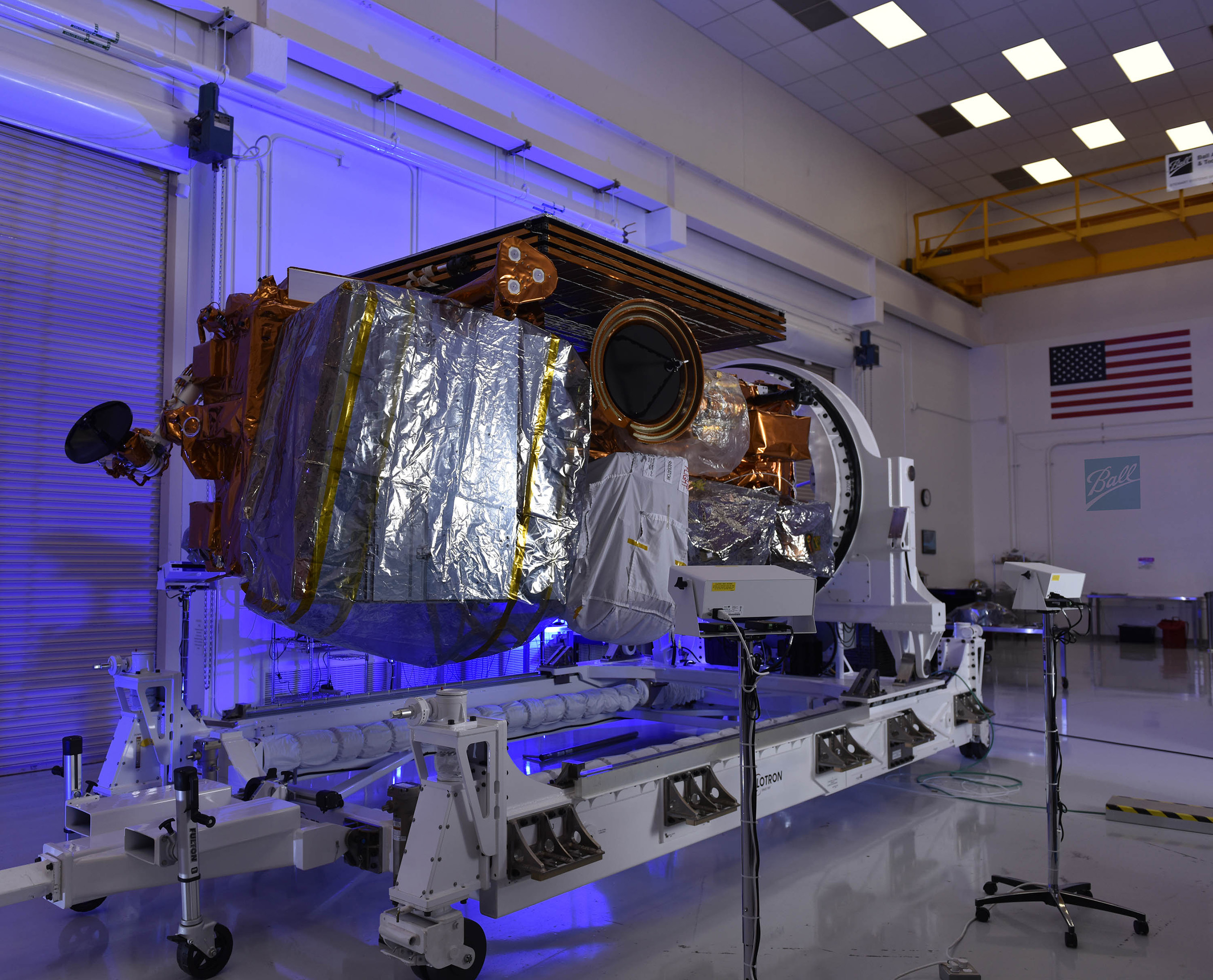
Ball Aerospace successfully delivered the Joint Polar Satellite System-1 (JPSS-1), NOAA's next-generation polar orbiting weather satellite, to Vandenberg Air Force Base in California on Aug. 31, where it is scheduled to launch Nov. 10, 2017. This follows a successful pre-ship review with NASA at Ball's Boulder, Colorado, manufacturing complex. "The arrival of the spacecraft at Vandenberg is a tremendous milestone for the program and the culmination of excellent collaboration and hard work by the JPSS-1 team - NOAA, NASA, Ball, Harris, Raytheon and Northrop Grumman," said Rob Strain, president, Ball Aerospace. "This advanced weather satellite will play a significant role in providing actionable environmental intelligence to decision makers in government and business, and to the general public." The JPSS series of polar-orbiting weather satellites will work as the foundation of NOAA's operational environmental forecasting system for the next 20 years. The JPSS missions are funded by NOAA to provide global environmental data in low-Earth polar orbit. NASA is the acquisition agent for the flight systems, launch services and components of the ground segment. JPSS data increases the timeliness and accuracy of numerical forecast models three to seven days in advance of severe weather events. These forecasts allow for early warnings and enable agency managers to make informed decisions to protect American lives and property. The JPSS-1 satellite will host a suite of state-of-the-art instruments: Advanced Technology Microwave Sounder (ATMS - Northrop Grumman), Cross-track Infrared Sounder (CrIS - Harris), Visible Infrared Imaging Radiometer Suite (VIIRS - Raytheon), Ozone Mapping and Profiler Suite (OMPS - Ball), and Clouds and the Earth's Radiant Energy System (CERES - Northrop Grumman). Ball designed and built the JPSS-1 spacecraft, the Ozone Mapping and Profiler Suite-Nadir instrument (OMPS), integrated all five of the satellite's instruments, and is performing satellite-level testing and launch support. JPSS-1 will launch aboard a United Launch Alliance Delta II rocket from Vandenberg Air Force Base. Following launch, JPSS-1 will join the Ball-built NOAA/NASA Suomi NPP satellite which has served as NOAA's primary operational satellite for global weather observations since May 2014. Together, the two satellites, each circling the Earth 14 times per day, will provide global observations for U.S. weather and environmental predictions.
 Airbus completes MetOp-C platform/payload coupling
Toulouse, France (SPX) Aug 14, 2017 MetOp-C is the third and final satellite of the first generation of MetOp polar-orbiting meteorological satellites. The payload module of MetOp-C, developed and built by Airbus in Germany, was delivered to Toulouse after it completed a series of tests at ESTEC, the technical centre of the European Space Agency (ESA) in Noordwijk, the Netherlands. The satellite, weighing in at four to ... read more Related Links Ball Aerospace Earth Observation News - Suppiliers, Technology and Application

|
|||||||||||||
|
|
| The content herein, unless otherwise known to be public domain, are Copyright 1995-2024 - Space Media Network. All websites are published in Australia and are solely subject to Australian law and governed by Fair Use principals for news reporting and research purposes. AFP, UPI and IANS news wire stories are copyright Agence France-Presse, United Press International and Indo-Asia News Service. ESA news reports are copyright European Space Agency. All NASA sourced material is public domain. Additional copyrights may apply in whole or part to other bona fide parties. All articles labeled "by Staff Writers" include reports supplied to Space Media Network by industry news wires, PR agencies, corporate press officers and the like. Such articles are individually curated and edited by Space Media Network staff on the basis of the report's information value to our industry and professional readership. Advertising does not imply endorsement, agreement or approval of any opinions, statements or information provided by Space Media Network on any Web page published or hosted by Space Media Network. General Data Protection Regulation (GDPR) Statement Our advertisers use various cookies and the like to deliver the best ad banner available at one time. All network advertising suppliers have GDPR policies (Legitimate Interest) that conform with EU regulations for data collection. By using our websites you consent to cookie based advertising. If you do not agree with this then you must stop using the websites from May 25, 2018. Privacy Statement. Additional information can be found here at About Us. |


 del.icio.us
 Digg
Digg Reddit
 Google