
. Military Space News .
FARM NEWS
Bee decline threatens US crop production
by Staff Writers
Burlington VT (SPX) Feb 22, 2017


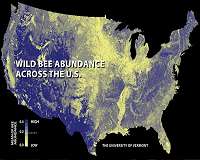
The first national study to map US wild bees suggests they're disappearing in many of the country's most important farmlands. Relatively low abundances are shown here in yellow; higher abundances in blue. Image courtesy PNAS.

The first-ever study to map U.S. wild bees suggests they are disappearing in the country's most important farmlands - from California's Central Valley to the Midwest's corn belt and the Mississippi River valley.

If wild bee declines continue, it could hurt U.S. crop production and farmers' costs, said Taylor Ricketts, a conservation ecologist at the University of Vermont, at the American Association for the Advancement of Science (AAAS) annual meeting panel, Plan Bee: Pollinators, Food Production and U.S. Policy on Feb. 19.

"This study provides the first national picture of wild bees and their impacts on pollination," said Ricketts, Director of UVM's Gund Institute for Ecological Economics, noting that each year $3 billion of the U.S. economy depends on pollination from native pollinators like wild bees.

At AAAS, Ricketts briefed scholars, policy makers, and journalists on how the national bee map, first published in the Proceedings of the National Academy of Sciences in late 2015, can help to protect wild bees and pinpoint habitat restoration efforts.

At the event, Ricketts also introduced a new mobile app that he is co-developing to help farmers upgrade their farms to better support wild bees.

"Wild bees are a precious natural resource we should celebrate and protect," said Ricketts, Gund Professor in UVM's Rubenstein School of Environment and Natural Resources. "If managed with care, they can help us continue to produce billions of dollars in agricultural income and a wonderful diversity of nutritious food."

Trouble Zones
The map identifies 139 counties in key agricultural regions of California, the Pacific Northwest, the upper Midwest and Great Plains, west Texas, and Mississippi River valley, which appear to have most worrisome mismatch between falling wild bee supply and rising crop pollination demand.

These counties tend to be places that grow specialty crops - like almonds, blueberries and apples - that are highly dependent on pollinators. Or they are counties that grow less dependent crops - like soybeans, canola and cotton - in very large quantities.

Of particular concern, some crops most dependent on pollinators - including pumpkins, watermelons, pears, peaches, plums, apples and blueberries - appeared to have the strongest pollination mismatch, growing in areas with dropping wild bee supply and increasing in pollination demand.

Globally, more than two-thirds of the most important crops either benefit from or require pollinators, including coffee, cacao, and many fruits and vegetables.

Pesticides, climate change and diseases threaten wild bees - but their decline may be caused by the conversion of bee habitat into cropland, the study suggests. In 11 key states where the map shows bees in decline, the amount of land tilled to grow corn spiked by 200 percent in five years - replacing grasslands and pastures that once supported bee populations.

Rising Demand, Falling Supply
Over the last decade, honeybee keepers facing colony losses have struggled with rising demand for commercial pollination services, pushing up the cost of managed pollinators - and the importance of wild bees.

"Most people can think of one or two types of bee, but there are 4,000 species in the U.S. alone," said Insu Koh, a UVM postdoctoral researcher who co-hosted the AAAS panel and led the study.

"When sufficient habitat exists, wild bees are already contributing the majority of pollination for some crops," Koh adds. "And even around managed pollinators, wild bees complement pollination in ways that can increase crop yields."

Making The Maps
A team of seven researchers - from UVM, Franklin and Marshall College, University of California at Davis, and Michigan State University - created the maps by first identifying 45 land-use types from two federal land databases, including croplands and natural habitats. Then they gathered detailed input from national and state bee experts about the suitability of each land-use type for providing wild bees with nesting and food resources.

The scientists built a bee habitat model that predicts the relative abundance of wild bees for every area of the contiguous United States, based on their quality for nesting and feeding from flowers. Finally, the team checked and validated their model against bee collections and field observations in many actual landscapes.

"The good news about bees," said Ricketts, "is now that we know where to focus conservation efforts, paired with all we know about what bees need, habitat-wise, there is hope for preserving wild bees."

FARM NEWS
Bioinvasion on the rise
Konstanz, Germany (SPX) Feb 17, 2017
"It had remained unclear whether or not the accumulation of alien species has already reached a point of slow-down", says Dr Hanno Seebens from the Senckenberg Biodiversity and Climate Research Centre (BiK-F) in Frankfurt, Germany. The first author of the study has an answer now: "For all groups of organisms on all continents, the number of alien species has increased continuously during t ... read more

Related Links
University of Vermont
Farming Today - Suppliers and Technology


Thanks for being here;
We need your help. The Space Media Network continues to grow but revenues have never been harder to maintain.

With the rise of Ad Blockers, and Facebook - our traditional revenue sources via quality network advertising continues to decline. And unlike so many other news sites, we don't have a paywall - with those annoying usernames and passwords.

Our news coverage takes time and effort to publish 365 days a year.

If you find our news sites informative and useful then please consider becoming a regular supporter or for now make a one off contribution.
SpaceMediaNetwork Contributor
$5 Billed Once


credit card or paypal
SpaceMediaNetwork Monthly Supporter
$5 Billed Monthly


paypal only


Comment on this article using your Disqus, Facebook, Google or Twitter login.

Share this article via these popular social media networks
del.icio.usdel.icio.us DiggDigg RedditReddit GoogleGoogle

FARM NEWS
Raytheon developing new tool for war game assessment

U.S. Army awards $3 billion in missile defense contracts

New US Missile Hits Target in Space

New Age, New Aims: CIS Air Defense to Be Upgraded for Aerospace Tasks

FARM NEWS
Raytheon, Rheinmetall to collaborate on future defense projects

Thales, Bharat Dynamics ink STARStreak capability transfer deal

US warns Russia amid reports of new cruise missile

Textron announces successful test of G-CLAW missile

FARM NEWS
Monitoring birds by drone

AeroVironment advances research with farmers and university partners

Indonesia first to purchase Skeldar V-200 drone

NS Mayport picked as forward operating base for drones

FARM NEWS
IAI secures $30 million in signals intelligence contracts

Terahertz wireless could make spaceborne satellite links as fast as fiber-optic links

Airbus provides satcom for EU security missions in Mali, Niger and Somalia

Engie, Airbus tapped to support French defense networks

FARM NEWS
U.S. Navy to buy 40 MRAP MaxxPro Dash DXM vehicles

Lockheed providing Poland with live-fire training rounds

New origami-inspired shield deflects handgun bullets

Honeywell's Gold Shield to be used in vests for Brazil's police

FARM NEWS
Pentagon chief says military running smoothly amid turbulent transition

Global arms trade highest since Cold War: study

Germany, Norway expand defense industry coooperation

NATO chief says increased defence spending top priority after Trump calls

FARM NEWS
Germany warns US off hurting Europe, favouring Russia

Tillerson, Wang in highest-level US-China meet under Trump

US remains 'your greatest ally', Pence tells Europe

Croatia, Albania warn NATO on Balkans security threats

FARM NEWS
Scientists create a nano-trampoline to probe quantum behavior

Scientists decipher the nanoscale architecture of a beetle's shell

Liquid metal nano printing set to revolutionize electronics

Nano-level lubricant tuning improves material for electronic devices and surface coatings


The content herein, unless otherwise known to be public domain, are Copyright 1995-2024 - Space Media Network. All websites are published in Australia and are solely subject to Australian law and governed by Fair Use principals for news reporting and research purposes. AFP, UPI and IANS news wire stories are copyright Agence France-Presse, United Press International and Indo-Asia News Service. ESA news reports are copyright European Space Agency. All NASA sourced material is public domain. Additional copyrights may apply in whole or part to other bona fide parties. All articles labeled "by Staff Writers" include reports supplied to Space Media Network by industry news wires, PR agencies, corporate press officers and the like. Such articles are individually curated and edited by Space Media Network staff on the basis of the report's information value to our industry and professional readership. Advertising does not imply endorsement, agreement or approval of any opinions, statements or information provided by Space Media Network on any Web page published or hosted by Space Media Network. General Data Protection Regulation (GDPR) Statement Our advertisers use various cookies and the like to deliver the best ad banner available at one time. All network advertising suppliers have GDPR policies (Legitimate Interest) that conform with EU regulations for data collection. By using our websites you consent to cookie based advertising. If you do not agree with this then you must stop using the websites from May 25, 2018. Privacy Statement. Additional information can be found here at About Us.