|
 |
 |
 |
 |
 |
 |
 |
 |
 |

| . |  |
. |
Big Auroras On Jupiter
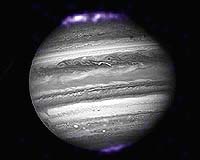
Hunstville AL (SPX) Apr 02, 2007 So you thought Northern Lights were big in Alaska? "That's nothing," says Randy Gladstone of the Southwest Research Institute in San Antonio, Texas. "Jupiter has auroras bigger than our entire planet." Last month, Gladstone and colleagues used NASA's Chandra X-ray Observatory to capture this picture: The purple ring traces Jupiter's X-ray auroras. Gladstone calls them "Northern Lights on steroids. They're hundreds of times more energetic than auroras on Earth." Chandra has observed Jupiter's auroras many times before, but this recent dataset is exceptional both in length and quality. Gladstone hopes it will help him solve some mysteries lingering for almost 30 years. Jupiter's auroras were discovered by the Voyager 1 spacecraft in 1979. A thin ring of light on Jupiter's nightside looked like a stretched-out version of our own auroras on Earth. But those early photos merely hinted at the power involved. The real action, astronomers soon learned, was taking place at high-energy wavelengths invisible to the human eye. In the 1990s, ultraviolet cameras on the Hubble Space Telescope photographed raging lights thousands of times more intense than anything ever seen on Earth, while X-ray observatories saw auroral bands and curtains bigger than Earth itself. Jupiter's hyper-auroras never stop. "We see them every time we look," says Gladstone. You don't see auroras in Alaska every time you look, yet on Jupiter the Northern Lights always seem to be "on." Gladstone explains the difference: On Earth, the most intense auroras are caused by solar storms. An explosion on the sun hurls a billion-ton cloud of gas in our direction, and a few days later, it hits. Charged particles rain down on the upper atmosphere, causing the air to glow red, green and purple. On Jupiter, however, the sun is not required. "Jupiter is able to generate its own lights," says Gladstone. The process begins with Jupiter's spin: The giant planet turns on it axis once every 10 hours and drags its planetary magnetic field around with it. As any science hobbyist knows, spinning a magnet is a great way to generate a few volts-it's the basic principle of DC motors. Jupiter's spin produces 10 million volts around its poles. "Jupiter's polar regions are crackling with electricity," says Gladstone, "and this sets the stage for non-stop auroras." The polar electric fields grab any charged particles they can find and slam them into the atmosphere. Particles for slamming can come from the sun, but Jupiter has another, more abundant source nearby: the volcanic moon Io, which spews oxygen and sulfur ions (O+ and S+) into Jupiter's spinning magnetic field. Somehow, these ions make their way to Jupiter's poles where electric fields send them hurtling toward the planet below. Upon entering the atmosphere, "their electrons are first stripped away by molecules they run into, but as they slow down they start grabbing electrons back. The 'charge exchange reaction' produces intense X-ray auroras," he explains. So Jupiter's Northern Lights are, in a sense, volcano powered. Mystery solved? Not quite. No one knows exactly how volcanic exhaust meanders from Io out through Jupiter's magnetosphere and back to Jupiter's poles. "We're still trying to figure it out," says Gladstone. But that is a minor detail compared to another, even bigger puzzle: There is an X-ray "pulsar" inside Jupiter's northern auroras. Sometimes Chandra sees it, sometimes not. When it's on, the pulsar emits gigawatt bursts of X-rays with a regular beat of 45 minutes. Gladstone suspects the pulsar has nothing to do with Io's volcanoes, but instead is caused by the sun. "Maybe Jupiter's magnetic field, when it gets hit by a solar wind gust, rings like a bell with a 45-minute period," he speculates. "There are many other possibilities as well." The February 2007 dataset may hold important clues. "Chandra observed the auroras for 15 hours, and we weren't the only ones watching," he says. The Hubble Space Telescope, the FUSE satellite, XMM-Newton (a European X-ray observatory), the New Horizons spacecraft and many ground-based observatories were all taking data at the same time. The campaign was timed to coincide with New Horizons flyby of Jupiter-a slingshot maneuver designed to increase its velocity en route to Pluto. "Jupiter's auroras have never been observed by so many telescopes at once," says Gladstone. "I'm really excited by these data, and the analysis is just beginning." Email This Article
Related Links  Laurel MD (SPX) Mar 27, 2007
The New Horizons Long Range Reconnaissance Imager (LORRI) has returned stunning new images of Jupiter's Little Red Spot, obtained as a 2-by-2 mosaic at 0312 UTC on February 27, 2007, from a distance of 3 million kilometers (1.8 million miles). The image scale is 15 kilometers (about 9 miles) per pixel. |
|
|

| The content herein, unless otherwise known to be public domain, are Copyright 1995-2006 - SpaceDaily.AFP and UPI Wire Stories are copyright Agence France-Presse and United Press International. ESA PortalReports are copyright European Space Agency. All NASA sourced material is public domain. Additionalcopyrights may apply in whole or part to other bona fide parties. Advertising does not imply endorsement,agreement or approval of any opinions, statements or information provided by SpaceDaily on any Web page published or hosted by SpaceDaily. Privacy Statement |