
 |
 |
 |
 |
 |
 |
 |
 |
 |
 |

| . |  |
. |
Big Science From Canada's Smallest Satellite
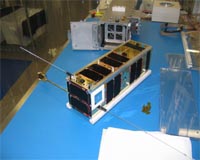
Toronto, Canada (SPX) Mar 09, 2009 The Canadian Advanced Nanospace eXperiment 2 (CanX-2) nanosatellite is nearing the completion of its first year in orbit. Having been developed on a shoestring budget, nearly 100 times cheaper than a traditional satellite of similar capabilities, the 3.5 kg, milk-carton-sized satellite continues to perform well in low Earth orbit. Launched on 28 April 2008 on board Polar Satellite Launch Vehicle (PSLV) C9 from India, CanX-2 carries a number of miniature satellite technologies that have been demonstrated to work well in space. "Within only three months of on-orbit operation, we were able to verify the performance of all the technologies on board CanX-2," says Dr. Robert E. Zee, Director of the Space Flight Laboratory (SFL) at the University of Toronto. "We are now well into the second phase of the mission, performing atmospheric science experiments. This is an unprecedented milestone achievement for Canada. CanX-2 is Canada's smallest operational satellite in history." CanX-2 is much more than its tiny size would suggest. Among a suite of custom, low power electronics, it carries a novel propulsion system developed at SFL that will be used to support a formation flying demonstration mission involving two satellites, CanX-4 and CanX-5 in the near future. A commercial GPS receiver on board CanX-2 has also been shown to work well. In addition to providing precise updates on the satellite's position in orbit, the GPS receiver is being used by Professor Susan Skone at the University of Calgary to perform radio occultation experiments - measurements of delays in GPS signals through the atmosphere to infer atmospheric properties such as water vapor and total electron content. CanX-2 is likely the smallest satellite to perform such scientific investigation from Earth orbit. In addition to Professor Skone's experiment, CanX-2 carries a compact spectrometer developed by Professor Brendan Quine at York University, that measures concentrations of greenhouse gases in the atmosphere. At present, the satellite is alternating between the two science experiments, gathering important data about our planet, while demonstrating leading edge satellite technology. Indeed, the experiments would not be possible without CanX-2's barrier-breaking miniature attitude control system that enables three-axis stabilization of the satellite to within a few degrees. "We have an outstanding student apprenticeship program, but the key to low-cost is not the involvement of students. Though we do train students at SFL to be the satellite engineers of tomorrow, the key to low-cost is SFL's use of the 'microspace' philosophy," says Zee. The microspace approach to building satellites allows SFL to achieve low-cost through reduced formality, tightly integrated design teams, and the judicious use of commercially available parts. Such parts are similar to those you would find in your cell phone or personal data assistant. "We've had some great customers, including Defence R and D Canada and the Canadian Space Agency, who are willing to trust us to get the job done according to our microspace experience," adds Zee. "Often large agencies will be tempted to protect their investment by getting involved in the design decisions or development approaches themselves. Our customers know that the contractor is already motivated to do a good job." The Space Flight Laboratory also builds custom separation systems, or the devices that eject satellites from their launch vehicles. The XPOD developed by SFL is a customizable separation system that can accommodate a wide variety of satellite sizes and shapes. SFL uses its XPOD separation systems to support low-cost launches of multiple nanosatellites arranged through its Nanosatellite Launch Service (NLS) program. CanX-2 is a project supported by Defence R and D Canada (Ottawa), the Canadian Space Agency, the Natural Sciences and Engineering Research Council (NSERC), MDA Space Missions, and the Ontario Centres of Excellence. Share This Article With Planet Earth
Related Links Space Flight Laboratory Microsat News and Nanosat News at SpaceMart.com
 NKorea preparing to launch satellite: state media
 Seoul (AFP) Feb 24, 2009
North Korea said Tuesday it was readying to launch a satellite, a move that the United States and its allies believe could actually be a long-range missile test that would deepen global tensions. |
|
|

| The content herein, unless otherwise known to be public domain, are Copyright 1995-2007 - SpaceDaily.AFP and UPI Wire Stories are copyright Agence France-Presse and United Press International. ESA Portal Reports are copyright European Space Agency. All NASA sourced material is public domain. Additional copyrights may apply in whole or part to other bona fide parties. Advertising does not imply endorsement,agreement or approval of any opinions, statements or information provided by SpaceDaily on any Web page published or hosted by SpaceDaily. Privacy Statement |
 del.icio.us
 Digg
Digg Reddit
 YahooMyWeb
 Google
 Facebook