|
 |
 |
 |
 |
 |
 |
 |
 |
 |

| . |  |
. |
Bionic Fiction Becomes Science Fact
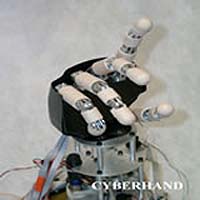
Pisa, Italy (SPX) Nov 29, 2005 A highly dexterous, bio-inspired artificial hand and sensory system that could provide patients with active feeling, is being developed by the European CYBERHAND project. Funded by the Future and Emerging Technologies initiative of the IST programme, the CYBERHAND project aims to hard wire this hand into the nervous system, allowing sensory feedback from the hand to reach the brain, and instructions to come from the brain to control the hand, at least in part. Coordinated by Professor Paolo Dario with Professor Maria Chiara Carrozza leading the development of the hand, the project united researchers from Germany, Spain, Italy and Denmark. So far, the project is racking up an impressive list of achievements. It has a complete, fully sensitised five-fingered hand. The CYBERHAND prototype has 16 Degrees of Freedom (DoFs) made possible by the work of six tiny motors. Each of the five fingers is articulated and has one motor dedicated to its joint flexing for autonomous control. It features that miracle of evolution, the opposable thumb, so the device can perform different grasping actions. Taking inspiration from the real hand, where a muscle pulls a tendon inside a synovial sheath, CYBERHAND's finger cables run through a Teflon sheath pulled by a DC motor. So the proximal, medial and distal phalanges, those bones between your finger knuckles, are all driven by the same tendon. This approach is called underactuation as there are more Degrees of Freedom than Degrees of Movement (motors); it means the prosthesis has a self-adaptive grasp. "This is a fundamental feature of the CYBERHAND prosthesis because only a limited number of control signals are available for user's voluntary control," says project manager, Dr Lucia Beccai. Importantly, it also means less user effort is required to control the hand during daylong use. The CYBERHAND prototype integrates the two types of human senses. One senses where parts of the body are relative to other parts, whether our fingers are open or closed, for example. The other relates to taste, touch, sound, hearing and sight that tell us about the external world. CYBERHAND includes sensors for tension, force, joint angle, end stroke and contact in the final prototype. This prototype uses Longitudinal IntraFascicular Electrodes (LIFEs) to connect the hand to the nervous system. Within the CYBERHAND project, in addition to traditional wire LIFEs, a new type of electrode has been developed to improve performance and make them less invasive in humans: the Thin Film LIFE (tfLIFE). So far, the project has produced excellent science and engineering to create an impressive prototype. The next step is to test the device in humans. Currently researchers are addressing all necessary medical and ethical issues for implantation in human volunteers. A clinical partner has been identified and the Local Ethical Committee has given the approval for the clinical validation of CYBERHAND system, which should begin in 2006. Some companies have expressed interest in commercialising the system. Nevertheless, it could be five to eight years before the device clears all the tests necessary to prove its safety, usability, and robustness. Related Links CYBERHAND project CYBERHAND factsheet on CORDIS SpaceDaily Search SpaceDaily Subscribe To SpaceDaily Express  Quick-Med Technologies Awarded U.S. Army SBIR Phase I Contract
 Gainesville FL (SPX) Nov 15, 2005
Quick-Med Technologies announced Tuesday that the United States Army Small Business Innovative Research ("SBIR") has competitively awarded a Phase I contract to Quick-Med Technologies titled: Chemical Casualty Care: Wound Dressing to Speed Wound Closure Following Debridement of Cutaneous Vesicant Injuries. |
|
|

| The content herein, unless otherwise known to be public domain, are Copyright 1995-2006 - SpaceDaily.AFP and UPI Wire Stories are copyright Agence France-Presse and United Press International. ESA PortalReports are copyright European Space Agency. All NASA sourced material is public domain. Additionalcopyrights may apply in whole or part to other bona fide parties. Advertising does not imply endorsement,agreement or approval of any opinions, statements or information provided by SpaceDaily on any Web page published or hosted by SpaceDaily. Privacy Statement |