
 |
 |
 |
 |
 |
 |
 |
 |
 |
 |

| . |  |
. |

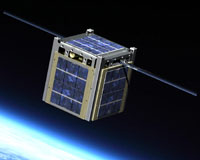
Houghton MI (SPX) Feb 22, 2011 A team of Michigan Technological University students has taken first place in the prestigious University Nanosat 6 competition, earning the rare privilege of having the Department of Defense launch their custom-made satellite into orbit. The University Nanosat Program is sponsored by the Air Force Research Laboratory, which handpicked 11 university teams from dozens of applicants across the nation. Each of those 11 teams was then awarded a two-year contract to design and build a small satellite ("nanosat") to perform a mission of its choosing. The program culminated with a flight competition review, held Jan. 16-17 in Albuquerque, N.M., adjacent to Kirtland Air Force Base. By winning the competition, Michigan Tech received a contract to further develop its satellite and launch it into orbit aboard a DOD rocket. "This is a major accomplishment by our students," said William Predebon, chair of the University's Department of Mechanical Engineering-Engineering Mechanics. "It's just fantastic." Built by students in the Aerospace Enterprise, Michigan Tech's entry is called Oculus-ASR, for its role as an orbiting eye and for its ability to assist scientists on the ground with satellite attitude and shape recognition-more on that later. The 154-pound satellite was engineered to help in a Department of Defense effort. "The DOD wants to know what's orbiting the Earth, who owns it, what it's doing, and what it might do in the future," said team advisor L. Brad King, an associate professor of mechanical engineering-engineering mechanics. Unfortunately, unless you use an extremely powerful telescope, it's hard to tell much about satellites from the surface of the Earth. For the most part, they look like nondescript dots of white light drifting overhead. Yet, those dots actually provide lots of information that scientists can use to recognize a satellite's attitude-its orientation in space-and its shape. The trick lies in analyzing that information, and Oculus was designed to help the Air Force do just that. "In general, our role will be to calibrate their telescopes," said King, by providing different views of the satellite for the air force to look at and by releasing targets, which both Oculus and air force scientists on the ground can photograph. "It's a very capable little vehicle. There's a lot packed into it." That functionality is a big reason Oculus won Nanosat 6. "Nobody wants to spend a million dollars to put a beeping university mascot into orbit," King observed. "One of our strengths was our vehicle's relevance to the DOD, the fact that it was doing meaningful science." Nanosat is exceptionally grueling for a college competition. "Reviewers come from all over government and industry, and they don't take it easy on the teams," he said. "If they see a flaw or have a question, they unload both barrels on the students and make them defend their design. They were expected to satisfy all the requirements of any satellite the air force launches." Above all, Nanosat teaches students about engineering design, he said. "They discover that design is really about accountability, proving that your design works and vigorously testing it. That's where we excelled," King said. "Our students also know how to build things, know how to do hands-on design, and that was an advantage." Winning Nanosat 6 wasn't quite like a Super Bowl victory. "You get this fantastic news, but it comes on the back of a five-day effort, with the students working day and night," he said. Because the contest is so stressful, "it's hard to tell if they felt exhilaration or release." King counseled the team members to accept their victory with quiet grace, but with limited success. "I told them, 'You get to the end zone, act like you've been there before.'" Restraint, however, was too much to ask of at least one student. "He said later, 'I don't care what you say, I'm dancing.'" For more on the science behind Oculus, see the story in Michigan Tech's employee newsletter, Tech Today.
Share This Article With Planet Earth
Related Links Aerospace Enterprise University Nanosat Program Microsat News and Nanosat News at SpaceMart.com

 MSU Satellite Set To Launch Feb. 23 On NASA Mission
Bozeman MT (SPX) Feb 17, 2011 The first Montana satellite chosen to ride on a NASA space mission - a small research satellite that involved more than 125 Montana State University students over five years - is set to launch on Wednesday, Feb. 23. If all goes as planned, MSU's Explorer-1 [Prime] will blast off at 3:08:43 a.m. Mountain time aboard a Taurus XL rocket from the Vandenberg Air Force Base in Santa Maria, Calif ... read more |
|
|
| The content herein, unless otherwise known to be public domain, are Copyright 1995-2010 - SpaceDaily. AFP and UPI Wire Stories are copyright Agence France-Presse and United Press International. ESA Portal Reports are copyright European Space Agency. All NASA sourced material is public domain. Additional copyrights may apply in whole or part to other bona fide parties. Advertising does not imply endorsement,agreement or approval of any opinions, statements or information provided by SpaceDaily on any Web page published or hosted by SpaceDaily. Privacy Statement |


 del.icio.us
 Digg
Digg Reddit
 YahooMyWeb
 Google
 Facebook


