
Subscribe free to our newsletters via your
. Military Space News .


FARM NEWS
Bodyguards for precious seeds
by Staff Writers
Vienna, Austria (SPX) May 21, 2015


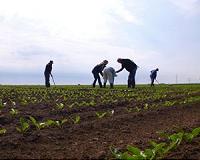
Growth control on a test field using biological plant protection. Image courtesy ACIB.

The fungi (Rhizoctonia solani) is stealthy blight, becoming visible only shortly before the harvest infesting beets or corn at their roots. The fungal rot begins early in the season, working its way from the inside out, and only becoming visible in the fall, destroying the possibility of a harvest.

Year after year crop failures due to attacks by pests and pathogens are reported in the media despite their being treated with pesticides. Crop failure is further exacerbated by pesticide treatments which cause the death of insects such as bees through neonicotinoids.

"There are also more extreme environmental conditions such as periods of hot weather, drought or flood disasters, to be taken into account when considering the ex-tent of damage caused by pesticide use alone", states ACIB researcher Christin Zachow.

The Austrian Centre of Industrial Biotechnology (ACIB) is perfecting protective methods which will make the use of "chemical mace" measures obsolete. One such research project currently underway involves biological plant protection, in which microorganisms (bacteria) work as bodyguards for the safeguarding of seeds like corn, canola, tomato, sorghum, or sugar beet.

The underlying principle is that special bacteria are planted in combination with the plant seeds in fields. ACIB engages the growth promoting properties of microorganisms: while the seed germinates, the microorganisms are simultaneously developing and supply-ing the plant with nutrients, promoting growth, warding off pests, reducing the stress on the crop and increasing their resilience.

"Crops are challenged by climate change, drought, and high salted floors. These nutrient deficiencies occur as a result of monoculture practices", states Christin Zachow. Since 2011, Christin Zachow has been managing project research and delivery in collaboration with Prof. Gabriele Berg - a pioneer in this research field - from the Institute for Environmental Bio-technology at Graz University of Technology. Their primary task has been to find bacteria that are adapted to extreme environmental conditions. Every plant needs specific bacteria, and every soil type harbors specific bacteria.

For example, researchers who work in the areas of moss and lichen research have found that the former tolerate acidic pH values and nutrient deficiencies, while the latter accept UV-light and drought. Bacteria that promote growth are identified, characterized and tested for their resistance to stress.

"We want to know which genes are activated by which particular environmental conditions in order to ensure that the bacteria will be ideally matched with crops under the local conditions", states Zachow. When a promising population of bacteria is found, it is deliberately improved by re-searchers so that the "microbiome" will have an optimal outcome under their given environ-mental conditions. Success has been recorded with the bacterial species Pseudomonas poae and Stenotrophomonas rhizophila.

While Stenotrophomonas caused an enormous burst of growth of crops in the salty steppe of Uzbekistan (300 % more than without microbiome treatment), Pseudomonas made a similarly positive impact in the sugar beet test field from ACIB's industry partner KWS SAAT SE in Germany. Five industrial enterprises are currently involved in the research project.

After finalizing the preliminary investigations, target bacteria have come into interaction with their prospective host plants. Zachow: "Plants are searching for exactly those types of bacteria that they need for perfect growth." The bacteria-host-interaction is similar to that which occurs in the human intestine, in which a specific microflora is beneficial to human health. The culmination of the research and development of a commercial product has led to the technique of enclosing a seed in a "bacterial hull". In moist soil types, the bacteria grow along with the germinating seed and at the same time protect it.

Our goal: "We strive to develop plants with optimal health to provide consumers with an optimal basis for a healthy diet", says the scientist, "a functioning biological plant protection system offers a viable alternative to pesticides." Biological plant protection is undeniably a significant step towards ensuring a biologically sound agricultural industry producing healthier food.

Ultimately, the ACIB method is in competition with conventional systems of pesticide driven "plant protection". The chemical industry turns over about 40 billion euros a year in chemical plant protection products worldwide, and a third of these chemicals ends up on the fields in the EU alone. There is a lot of money to be made using biological plant protection when more and more customers call for healthier food.


Thanks for being here;
We need your help. The Space Media Network continues to grow but revenues have never been harder to maintain.

With the rise of Ad Blockers, and Facebook - our traditional revenue sources via quality network advertising continues to decline. And unlike so many other news sites, we don't have a paywall - with those annoying usernames and passwords.

Our news coverage takes time and effort to publish 365 days a year.

If you find our news sites informative and useful then please consider becoming a regular supporter or for now make a one off contribution.
SpaceMediaNetwork Contributor
$5 Billed Once


credit card or paypal
SpaceMediaNetwork Monthly Supporter
$5 Billed Monthly


paypal only


.


Related Links
Austrian Research Centre of Industrial Biotechnology
Farming Today - Suppliers and Technology


Comment on this article via your Facebook, Yahoo, AOL, Hotmail login.

Share this article via these popular social media networks
del.icio.usdel.icio.us DiggDigg RedditReddit GoogleGoogle


FARM NEWS
Google backs farm-focused startup as 'AgTech' blooms
San Francisco (AFP) May 19, 2015
Google on Tuesday pumped $15 million into a farming-focused technology startup, the latest in a surge of investment applying Internet innovations to growing food. The funding round led by Google's investment arm brings to nearly $28 million the total amount of money pumped into Farmers Business Network (FBN) by backers including powerhouse Silicon Valley venture capital firm Kleiner Perkins ... read more


FARM NEWS
US Missile Defense System Beset by Delays

US Awards $600 Million for NATO's Ballistic Missile Defense Kill Vehicle

Teledyne to provide missile defense test and evaluation services

Turkish firm joins NATO BMD support effort

FARM NEWS
U.S. Navy grants IOC status to missile variant

Japan, Norway seek U.S. missile buys

Lockheed Martin producing ATACMS for UAE

N. Korea says successfully test-fired underwater ballistic missile

FARM NEWS
Russia to Receive Hundreds of New Drones Over Next Decade

Pentagon's Mysterious X-37B Space Drone Heads Back Into Orbit

'Cicadas': US military's new swarm of mini-drones

Next X-37B Mission Set To Begin Soon

FARM NEWS
Thales granted multiple-award IDIQ contract for Army radios

German ships receiving Indra's satellite communications terminals

French-Italian military communications satellite launched

Harris wins IDIQ contract for Rifleman Radio

FARM NEWS
Raytheon low-rate production of SDB II bomb looms closer

Naval Research Lab previews new body armor

US delivers Humvees, patrol boat to Tunisia

U.S. Army orders more chemical detectors

FARM NEWS
Russia says will not sign 'weak' arms trade treaty

Obama picks new chiefs for US Army, Navy

French industrialist gives up Thales job in spat over Russia ties

Rheinmetall, MKEK of Turkey forming joint venture company

FARM NEWS
NATO urges Russia to be more 'transparent' on military exercises

Japan dove Murayama urges hawk Abe to follow war apology

Japan to earmark $100 bn for Asian infrastructure: report

New coastal watch center opens in Philippines

FARM NEWS
Nano-policing pollution

Random nanowire configurations boost conductivity

Rice scientists use light to probe acoustic tuning in gold nanodisks

'Microcombing' creates stronger, more conductive carbon nanotube films


The content herein, unless otherwise known to be public domain, are Copyright 1995-2014 - Space Media Network. All websites are published in Australia and are solely subject to Australian law and governed by Fair Use principals for news reporting and research purposes. AFP, UPI and IANS news wire stories are copyright Agence France-Presse, United Press International and Indo-Asia News Service. ESA news reports are copyright European Space Agency. All NASA sourced material is public domain. Additional copyrights may apply in whole or part to other bona fide parties. Advertising does not imply endorsement, agreement or approval of any opinions, statements or information provided by Space Media Network on any Web page published or hosted by Space Media Network. Privacy Statement All images and articles appearing on Space Media Network have been edited or digitally altered in some way. Any requests to remove copyright material will be acted upon in a timely and appropriate manner. Any attempt to extort money from Space Media Network will be ignored and reported to Australian Law Enforcement Agencies as a potential case of financial fraud involving the use of a telephonic carriage device or postal service.