|
 |
 |
 |
 |
 |
 |
 |
 |
 |

| . |  |
. |
Boeing Completes CubeSat Mission To Advance Nano-Satellite Technology
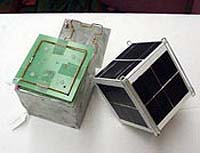
St. Louis MO (SPX) Aug 17, 2007 Boeing has completed the first phase of its nano-satellite research and experimentation with the successful conclusion of the CubeSat TestBed 1 (CSTB1) mission. The spacecraft, launched April 17 from the Baikonur Cosmosdrome in Kazakhstan, accomplished 100 percent of its primary mission objectives. Through experiments such as CSTB1, Boeing is evaluating a variety of technologies, design elements, and attitude determination and control approaches for future operational nano-satellites -- spacecraft weighing less than 22 pounds (10 kg). Pico-satellites like CSTB1 weigh less than 3 pounds (1 kg). With the tiny spacecraft still fully operational, the program is entering an optional test phase to support additional experiments such as taking more photographs using CubeSat's ultra-low power imager and evaluating non-traditional attitude control algorithms. "The extremely low cost and risk of CTSB1 allowed us to experiment with a range of more radical design elements that wouldn't occur with a more traditional program," said Scott MacGillivray, manager of Boeing Nano-Satellite Programs and CSTB1 program manager. "Leveraging the experience gained from this mission and its flight-validated design elements will enable us to explore new, more capable designs to support emerging nano-satellite missions." Boeing collected more than 500,000 sensor data points from the test bed during the three-and-one-half-month mission and more than 1,650 orbits to date. Boeing will correlate the data with simulations and ground testing, apply it to development tools for future nano-satellites and assess the lifespan of several commercial off-the-shelf parts used on the spacecraft. "The technology demonstrated on CSTB1 fits well with the goals of our Advanced Systems group," said Alex Lopez, vice-president, Boeing Advanced Network and Space Systems. "In addition to nano-satellite applications, we can incorporate components and design elements into larger spacecraft to reduce volume, mass and power needs for the main spacecraft bus and increase resources available for mission and payload needs." CSTB1 features multi-functional side panels with a variety of embedded sensors, a key design element of the compact, highly-integrated nano-satellite. Future design work will increase spacecraft performance in attitude determination knowledge and control accuracy, enable higher computational throughput and communications bandwidth, and support a wide range of specialized missions at which nano-satellites can excel. Community Email This Article Comment On This Article Related Links Integrated Defense Systems Microsat News and Nanosat News at SpaceMart.com
 ISRO To Build Nano-Satellite Platform, Eyes Overseas Business
 Bangalore, India (PTI) Aug 09, 2007
India's space agency will next year launch a special platform to put into space miniature satellites catering to the needs of developing countries and the domestic scientific community, its chief said today. The Indian Space Research Organisation (ISRO) is developing a 100-kg "satellite bus" as demand has picked up for launching nano-satellites, its Chairman G Madhavan Nair said. "We are trying to look at a small platform which can take up scientific experiments or may even be used for various cluster formations and things like that," Nair told PTI here. |
|
|

| The content herein, unless otherwise known to be public domain, are Copyright 1995-2006 - SpaceDaily.AFP and UPI Wire Stories are copyright Agence France-Presse and United Press International. ESA PortalReports are copyright European Space Agency. All NASA sourced material is public domain. Additionalcopyrights may apply in whole or part to other bona fide parties. Advertising does not imply endorsement,agreement or approval of any opinions, statements or information provided by SpaceDaily on any Web page published or hosted by SpaceDaily. Privacy Statement |