|
 |
 |
 |
 |
 |
 |
 |
 |
 |

| . |  |
. |
Boeing Pico-Satellite Mission To Advance Miniature Satellite Technology
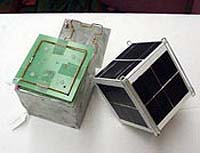
St. Louis MO (SPX) Apr 20, 2007 A pico-satellite developed by Boeing to evaluate miniature spacecraft technologies was successfully launched to orbit on April 17 by an ISC Kosmotras Dnepr rocket from the Baikonur Cosmodrome in Kazakhstan. Initial system checks indicate that the CubeSat TestBed 1 (CSTB1) spacecraft is operational and ready for a series of on-orbit demonstrations that will help Boeing further develop nano-satellites weighing less than 22 pounds. "Our pico- and nano-satellite activities are part of a broader Boeing effort to enable a more operationally responsive space," said Alex Lopez, vice president of Boeing Advanced Network and Space Systems. During the CSTB1 demonstrations, Boeing will test several new technologies, software designs and on-orbit operations for nano-satellite functions. "Our team is excited that CSTB1 is in orbit, and we're ready to proceed with our demonstrations," said Scott MacGillivray, manager of Boeing Nano-Satellite Programs. "These satellites can quickly and inexpensively test miniature, low-power components and subsystems to help reduce the power requirements and weight of larger satellites." Boeing developed the CSTB1 spacecraft at its new Engineering Development Center in Huntington Beach, Calif., where engineers are exploring new ways to reduce the size, weight and power needs for key satellite components. The new facility includes a Mission Operations Center where on-orbit operations for CSTB1 will be conducted. "On-orbit tests of CubeSats like CSTB1 can be conducted years earlier than larger satellites and at considerably less cost than Earth-based testing. Nano-satellites also are less costly to develop and deploy than larger satellites and can piggy back on rockets launching larger payloads," added MacGillivray. Weighing a little more than two pounds, CSTB1 consists of four microcontrollers as the brains, redundant communication systems with two independent radios, two high-capacity lithium-ion rechargeable batteries, a deployable antenna, a sophisticated control system that determines the attitude of the spacecraft using sun and magnetic field sensors, a simple attitude control system using magnetic torque coils and multi-functional boards containing sensors and electronics. Future missions may test better control accuracy, additional electrical power, more communications bandwidth and higher computational performance. Email This Article
Related Links  Ashburn VA (SPX) Apr 18, 2007
AeroAstro reports that STPSat-1 successfully completed Normal Operations Readiness Review (NORR), conducted on 28 March at the Space Development and Test Wing (SDTW) at Kirtland AFB, NM. The NORR marks completion of the on-orbit checkout period that began with STPSat-1's launch on 8 March from Cape Canaveral on an Atlas V rocket. The checkout encompassed complete verification of each spacecraft subsystem's performance, and initialization of the two payload experiments. The checkout period was baselined for 30 days, but was accomplished in less than 3 weeks. |
|
|

| The content herein, unless otherwise known to be public domain, are Copyright 1995-2006 - SpaceDaily.AFP and UPI Wire Stories are copyright Agence France-Presse and United Press International. ESA PortalReports are copyright European Space Agency. All NASA sourced material is public domain. Additionalcopyrights may apply in whole or part to other bona fide parties. Advertising does not imply endorsement,agreement or approval of any opinions, statements or information provided by SpaceDaily on any Web page published or hosted by SpaceDaily. Privacy Statement |