. Military Space News .
Boosting The Accuracy Of Rosetta's Earth Approach

After entering orbit around Comet 67P/Churyumov-Gerasimenko in 2014, the spacecraft will release the lander onto the icy nucleus. It will then spend the next two years orbiting the comet as it heads towards the Sun.
by Staff Writers
Paris, France (ESA) Oct 22, 2007
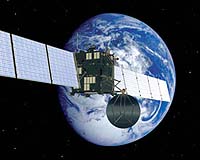
Yesterday, 18 October at 18:06 CEST, the thrusters of ESA's comet chaser, Rosetta, were fired in a planned, 42-second trajectory correction manoeuvre designed to 'fine tune' the spacecraft's approach to Earth. Rosetta is now approaching Earth for its second planetary swing-by of 2007. After passing Mars in April 2007, Rosetta is now approaching Earth for the second time - the third of four planetary swing-bys that provide fuel-saving gravitational assists enabling the spacecraft to ultimately reach and cross the orbit of comet 64P/Churyumov-Gerasimenko in 2014.

Rosetta's closest approach is predicted for 21:57 CET at a height of 5301 km over the Pacific Ocean and a speed of 45 000 km/h relative to the Earth. The third and last Earth swing-by will take place in November 2009.

Rosetta lines up
"We have a target trajectory for Earth swing-by and regular orbit determinations allow us to decide when to do a correction manoeuvre. Brief burns now allow us to optimise the orbit and make the swing-by more accurate, saving us a lot of precious fuel later on," said Andrea Accommazzo, Rosetta Spacecraft Operations Manager at ESOC. He confirmed that yesterday's manoeuvre results were as expected.

A second trajectory correction slot, on 1 November, may also be used depending on results of an orbit determination scheduled for 30 October.

ESA's comet chaser
Rosetta will be ESA's first spacecraft to undertake long-term exploration of a comet at close quarters. The mission consists of a large orbiter, designed to operate for a decade at large distances from the Sun, and a small lander, Philae. Each of these carries a large suite of scientific experiments designed to complete the most detailed study of a comet ever attempted.

After entering orbit around Comet 67P/Churyumov-Gerasimenko in 2014, the spacecraft will release the lander onto the icy nucleus. It will then spend the next two years orbiting the comet as it heads towards the Sun. On the way to Comet Churyumov-Gerasimenko, Rosetta has received gravity assists from Earth and Mars, and will fly past two main-belt asteroids - Steins (September 2008), and Lutetia (July 2010).

Community
Email This Article
Comment On This Article

Related Links
Spacecraft Operations at ESA
ESA's comet chaser: Rosetta
Asteroid and Comet Mission News, Science and Technology


Memory Foam Mattress Review
Newsletters :: SpaceDaily :: SpaceWar :: TerraDaily :: Energy Daily
XML Feeds :: Space News :: Earth News :: War News :: Solar Energy News


Chance Encounter With Comet Nets Surprising Results
Ann Arbor MI (SPX) Oct 02, 2007
Comets are made of the most primitive stuff in the solar system. As hunks of rock and ice that never coalesced into more planets, they give researchers clues to the evolution of solar systems. So a chance encounter between spacecraft Ulysses and Comet McNaught's ion tail has scientists in the University of Michigan's College of Engineering marveling at a stroke of luck and some surprising data.


  • Putin boast of 'grandiose' military plans no cause for alarm: Gates
  • USS Fort McHenry Mission To Set Tone For US Africa Command
  • Walker's World: Inflating Russian reality
  • Analysis: China's unique assets

  • India, Pakistan talk to ease nuclear tensions
  • Olmert Wants To Know All About Ahmadinejad
  • Iran Warns It Can Fire 11,000 Rockets In One Minute If Attacked
  • Friction between EU, Egypt over nuclear-free Middle East

  • Russia Announces Successful Topol Ballistic Missile Test
  • Russian Military Chief Says No Need To Give Up INF Treaty
  • Pentagon confirms accidental Patriot launch
  • Cruise Missile Sector Facing Supersonic Challenge

  • US heeding Russia's concerns on missile defence: Putin
  • BMD Focus: The toll of the Qassams
  • US could change missile shield plan if Iranian threat subsides
  • Barak, Gates discuss joint US-Israel anti-missile system

  • Airbus US boss demands end to WTO "histrionics"
  • MEPs seek limits on aircraft emissions by 2010
  • New Delft Material Concept For Aircraft Wings Could Save Billions
  • Aircraft And Automobiles Thrive In Hurricane-Force Winds At Lockheed Martin

  • BAE Systems Led UCAV Programme Breaks New Ground
  • Reaper Aids Commanders On Battlefield
  • UAS Video Terminal Connects Boots On The Ground To Eyes In The Sky
  • Unmanned Aerial Vehicles Increase In Numbers

  • Iraqi President Says Large-Scale Turkish Incursion Impossible
  • Turkish campaign against Kurds faces many pitfalls
  • No Turkish hostages held by Kurdish rebels: defence minister
  • Pentagon announces Iraq deployments

  • Taiwan to develop 'blackout bomb': report
  • GPS Operators Unveil New Early-Orbit, Anomaly Resolution System
  • Thompson Files: C-130 lessons -- Part 1
  • LockMart Unveils Operational Prototype EQ-36 Counterfire Target Acquisition Radar

  • The content herein, unless otherwise known to be public domain, are Copyright 1995-2006 - SpaceDaily.AFP and UPI Wire Stories are copyright Agence France-Presse and United Press International. ESA PortalReports are copyright European Space Agency. All NASA sourced material is public domain. Additionalcopyrights may apply in whole or part to other bona fide parties. Advertising does not imply endorsement,agreement or approval of any opinions, statements or information provided by SpaceDaily on any Web page published or hosted by SpaceDaily. Privacy Statement