
 |
 |
 |
 |
 |
 |
 |
 |
 |
 |

| . |  |
. |
Breakthrough In Stereo Mission Could Help Prevent Satellite Damage
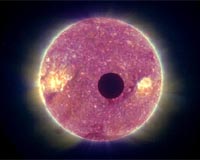
Greenbelt, MD (SPX) Apr 16, 2009 Scientists working on NASA's twin STEREO spacecraft have made a significant breakthrough that could play a major role in protecting satellites from the damage caused by solar explosions, known as Coronal Mass Ejections (CMEs). CMEs are powerful sudden eruptions of plasma and magnetic energy from the Sun's outer atmosphere that when directed towards Earth, can have damaging effects. Protecting satellites from these potential negative consequences is vital for preventing disruption to everything from GPS to power stations. Now scientists using data from the twin STEREO spacecraft have shown that these unique 3D images enable a CME to be tracked all the way to the Earth and predict its arrival at least 24 hours beforehand. This allows more time for preventative measures to be put in place to minimize the damage caused to satellites and the resulting disruption to technologies. A paper led by Dr Chris Davis, of the Science and Technology Facilities Council's (STFC's) Rutherford Appleton Laboratory (RAL) due to be published in Geophysical Research Letters explains this has been made possible because of the UK-built Heliospheric Imagers (hi-tech cameras) onboard the twin STEREO spacecraft that view the space between the Sun and the Earth, using wide-angle telescopes. "The images taken from the UK-built Heliospheric Imagers represent a major step forward in predicting the arrival of these solar storms at Earth" said Dr Chris Davis. "These results demonstrate that we are now able to predict a storm's arrival at Earth with over twenty-four hours notice. That's sufficient time for satellite operators and astronauts on the International Space Station to minimize their risks". Angelos Vourlidas, project scientist for the SECCHI imaging suite aboard STEREO said; "The larger the separation between the STEREO spacecraft, the larger the structures we can examine." The NASA STEREO mission was launched in October 2006. Two identical probes are now in solar orbit, one flying ahead of the Earth and one behind the Earth, from where they look back at the Sun and the space between the Sun and the Earth. This two-platform view allows 3D images of the Sun to be produced. However, it is the RAL-led Heliospheric Images on STEREO that look at the space between the Sun and the Earth, using wide-angle telescopes. They are being used to detect the CMEs as they propagate through interplanetary space. In addition to leading the HI instruments, all of the imaging instruments on board the two STEREO spacecraft use a novel CCD-based camera system developed at RAL. Share This Article With Planet Earth
Related Links - Solar Science News at SpaceDaily
 NKorea rocket followed flight path of satellite: official
 Seoul (AFP) April 14, 2009
A North Korean rocket fired last week appeared to have carried a satellite and to have separated in its final two stages as planned, South Korea's defence minister said Tuesday. |
|
|

| The content herein, unless otherwise known to be public domain, are Copyright 1995-2007 - SpaceDaily.AFP and UPI Wire Stories are copyright Agence France-Presse and United Press International. ESA Portal Reports are copyright European Space Agency. All NASA sourced material is public domain. Additional copyrights may apply in whole or part to other bona fide parties. Advertising does not imply endorsement,agreement or approval of any opinions, statements or information provided by SpaceDaily on any Web page published or hosted by SpaceDaily. Privacy Statement |
 del.icio.us
 Digg
Digg Reddit
 YahooMyWeb
 Google
 Facebook