. Military Space News .
Brightest Comet In 40 Years Dazzles

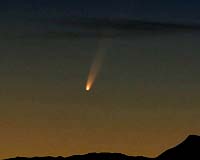
The McNaught Comet as seen in the northern hemisphere. Southern hemisphere residents can enjoy the light show this week.
by Staff Writers
Beijing, China (XNA) Jan 16, 2007
The brightest comet for more than 40 years dazzling the skies in the past week will shine over Australia from Monday, Austrailan astronomers said. The McNaught Comet is currently at its closest approach around the sun and will become visible to West Australians from Monday for about a week. James Biggs, director of the Perth Observatory, said. "It should be easy to locate. Find a vantage point with an unobstructed view and look low on the horizon near where the sun has set, in the direction of south-west, around 9 p.m. (WDT)," Biggs said.

The comet, which was discovered by Australian astronomer Rob McNaught last year, was 12 percent brighter than the sighting in 1995 of the Hale-Bopp Comet but still 25 times fainter than 1965's Ikeya-Seki Comet, according to Biggs.

Northern Hemisphere observers have reported the tail of dust cloud following the comet is especially impressive when viewed through binoculars.

Because of the comet's closeness to the sun, observers are warned never to look directly at the sun with the naked eye or through an optical instrument.

Source: Xinhua News Agency

Related Links
The Iron and Ice Of Our Solar System

Small Landing Probes For In-Situ Characterization of Asteroids and Comets
Boulder CL (SPX) Jan 16, 2007
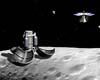
The 2007 American Astronomical Society's annual meeting in Seattle, Jan 5-10, included a poster presentation depicting a small landing probe design developed by Ball Aerospace and Technologies Corp and was presented by Dennis Ebbets, Senior Business Development Manager for Ball Aerospace's Space Science division in Boulder, CO.


  • Assuring Vital Interests Drives US Space Policy
  • Japan Launches First Defense Ministry Since WWII
  • Schmoozing At the White House
  • Japan To Strengthen International Alliances

  • US Seeks To Banish Iran War Rumor
  • North Korea Slams US Fighter Jet Deployment In South
  • Doomsday Clock To Move Closer To Nuclear Armageddon
  • Southeast Asia Warns North Korea On Nuclear Test

  • Raytheon Receives Contracts For Standard Missile-1 Support Services
  • Javelin Block I Missile Achieves Success In Test Firings
  • ATK Receives New Contract For HELLFIRE Rocket Motors And Warheads
  • Navy Posts Successful Test Of Raytheon Block IV Tomahawk Cruise Missile

  • Missile Defense Really Does Take Rocket Science
  • Banner Year For US Missile Defense Plans
  • Raytheon Awarded Subcontract for Sea-Based X-Band Radar Sustainment Support
  • Raytheon Completes Negotiations Billion Dollar Contract For JLENS Development

  • USGS Examines Environmental Impacts Of Aircraft De-Icers
  • China Gives Rare Glimpse Of Homegrown Jet Fighter
  • IATA Gives Cautious Welcome To EU Emissions Trading Plan
  • EU Proposes CO2 Emission Quotas For Airlines

  • Enhanced Fire Scout Makes Flight Debut
  • Israel Developing Massive New Unmanned Aerial Vehicle
  • Boeing Provides ScanEagle UAV to Australian Army
  • Techsphere Structures Licensing Agreement With Global Skyship Industries

  • Looking Ahead In Iraq
  • An Admiral For Iraq
  • Iraq And The War On Terror
  • Bush Says His Decisions Helped Destabilize Iraq

  • Pentagon Report Warns Canadian Coins Bugged
  • Raytheon Wins Silent Knight Radar Development Contract
  • Recon Optical Awarded Contract For Stabilized Remotely Operated Weapon Systems
  • Northrop Grumman Airborne Signals Intelligence Payload Takes To Air On First U-2 Flight

  • The content herein, unless otherwise known to be public domain, are Copyright 1995-2006 - SpaceDaily.AFP and UPI Wire Stories are copyright Agence France-Presse and United Press International. ESA PortalReports are copyright European Space Agency. All NASA sourced material is public domain. Additionalcopyrights may apply in whole or part to other bona fide parties. Advertising does not imply endorsement,agreement or approval of any opinions, statements or information provided by SpaceDaily on any Web page published or hosted by SpaceDaily. Privacy Statement