
Subscribe free to our newsletters via your
. Military Space News .


WATER WORLD
Britain's urban rivers cleanest in 20 years
by Staff Writers
Cardiff, UK (SPX) Jun 03, 2014


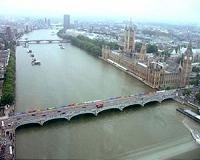
File image.

Scientists from Cardiff University have found that Britain's urban rivers are the cleanest they've been in over two decades. The 21-year study of over 2300 rivers measured the presence of clean-river invertebrates - a yardstick for river health - which during the days of heavy industry and poor sewage treatment had declined considerably, but now appear to be making a comeback.

Although climate change has warmed British rivers by around 1-2 degrees over recent decades, the findings suggest that improved pollution control has managed to offset its damaging effects on river ecosystems. This indicates that society can prevent some undesirable climate change effects on the environment by improving habitat quality.

Dr Ian Vaughan and Professor Steve Ormerod from the University's School of Biosciences analysed changes in the occurrence and spread of insects, snails and other mini-beasts from major rivers between 1991 and 2011. The researchers then asked whether water quality, temperature or river flow best explained the biological changes they observed.

Among 78 types of organisms examined, 40 have become more prevalent in English and Welsh rivers while 19 have declined. Overwhelmingly, these trends were explained by reductions in gross pollution rather than warming or changing flow caused by climate change.

Improving water quality has allowed some clean-water organisms from upland rivers to return to previously polluted lowland rivers, and may even explain some northwards movement previously attributed to climate-change.

The researchers believe these results to be very encouraging in showing how reductions in pollution can help offset climate change impacts. Dr Ian Vaughan said: "Our analysis showed clearly that many British river invertebrates are sensitive to climate - for example; because they require good supplies of oxygen that decline as rivers warm up. However, it seems that efforts over the last 2-3 decades to clean up pollution from sewage and other sources have allowed many of these sensitive organisms to expand their range despite 1-2 C warming trends and several periods of drought."

Prof Steve Ormerod added: "These results reveal part of a larger pattern in which organisms dependent on cleaner waters, faster flows and high oxygen concentrations have been progressively recolonizing Britain's urban rivers: Atlantic salmon, mayflies, and Dippers are prime examples. We need to protect these and other river organisms against climate change effects - and solving other problems such as pollution clearly helps.

"Away from Britain's urban areas, some pollution problems are increasing, and our analysis shows some negative trends among sensitive organisms such as stoneflies that are typical for rural hill-streams. It's important that our efforts to protect Britain's rivers against pollution or climate change are extended to the farmed, rural, upland landscape."

The data were supplied by the Environment Agency and Natural Resources Wales. The full study can be found in the journal, Global Change Biology and can be found here

.


Related Links
Cardiff University
Water News - Science, Technology and Politics


Comment on this article via your Facebook, Yahoo, AOL, Hotmail login.

Share this article via these popular social media networks
del.icio.usdel.icio.us DiggDigg RedditReddit GoogleGoogle


WATER WORLD
13 dead as monsoon triggers havoc in Sri Lanka capital
Colombo (AFP) June 02, 2014
Unusually heavy monsoon rains have flooded Sri Lanka's capital and neighbouring districts where mudslides killed at least 13 people, officials said Monday. The island's western and southern regions experienced heavy rains with more than 100 millimetres (four inches) dumped within about one hour on Sunday, an official at the Disaster Management Centre (DMC) said. "The weather appears to b ... read more


WATER WORLD
US seeks greater missile defense cooperation by Japan, South Korea

Land-based variant of Aegis tested

Canadian missile defense radar to be operated, maintained by Raytheon

Propulsion Module For SBIRS GEO-4 Satellite Completed

WATER WORLD
Combined Diehl, Elbit missile counter-measures for Germany's A400Ms

British helicopters getting new missile warning system

Australian military gives JASSM final operational capability status

Lockheed Martin Demonstrates Javelin Firing From Turret in UK Test

WATER WORLD
Camcopter S-100S put through its paces

Nature inspires drones of the future

US drone deployed in Japan for first time

ATC coms system in works for Predator

WATER WORLD
NATO agency extends Globalcomms services

Rockwell supplying radios, satellite terminals to Canadian military

Exelis to help repair, modernize tactical radios

The U.S. Navy has contracted Harris Corporation for next-gen radios

WATER WORLD
Compact Indium Phosphide Ultra-Low-Noise Amplifiers For Military Use

US Veterans Affairs secretary resigns amid scandal

Latin American country orders security system from Elbit

BAE Systems offers vehicle in Army M113 replacement competition

WATER WORLD
New collaboration underway in Canada

'Significant delays' found in treatment of US veterans

Pentagon chief to take in Singapore, Europe next week

French PM vows to keep defence budget intact after warnings

WATER WORLD
NATO sees 'some signs' Russia troops leaving Ukraine border

US urges China to avoid tensions in airspace

Russia says Ukraine breaches Geneva Convention on protection of civilians

China to promote its security theory at Shangri-La

WATER WORLD
DNA nanotechnology places enzyme catalysis within an arm's length

Engineers build world's smallest, fastest nanomotor

Bending helps to control nanomaterials

Nanoscale heat flow predictions


The content herein, unless otherwise known to be public domain, are Copyright 1995-2014 - Space Media Network. All websites are published in Australia and are solely subject to Australian law and governed by Fair Use principals for news reporting and research purposes. AFP, UPI and IANS news wire stories are copyright Agence France-Presse, United Press International and Indo-Asia News Service. ESA news reports are copyright European Space Agency. All NASA sourced material is public domain. Additional copyrights may apply in whole or part to other bona fide parties. Advertising does not imply endorsement, agreement or approval of any opinions, statements or information provided by Space Media Network on any Web page published or hosted by Space Media Network. Privacy Statement All images and articles appearing on Space Media Network have been edited or digitally altered in some way. Any requests to remove copyright material will be acted upon in a timely and appropriate manner. Any attempt to extort money from Space Media Network will be ignored and reported to Australian Law Enforcement Agencies as a potential case of financial fraud involving the use of a telephonic carriage device or postal service.