|
 |
 |
 |
 |
 |
 |
 |
 |
 |

| . |  |
. |
Brown Scientist Answers How Peruvian Meteorite Made It To Earth
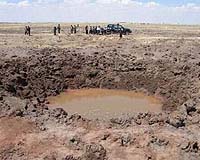
Providence RI (SPX) Mar 14, 2008 It made news around the world: On Sept. 15, 2007, an object hurtled through the sky and crashed into the Peruvian countryside. Scientists dispatched to the site near the village of Carancas found a gaping hole in the ground. Peter Schultz, professor of geological sciences at Brown University and an expert in extraterrestrial impacts, went to Peru to learn more. For the first time, he will present findings from his travels at the 39th annual Lunar and Planetary Science Conference in League City, Texas, in a talk scheduled for 2 p.m. on March 11, 2008. Brown graduate student Robert "Scott" Harris collaborated on the research, joined by Jose Ishitsuka, a Peruvian astrophysicist, and Gonzalo Tancredi, an astronomer from Uruguay. What Schultz and his team found is surprising. The object that slammed into a dry riverbed in Peru was a meteorite, and it left a 49-foot-wide crater. Soil ejected from the point of impact was found nearly four football fields away. When Schultz's team analyzed the soil where the fireball hit, he found "planar deformation features," or fractured lines in sand grains found in the ground. Along with evidence of debris strewn over a wide area, the shattered sand grains told Schultz that the meteorite had maintained a high rate of speed as it shot through the atmosphere. Scientists think it was traveling at roughly 15,000 miles per hour at the moment of impact. "Normally with a small object like this, the atmosphere slows it down, and it becomes the equivalent of a bowling ball dropping into the ground," Schultz said. "It would make a hole in the ground, like a pit, but not a crater. But this meteorite kept on going at a speed about 40 to 50 times faster than it should have been going." Scientists have determined the Carancas fireball was a stony meteorite - a fragile type long thought to be ripped into pieces as it enters the Earth's atmosphere and then leaves little more than a whisper of its journey. Yet the stony meteorite that struck Peru survived its passage mostly intact before impact. "This just isn't what we expected," Schultz said. "It was to the point that many thought this was fake. It was completely inconsistent with our understanding how stony meteorites act." Schultz said that typically fragments from meteorites shoot off in all directions as the object speeds to Earth. But he believes that fragments from the Carancas meteorite may have stayed within the fast-moving fireball until impact. How that happened, Schultz thinks, is due to the meteorite's high speed. At that velocity, the fragments could not escape past the "shock-wave" barrier accompanying the meteorite and instead "reconstituted themselves into another shape," he said. That new shape may have made the meteorite more aerodynamic - imagine a football passing through air versus a cinderblock - meaning it encountered less friction as it sped toward Earth, hitting the surface as one large chunk. "It became very streamlined and so it penetrated the Earth's atmosphere more efficiently," Schultz said. Schultz's theory could upend the conventional wisdom that all small, stony meteorites disintegrate before striking Earth. If correct, it could change the thinking about the size and type of extraterrestrial objects that have bombarded the Earth for eons and could strike our planet next. "You just wonder how many other lakes and ponds were created by a stony meteorite, but we just don't know about them because when these things hit the surface they just completely pulverize and then they weather," said Schultz, director of the Northeast Planetary Data Center and the NASA/Rhode Island University Space Grant Consortium. Schultz's research could have implications for Mars, where craters have been discovered in recent missions. "They could have come from anything," he said. "It would be interesting to study these small craters and see what produced them. Perhaps they also will defy our understanding." Community Email This Article Comment On This Article Related Links Brown University Asteroid and Comet Impact Danger To Earth - News and Science
 Canadian astronomers tape meteor fall
 London, Ontario (UPI) Mar 11, 2008
 Canadian astronomers at the University of Western Ontario are hunting for pieces of a meteorite they videotaped falling to Earth. |
|
|

| The content herein, unless otherwise known to be public domain, are Copyright 1995-2007 - SpaceDaily.AFP and UPI Wire Stories are copyright Agence France-Presse and United Press International. ESA Portal Reports are copyright European Space Agency. All NASA sourced material is public domain. Additional copyrights may apply in whole or part to other bona fide parties. Advertising does not imply endorsement,agreement or approval of any opinions, statements or information provided by SpaceDaily on any Web page published or hosted by SpaceDaily. Privacy Statement |