
 |
 |
 |
 |
 |
 |
 |
 |
 |
 |

| . |  |
. |

Bethesda MD (SPX) Feb 14, 2011 The sun is the predominant source of energy for the Earth. While there are long- and short-term variations in solar intensity that effect periodic global climate changes, there is also a secular temperature increase as the sun ages. Fortunately, the rate of increase is very low and we will not notice a significant change for at least thousands of years. Nevertheless, if we are to counter inevitable global warming the planning process must start soon, as any solution will likely require many centuries of implementation. We do know that three to four billion years ago the sun emitted only 70% as much power as it does today. Had the atmospheric composition been what it is today, liquid water would not have existed on Earth. Nevertheless, there is evidence that water was present at that time. In order for this to be true, theory tells us that there had to have been a much different atmosphere, one with much higher concentrations of greenhouse gases. Over the subsequent roughly three billion years, the sun's energy output increased, causing changes in the atmospheric composition. The primary effect was the oxygenation of the atmosphere. Short-term variations in the sun's output include the well-known 11-year solar cycle. Long-term variations are thought to have influenced the Little Ice Age, and some of the warming trends noted from 1900 to 1950. Obviously, solar dynamics are not fully understood, but we hope to learn more over the coming decades with space experiments such as NASA's STEREO and Solar Probe Plus missions. In the near-term, the human race is relatively safe from natural processes such as increased solar heating. Over the next 100,000 years or so, conditions will change significantly. Average temperatures will rise. Sea levels will also rise, causing a reduction in dry land areas. The atmosphere will change in ways that may require modifications of the way we live and breathe. A million years from now solar output may have increased enough to make Earth unlivable by todays standards. How can we counter this effect? Any solution will require long-term planning and execution. The required expenditures will surely be huge on a world economic scale. However, the alternative to action may be the end of the human race. The Earth will need a thermostat to control incoming solar energy. One approach may be the placement of a huge sun shield at the L1 Earth-Sun libration point. This is one of five points of gravitational equilibrium in the rotating Earth-Sun coordinate frame. L1 is particularly attractive for the positioning of a shield, because the positioning control requirements are minimal and this point is in the Earth-Sun line of sight at about 1.5 million km from Earth. This is a long-term project, since any solar shield would require a cross sectional area of at least several million square kilometers. Such a shield could be articulated to vary the shading effect as solar radiation varies over time. This idea may seem ridiculous today, but we do know that the sun will continue to warm. Some action will eventually be required to preserve the race. If you have a better idea, please let us know at [email protected].
Share This Article With Planet Earth
Related Links Launchspace Solar Science News at SpaceDaily

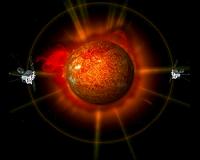 First Ever STEREO Images Of The Entire Sun
Washington DC (SPX) Feb 14, 2011 It's official: The sun is a sphere. On Feb. 6th, NASA's twin STEREO probes moved into position on opposite sides of the sun, and they are now beaming back uninterrupted images of the entire star-front and back. "For the first time ever, we can watch solar activity in its full 3-dimensional glory," says Angelos Vourlidas, a member of the STEREO science team at the Naval Research Lab in Washington ... read more |
|
|
| The content herein, unless otherwise known to be public domain, are Copyright 1995-2010 - SpaceDaily. AFP and UPI Wire Stories are copyright Agence France-Presse and United Press International. ESA Portal Reports are copyright European Space Agency. All NASA sourced material is public domain. Additional copyrights may apply in whole or part to other bona fide parties. Advertising does not imply endorsement,agreement or approval of any opinions, statements or information provided by SpaceDaily on any Web page published or hosted by SpaceDaily. Privacy Statement |


 del.icio.us
 Digg
Digg Reddit
 YahooMyWeb
 Google
 Facebook


