|
 |
 |
 |
 |
 |
 |
 |
 |
 |

| . |  |
. |
Bush may offer new carrot to end Korean nuclear crisis
Washington (AFP) May 18, 2006 The top US negotiator to stalled North Korean nuclear talks is to travel to China and South Korea to possibly market a new plan by President George W. Bush's administration to end a four-year standoff with Pyongyang. Assistant Secretary of State Christopher Hill will visit Beijing and Seoul on May 24-26 after an extensive Southeast Asian trip covering Malaysia, Singapore and Thailand beginning this week, the State Department said Wednesday. If North Korea agrees to return to six-party talks stalled since November, Bush could allow a parallel track of negotiations on a peace treaty which would replace the 1953 armistice ending the Korean War, the New York Times reported Thursday. The newspaper, quoting the president's aides, said Bush "is very likely to approve the new approach" hotly debated within the different factions within the administration. North Koreans have long demanded a peace treaty to put an end to the Korean War that left North and South Korea separated by a demilitarized zone. They remain technically at war to the present day. Korea was the first battleground of the Cold War. An estimated three million Koreans and over 50,000 US troops were killed during the 1950-1953 conflict. The Bush administration's new strategy to woo the North Koreans to the negotiating table may have been influenced in part by growing concerns about Iran's nuclear program, the New York Times said. "There is a sense that they can't leave Korea out there as a model for what the Iranians hope to become -- a nuclear state that can say no to outside pressure," one senior Asian official briefed on the administration's discussions was quoted saying. Western nations are spearheading efforts to draw up a package of incentives for Iran to stop enriching uranium, a process which could be diverted to build a nuclear weapon. Tehran says it only wants to generate energy. The United States is seeking sanctions from the UN Security Council, but it has failed to win support and has given its European allies "a couple of weeks" to draft a fresh approach. Asian diplomats said the nuclear issue would be a key topic of discussions during Hill's trip to China and South Korea, both of which had been banking on US flexibility to jump start the nuclear negotiations. The six-party talks -- involving the two Koreas, the United States, China, Japan and Russia -- ran into trouble when Washington imposed financial sanctions on North Korea for alleged counterfeiting and money laundering. North Korea protested, calling for the removal of the sanctions as a precondition for returning to talks but the United States has refused to budge, thanks to hawks in the Bush administration bent on pursuing a hardline policy on the Stalinist state. Experts believe it would be difficult to jumpstart the six-party talks if the United States does not lift the financial sanctions, which Pyongyang says breached the spirit of a landmark September 2005 agreement under which it agreed in principle to abandon nuclear weapons in return for security, diplomatic and energy aid guarantees. Charles Pritchard, former top US negotiator with North Korea, said the "high point" of the six-party talks was "just prior" to September agreement. "Everything has gone downhill since then," he said at a Washington forum Wednesday. Before the September agreement, Hill had "great deal of flexibility and authority to actually negotiate in a serious manner," Pritchard said, suggesting the administration's hardline stance had led a trimming of Hill's negotiating powers. Despite the pessimism, Pritchard said, the United States should capitalize on the six-party process to forge a permanent security mechanism to achieve permanent peace for the Korean peninsula. Yang Bojiang, a Chinese scholar at Washington-based Brookings Institution, said an apparent stumbling block to the six-party talks was the "serious lack of cooperation" among the different groups within the Bush administration. He called for the setting up of a "liaison organization" among the six nations aimed at implementing the September agreement. Alexander Vorontsov, a Russian scholar at Brookings, said Moscow was eager for the six-party talks to succeed -- not only to resolve the North Korean nuclear crisis but develop a multilateral security forum for Northeast Asia. Related Links  Iran using Chinese-made feedstock for enriched uranium: diplomats
 Vienna (AFP) May 18, 2006
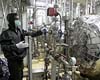
 Iran used stocks of high-quality uranium gas from China in order to hasten a breakthrough in enrichment for a programme the West fears could be hiding nuclear weapons work, diplomats told AFP. |
|
|

| The content herein, unless otherwise known to be public domain, are Copyright 1995-2006 - SpaceDaily.AFP and UPI Wire Stories are copyright Agence France-Presse and United Press International. ESA PortalReports are copyright European Space Agency. All NASA sourced material is public domain. Additionalcopyrights may apply in whole or part to other bona fide parties. Advertising does not imply endorsement,agreement or approval of any opinions, statements or information provided by SpaceDaily on any Web page published or hosted by SpaceDaily. Privacy Statement |