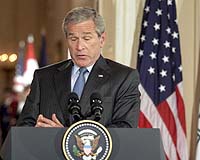
US President George W. Bush. Photo courtesy AFP.
US President George W. Bush. Photo courtesy AFP. |
"Despite these frustrations and disappointments, the Middle East in 2008 is a freer, more hopeful, and more promising place than it was in 2001," Bush said in prepared remarks that amount to a wide-ranging defense of his legacy in the region.
The US president, who hands the keys to the White House to Obama on January 20, warned again that Washington will not permit Tehran to acquire nuclear weapons -- a view shared by the president-elect.
"We have made our bottom line clear: For the safety of our people and the peace of the world, America will not allow Iran to develop a nuclear weapon," said Bush, who was to deliver the speech at 5 pm (2200 GMT).
He accused Iran and Syria of supporting terrorism, expressed frustration with the pace of democratic reforms in the Middle East, called the Iraq war "longer and more costly than expected" and said the Israeli-Palestinian conflict remained "the most vexing problem in the region."
He pointed to Lebanon's "Cedar Revolution" against Syrian sway, Libya's decision to halt its quest for nuclear weapons, Iraq's fledgling democracy, and prosperity in places like the United Arab Emirates.
"There is now greater international consensus than at any point in recent memory" on the need to build an independent Palestinian state living side by side at peace with Israel, he said.
"The regime in Iran is facing greater pressure from the international community than ever before. Terrorist organizations like Al-Qaeda have failed decisively in their attempts to take over nations, and they are increasingly facing ideological rejection in the Arab world," he said.
But "there are still serious challenges facing the Middle East. Iran and Syria continue to sponsor terror, Iran's uranium enrichment remains a major threat to peace, and many in the region still live under oppression," he said.
Bush, who made no reference in the speech to Obama, defended his much-criticized approach to ending the 60-year conflict between Israel and the Palestinians, pointing to the US-backed conference in Annapolis, Maryland, in November 2007.
"The negotiations since Annapolis have been determined and substantial," he said, though critics note that the talks have yet to yield agreement on any major core issues.
"While the Israelis and Palestinians have not yet produced an agreement, they have made important progress," he said. "They have laid a new foundation of trust for the future.
Share This Article With Planet Earth
 del.icio.us del.icio.us |
 Digg Digg |
 Reddit Reddit |
 YahooMyWeb YahooMyWeb |
 Google Google |
 Facebook Facebook |
 US panel presents sobering report on WMD threat
 Washington (AFP) Dec 3, 2008
| The content herein, unless otherwise known to be public domain, are Copyright 1995-2007 - SpaceDaily.AFP and UPI Wire Stories are copyright Agence France-Presse and United Press International. ESA Portal Reports are copyright European Space Agency. All NASA sourced material is public domain. Additional copyrights may apply in whole or part to other bona fide parties. Advertising does not imply endorsement,agreement or approval of any opinions, statements or information provided by SpaceDaily on any Web page published or hosted by SpaceDaily. Privacy Statement |