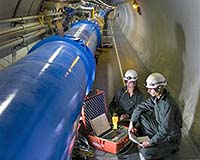
Engineers checking the electronics on a LHC dipole magnet.
Engineers checking the electronics on a LHC dipole magnet. |
The LHC is CERN's new flagship research facility, bringing together some 9000 researchers from around the world. Approved by the CERN Council in 1996, it will begin operation in 2008 and has an expected operational lifetime of around 20 years. The experimental collaborations running the LHC's detectors, ALICE, ATLAS, CMS, LHCb, and TOTEM are poised to bring new and profound insights into the workings of our Universe.
Three main ingredients are necessary for this kind of research at the frontier of knowledge - the LHC itself will accelerate and collide particles of matter, the detectors will observe the collisions, and a vast global computing infrastructure, the Worldwide LHC Computing Grid, is being put in place to analyze the resulting data. In 2007, good progress has been made on all fronts.
The LHC is now fully installed in its 27 km tunnel, and commissioning is well under way. The second of the two transfer lines that will carry beams into the LHC in opposite directions was successfully commissioned at the first attempt at the end of October. Two of the LHC's eight sectors are currently cooling down to their operating temperature of 1.9 degrees above absolute zero, with a further three sectors being prepared for cool down.
"The impressive speed of commissioning LHC beams right through CERN's injection complex bodes well for a fast and efficient commissioning of the LHC itself," said Aymar. "Today, we're on course for start-up in early summer 2008, but we won't be able to fix the date for certain before the whole machine is cold and magnet electrical tests are positive. We're expecting that in the spring".
Any difficulties encountered during this commissioning that require any sector of the machine to be warmed up would lead to a delay of two to three months.
Installation of the detectors is approaching its conclusion, and attention is turning towards physics analysis, including testing of the full data chain from the detectors through the Grid to data storage. All of the experimental collaborations expect to have their initial detectors ready for April 2008, some are already taking data routinely with cosmic rays, and baseline Grid services are in regular daily operation.
With the LHC moving into commissioning and beams expected in 2008, Council turned its attention to CERN's future programme. In approving the laboratory's 2008 budget, Council paved the way for the renovation of the LHC's injector complex, including replacement of the Proton Synchrotron accelerator, which was first switched on in 1959. This process will allow the LHC's beam intensity to be increased by around 2016, improving the experiments' sensitivity to rare phenomena. The 2008 budget includes additional funds for this work, with special contributions being made by the Organization's host states, France and Switzerland.
Community
 Radiation Flashes May Help Crack Cosmic Mystery
 Chicago IL (SPX) Dec 05, 2007
| The content herein, unless otherwise known to be public domain, are Copyright 1995-2006 - SpaceDaily.AFP and UPI Wire Stories are copyright Agence France-Presse and United Press International. ESA PortalReports are copyright European Space Agency. All NASA sourced material is public domain. Additionalcopyrights may apply in whole or part to other bona fide parties. Advertising does not imply endorsement,agreement or approval of any opinions, statements or information provided by SpaceDaily on any Web page published or hosted by SpaceDaily. Privacy Statement |