
 |
 |
 |
 |
 |
 |
 |
 |
 |
 |

| . |  |
. |

Geneva (AFP) April 22, 2011 The world's biggest atom smasher has set a new world record for beam intensity, a key measure of performance and power, the European Organisation for Nuclear Research (CERN) said Friday. On a quest to unlock some of the universe's deepest secrets, the Large Hadron Collider (LHC) in Geneva collided beams with a luminosity exceeding the mark set last year by the US Tevetron accelerator, CERN said. In particle physics, luminosity affects the number of collisions -- the higher the luminosity, the more particles are likely to collide. "Beam intensity is key to the success of the LHC, so this is a very important step," said CERN Director General Rolf Heuer. "High intensity means more data, and more data means greater discovery potential," he said in a statement. The new record measured a level of luminosity of 467,000 billion billion billion -- 467 followed by 30 zeros -- per square centimetre per second, which corresponds to several million particle collisions per second. Enhanced power boosts the odds of identifying extremely rare sub-atomic particles, especially the elusive Higgs boson, or 'God particle'. Earlier experiments have found most of the tiny and ephemeral matter predicted by the so-called Standard Model of particle physics -- except the Higgs boson. Many scientists believe only the 27-kilometre (16.8-mile), 3.9-billion-euro (5.2-billion-dollar) LHC may be powerful enough to detect it. The current run of LHC experiments is set to continue through 2012, by which time it should be possible to determine if the Higgs boson truly exists, CERN said. "There's a lot of excitement at CERN today, and a tangible feeling that we're on the threshold of new discovery," said Serge Bertolucci, CERN's Director for Research and Scientific Computing. So far, CERN has cranked the cathedral-sized machine up to energy levels of 7.0 trillion electronvolts (TeV), or 3.5 TeV per beam, more than three times the level attained by any other accelerator. It is aiming to trigger collisions at 14 TeV -- equivalent to 99.99 percent of the speed of light -- in the cryogenically-cooled machine after 2011. At full throttle, the collisions should create powerful but microscopic bursts of energy that mimic conditions close to the Big Bang. Even if validated, the Standard Model only accounts for about five percent of energy and matter in the Universe. Dark matter and dark energy are thought to make up the rest, but have yet to be detected.
Share This Article With Planet Earth
Related Links Understanding Time and Space

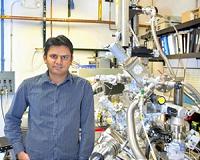 New Kid On The Plasmonic Block
Berkeley CA (SPX) Apr 21, 2011 With its promise of superfast computers and ultrapowerful optical microscopes among the many possibilities, plasmonics has become one of the hottest fields in high-technology. However, to date plasmonic properties have been limited to nanostructures that feature interfaces between noble metals and dielectrics. Now, researchers with the U.S. Department of Energy (DOE)'s Lawrence Berkeley Na ... read more |
|
|
| The content herein, unless otherwise known to be public domain, are Copyright 1995-2010 - SpaceDaily. AFP and UPI Wire Stories are copyright Agence France-Presse and United Press International. ESA Portal Reports are copyright European Space Agency. All NASA sourced material is public domain. Additional copyrights may apply in whole or part to other bona fide parties. Advertising does not imply endorsement,agreement or approval of any opinions, statements or information provided by SpaceDaily on any Web page published or hosted by SpaceDaily. Privacy Statement |


 del.icio.us
 Digg
Digg Reddit
 YahooMyWeb
 Google
 Facebook


