|
 |
 |
 |
 |
 |
 |
 |

| . |  |
. |

|
|
. |

 by Staff Writers Boulder CO (SPX) Aug 02, 2011
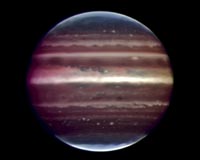
Several University of Colorado Boulder faculty and students are participating in NASA's Juno Mission to Jupiter, now slated for launch Aug. 5 from Florida's Kennedy Space Center and which is expected to help steer scientists toward the right recipe for planet-making. The primary goal of the mission is to understand the origin and evolution of the massive gas planet, said CU-Boulder Professor Fran Bagenal of the Laboratory for Atmospheric and Space Physics, a mission co-investigator. The data should reveal not only the conditions of the early solar system, but also help scientists to better understand the hundreds of planetary systems recently discovered around other stars, she said. After the sun formed, Jupiter got the majority of the "leftovers," said Juno Mission principal investigator Scott Bolton from the Southwest Research Institute in San Antonio. Since Jupiter has a larger mass than all of the other planets in the solar system combined, scientists believe it holds the keys to understanding how the planets formed and why some are rocky and others are gas giants, Bagenal said. Once Juno reaches Jupiter orbit in 2016 after a 400-million-mile trip, the spacecraft will orbit the planet's poles 33 times, skimming roughly 3,000 miles above the cloud tops in a region below Jupiter's powerful radiation belts. While the spacecraft itself is about the size of a Volkswagen and encased in a protective radiation vault, its three solar panels that will unfurl in space will make the spinning spacecraft more than 65 feet in diameter. Bagenal said scientists were continually surprised by the data beamed back from NASA's Galileo mission to Jupiter, which arrived at the planet in 1995 and carried 16 instruments, including two developed by CU-Boulder's LASP. Among other discoveries, Galileo scientists identified the global structure and dynamics of the planet's magnetic activity, confirmed the presence of ammonia clouds in its atmosphere and discovered that one of its moons, Europa, has a global ocean beneath a thick crust of ice. "One of the biggest questions left after the Galileo mission was how much water there is in Jupiter's atmosphere," said Bagenal. "The amount of water is key, because water played a huge role in the formation of the solar system." Bagenal also is a professor in the astrophysical and planetary sciences department. "Most of us know that water absorbs microwaves, because that is what happens when you put a cup of tea in your microwave oven," said Bagenal. "We are going to be using a microwave detector and fly just over the clouds of Jupiter, looking down at different cloud depths to measure the amounts of water below. It's a bit like doing a CT scan of Jupiter's dense clouds." Bagenal's role in the mission is to coordinate observations of Jupiter's magnetosphere --the area of space around the planet that is controlled by its magnetic field. She and her collaborators are especially interested in understanding the processes that control auroral activity at the planet's poles - its northern and southern lights - and assess the roles of the planet's strong magnetic field on its surroundings. In addition to collaborating closely with the Juno science team, Bagenal is working with CU-Boulder Professor Robert Ergun of LASP, who has extensively studied Earth's magnetosphere and associated polar auroras. Ergun will use his expertise in auroral physics as part of the mission to compare the physical processes at Jupiter with those seen on Earth. "This will be the first time anyone has flown over the poles of Jupiter to look directly down on the aurora," said Bagenal. "We will be flying the spacecraft through regions where charged particles are accelerated to the point of bombarding the atmosphere of Jupiter hard enough to make it glow at the poles." Bagenal also is working with LASP Research Associate Peter Delomere on the Jovian magnetosphere studies and with physics department graduate student Mariel Desroche, who is modeling the outer region of Jupiter's magnetosphere as part of the Juno effort. CU-Boulder senior Dinesh Costlow of the astrophysical and planetary sciences department also is collaborating with Bagenal and the Juno science team by using computer models to simulate the trajectory of the spacecraft through all 33 individual orbits as it passes through Jupiter's magnetosphere. "We are interested in finding the optimal places in orbit to point the spacecraft for our data collection," he said. Costlow, who is from Auburn, Maine, said he knew CU-Boulder had a good astronomy program before he ever set foot on campus. "Everything fell into place, and I feel very lucky to have an opportunity to work on this mission," Costlow said. "I think graduate school may be my next step, and after that maybe I can make a career out of this kind of planetary research." By mapping Jupiter's gravitational and magnetic fields, mission scientists should be able to see the planet's interior structure and determine if it has a rocky iron core - a core that some scientists believe could be 15 or 20 times the size of Earth. But because of the immense pressure in the Jovian atmosphere, any spacecraft seeking the core would be crushed long before it neared the middle of the planet, much as the Galileo spacecraft was crushed after it was crashed into the planet's clouds after the mission concluded in 2003. "My biggest hope is that all of our predictions about Jupiter are wrong, and that we find something completely different than what we expect," said Bagenal. "When our preconceived notions are off, it shows us we can never become complacent. New data from the solar system's planets keeps us excited enough to re-visit them to learn more about the history and fate of our solar system." The Juno spacecraft is carrying 11 experiments to probe the planet's mass, magnetic field, charged particles, auroras, plasma, radio waves, thermal and ultraviolet emissions, and includes a camera to provide images of the colorful Jovian cloud tops.
|
. |
|
| The content herein, unless otherwise known to be public domain, are Copyright 1995-2011 - Space Media Network. AFP and UPI Wire Stories are copyright Agence France-Presse and United Press International. ESA Portal Reports are copyright European Space Agency. All NASA sourced material is public domain. Additional copyrights may apply in whole or part to other bona fide parties. Advertising does not imply endorsement,agreement or approval of any opinions, statements or information provided by Space Media Network on any Web page published or hosted by Space Media Network. Privacy Statement |

 del.icio.us
 Digg
Digg Reddit
 Google