
 |
 |
 |
 |
 |
 |
 |
 |
 |
 |

| . |  |
. |
Caltech Astronomers Describe The Bar Scene At Beginning Of Universe
Pasadena CA (SPX) Jul 31, 2008 Bars abound in spiral galaxies today, but this was not always the case. A group of 16 astronomers, led by Kartik Sheth of NASA's Spitzer Science Center at the California Institute of Technology, has found that bars tripled in number over the past seven billion years, indicating that spiral galaxies evolve in shape. The thought of spiral galaxies invokes images of star-studded arms trailing off of spinning disks. But more than two-thirds of spiral galaxies, including our own Milky Way, have a bar-shaped path through their middles. Barred galaxies are shaped more like a tiger's eye, with two starry arms trailing off either end of a long, dark stardust lane. They take shape as stellar orbits in a disk become unstable and deviate from a circular path. "The formation of a bar may be the final important act in the evolution of a spiral galaxy," says Sheth, a Spitzer staff scientist and lead author on a study examining the evolution of barred galaxies. "Galaxies are thought to build themselves up through mergers with other galaxies. After settling down, the only other dramatic way for galaxies to evolve is through the action of bars." According to new observations of over 2,000 spiral galaxies, made with NASA's Hubble Space Telescope, the bar scene was dramatically different seven billion years ago, when the universe was half as old as it is today. The study is part of the Cosmic Evolution Survey (COSMOS), Hubble's largest survey ever, in which Sheth and his team of 15 scientists is examining how galaxies form and evolve. COSMOS covers an area of sky nine times larger than the full moon, surveying 10 times more spiral galaxies than previous studies, which Sheth says typically yielded ambiguous clues to barred galaxy evolution. The astronomers discovered that while spiral galaxies were around in the distant past, only around 20 percent of them possessed the bars that are so common in their modern counterparts. The tripling rate does not proceed in an even-handed way, either. "They are forming mostly in the small, low-mass galaxies," says Sheth, adding that among the most massive galaxies, the proportion of bars to no bars is the same as it is today. "We know that evolution is generally faster for more massive galaxies--they form their stars early and fast and then fade into red disks," Sheth explains. "Low-mass galaxies were also known to form more slowly, but now we see that they also made their bars slower." Survey team member Bruce Elmegreen, an astrophysicist with IBM's Research Division, describes how a bar grows after stellar orbits in a spiral galaxy begin to deviate from a circular path. "It locks more and more of these elongated orbits into place, making the bar even stronger. Eventually a high fraction of the stars in the inner disk join the bar." Bars are perhaps the most important catalysts for changing a galaxy, Sheth says. They force a large amount of gas towards the galactic center, fueling new star formation, building bulges--spheres in the centers of galaxies made only of stars--and feeding massive black holes. Indeed, bars may even contribute to the growth of black holes, says Nicholas Scoville, Caltech's Moseley Professor of Astronomy and COSMOS principal investigator. "They pull stars and gas out of their normal circular orbits into the central regions, perhaps even funneling gas to the central supermassive black hole. Without this fueling, the black holes would be starved and the central regions of galaxies devoid of young stars." "The new observations suggest that instabilities are faster in more massive galaxies, perhaps because their inner disks are denser and their gravity is stronger," adds team member Lia Athanassoula of the Laboratoire d'Astrophysique de Marseille. The Milky Way, possibly the best-known barred galaxy, is a massive one whose bar probably formed somewhat early, like the bars in other massive galaxies, Sheth suggests. "Understanding how this occurred in the most distant galaxies will eventually shed light on how it occurred here, in our own backyard," he adds. Community Email This Article Comment On This Article Share This Article With Planet Earth
Related Links Stellar Chemistry, The Universe And All Within It
 At The Edge Of The Pinwheel
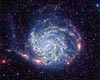 Moffet Field CA (SPX) Jul 30, 2008
The Pinwheel galaxy is gussied up in infrared light in a new picture from NASA's Spitzer Space Telescope. The fluffy-looking galaxy, officially named Messier 101, is dominated by a mishmash of spiral arms. |
|
|

| The content herein, unless otherwise known to be public domain, are Copyright 1995-2007 - SpaceDaily.AFP and UPI Wire Stories are copyright Agence France-Presse and United Press International. ESA Portal Reports are copyright European Space Agency. All NASA sourced material is public domain. Additional copyrights may apply in whole or part to other bona fide parties. Advertising does not imply endorsement,agreement or approval of any opinions, statements or information provided by SpaceDaily on any Web page published or hosted by SpaceDaily. Privacy Statement |
 del.icio.us
 Digg
Digg Reddit
 YahooMyWeb
 Google
 Facebook