|
 |
 |
 |
 |
 |
 |
 |
 |
 |

| . |  |
. |
Campaigning For Jupiter Broadens The Horizons Of Planetary Science
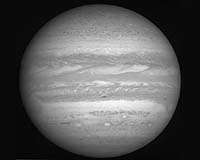
Laurel MD (SPX) Feb 26, 2007 We're now inside of a week to Jupiter closest approach! One aspect of our flyby that I have not yet noted is the broad campaign of coordinated Jupiter observations taking place on Earth and in space. As New Horizons approaches Jupiter, telescopes on terra firma, in Earth orbit and even far across the solar system are turning to observe the "big picture" while New Horizons provides the fine details. Prominent examples of telescopes enlisted to this cause include a wide variety of amateur telescopes, NASA's large Infrared Telescope Facility (IRTF) and huge Keck telescopes on Mauna Kea, Hawaii, as well as the Hubble Space Telescope (HST), the Chandra X-ray Observatory (CXO) and the Far Ultraviolet Spectroscopic Explorer (FUSE) satellites operating in Earth orbit. Over the next two weeks, these various facilities will intensively image and obtain spectroscopy of Jupiter's atmosphere and aurora, Jupiter's moon Io, and of the Io plasma torus - the donut-shaped ring of plasma that rotates with the moon around Jupiter. Additionally, the Alice ultraviolet spectrometer on the European Space Agency's Rosetta comet-orbiter mission will be observing the Io plasma torus from its ringside seat near Mars beginning next week. (Rosetta flies by Mars on February 25 for a gravity assist of its own). Rosetta's Alice, a sister of the Alice ultraviolet spectrometer on New Horizons, will monitor the Io plasma torus and Jovian aurora emission during March and April as New Horizons flies down Jupiter's magnetotail. Why? The Alice instrument aboard New Horizons can't do this because it would involve looking almost directly back into the Sun, but the Rosetta Alice instrument can achieve the same thing since Jupiter is deep in the night sky as seen from Mars. Pretty sweet, huh? The Hubble Space Telescope (top) and Infrared Telescope Facility in Hawaii (below) are among the many observatories on Earth and in space watching Jupiter during the New Horizons encounter. Image Credits: NASA, STScI, Institute for Astronomy, U of Hawaii Rosetta's Alice, a sister of the Alice ultraviolet spectrometer on New Horizons, will monitor the Io plasma torus and Jovian aurora emission during March and April as New Horizons flies down Jupiter's magnetotail. Why? The Alice instrument aboard New Horizons can't do this because it would involve looking almost directly back into the Sun, but the Rosetta Alice instrument can achieve the same thing since Jupiter is deep in the night sky as seen from Mars. Pretty sweet, huh? As we gear up for the onslaught of observations New Horizons will make, my team at New Horizons thanks all of the ground-based and space-based observing teams, whose important supporting observations strengthen and deepen the value of our Jupiter flyby. I'll be back with more news and views in a few days. Keep exploring! Email This Article
Related Links  Boulder CO (SPX) Feb 16, 2007
If you look at our "Where Is New Horizons?" page, which displays the spacecraft's trajectory status, you'll see we're right on Jupiter's doorstep. And it's true. Jupiter already appears one-third of a degree across - just a little smaller than the full Moon as seen from Earth - and growing every day. |
|
|

| The content herein, unless otherwise known to be public domain, are Copyright 1995-2006 - SpaceDaily.AFP and UPI Wire Stories are copyright Agence France-Presse and United Press International. ESA PortalReports are copyright European Space Agency. All NASA sourced material is public domain. Additionalcopyrights may apply in whole or part to other bona fide parties. Advertising does not imply endorsement,agreement or approval of any opinions, statements or information provided by SpaceDaily on any Web page published or hosted by SpaceDaily. Privacy Statement |