
. Military Space News .
CLONE AGE
Can stem cell technology be harnessed to generate biological pacemakers?
by Staff Writers
London, UK (SPX) Nov 26, 2015


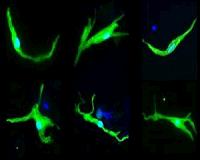
This graphic shows examples of individual pacemaker cells. Image courtesy of Vasanth Vedantham. For a larger version of this image please go here.

Although today's pacemakers are lifesaving electronic devices, they are limited by their artificial nature. For example, their parts can fail or they can become infected. In addition, the devices require regular maintenance, must be replaced periodically, and can only approximate the natural regulation of a heartbeat.

A Review article published on November 20 in Trends in Molecular Medicine highlights the promise and limitations of new methods based on stem cell and reprogramming technologies to generate biological pacemakers that might one day replace electronic pacemakers.

"Theoretically, biological pacemakers, which are composed of electrically active cells that can functionally integrate with the heart, could provide natural heart rhythm regulation without the need for indwelling hardware," says author Vasanth Vedantham, of the University of California, San Francisco.

To create biological pacemakers, one approach is to coax stem cells to become specialized cardiac pacemaker cells that are normally found within the sinoatrial node of the heart. These are then transplanted into an ailing heart to restore pacemaking function.

Another promising approach is to directly reprogram supporting cells, already present in the heart--for instance, fibroblasts (e.g., connective tissue)--and convert them into pacemaker cells to restore cardiac function.

Vedantham states that initial large animal studies on biological pacemakers have generated promising results but that much more work remains ahead before biological pacing can be actually considered a clinically viable therapy.

For example, researchers need to better understand the mechanisms controlling the development and maintenance of pacemaker cells in the sinoatrial node, just as they must develop ways to compare experimental biological pacemaker tissue with bona fide sinoatrial node tissue.

Also, scientists will need to improve the methods used to deliver cells to desired locations within the heart, as well as the recovery of specific individual cells for detailed characterization and functional analyses.

"Biological pacemakers must meet a very high standard of performance to supplant electronic pacemakers," Vedantham says.

"Because even a few seconds without a heartbeat can lead to serious consequences, a biological pacemaker would need to exhibit very robust and reliable performance. It remains to be determined whether this will be technically feasible. Despite such challenges, the field is poised for rapid progress over the next few years," he adds.

Trends in Molecular Medicine, Vedantham, V.: "Rewiring the Heart: New Approaches to Biological Pacemakers"


Thanks for being here;
We need your help. The Space Media Network continues to grow but revenues have never been harder to maintain.

With the rise of Ad Blockers, and Facebook - our traditional revenue sources via quality network advertising continues to decline. And unlike so many other news sites, we don't have a paywall - with those annoying usernames and passwords.

Our news coverage takes time and effort to publish 365 days a year.

If you find our news sites informative and useful then please consider becoming a regular supporter or for now make a one off contribution.
SpaceMediaNetwork Contributor
$5 Billed Once


credit card or paypal
SpaceMediaNetwork Monthly Supporter
$5 Billed Monthly


paypal only


.


Related Links
Cell Press
The Clone Age - Cloning, Stem Cells, Space Medicine


Comment on this article via your Facebook, Yahoo, AOL, Hotmail login.

Share this article via these popular social media networks
del.icio.usdel.icio.us DiggDigg RedditReddit GoogleGoogle

Previous Report
CLONE AGE
Aged neurons can now be generated using stem cell technology
Washington DC (SPX) Oct 12, 2015
Diseases of human aging have always been difficult to study in the lab. Stem cell technology always had promise, but when scientists reverted a skin cell from an 89-year-old woman back into a stem cell-like state, the cells became young again. Now, a new approach, presented October 8 in Cell Stem Cell, makes it possible to generate and grow cultures of neurons with gene expression reflecting a p ... read more


CLONE AGE
Thales sub-contracted for NATO BMD test activities

Patriot takes out two ballistic missiles in latest test

Army system integrates different radars for Patriot-3 interceptor

Putin: Russia Has Weapons Capable of Penetrating Any Missile Defenses

CLONE AGE
India test fires ship-based nuclear-capable missile

India test fires Advanced Air Defense missile

Navy, Boeing test new Harpoon missile variant

Hundreds of TOW missiles tipped for sale to Morocco

CLONE AGE
CACI launches SkyTracker UAV detection system

Japan to acquire Global Hawk drones

Former operators speak out about US drone killings

Navy starts pre-Milestone C tests on MQ-4C Triton UAS

CLONE AGE
Australia contracts for defense computer network upgrades

Harris Corporation Wins $40 Million Air Force Satellite Control Network Contract Extension

Commercialization is coming to WGS

DARPA's RadioMap Program Enters Third Phase

CLONE AGE
Rockwell Collins opens new facility in India

Tank Killer: New Armata gets really big gun

Raytheon's Next Generation Jammer completes preliminary design review

Australia seeks costing info for new armored vehicles

CLONE AGE
US approves $1.29 bn sale of bombs to Saudi Arabia

New York City turns tide on homeless vets

Orbital ATK and Boeing open offices in UAE

Bullets, cluster bombs at Thai arms fair despite censure over junta rule

CLONE AGE
Putin inaugurates museum honouring ex-leader Yeltsin

China under fresh fire over sea rows as US courts SE Asia

Japan backs US South China Sea operations

Under junta rule, Thailand pivots towards China

CLONE AGE
Navy researchers recruit luminescent nanoparticles to image brain function

Light wave technique an advance for optical research

Nanostructuring technology can simultaneously control heat and electricity

Rice makes light-driven nanosubmarine


The content herein, unless otherwise known to be public domain, are Copyright 1995-2024 - Space Media Network. All websites are published in Australia and are solely subject to Australian law and governed by Fair Use principals for news reporting and research purposes. AFP, UPI and IANS news wire stories are copyright Agence France-Presse, United Press International and Indo-Asia News Service. ESA news reports are copyright European Space Agency. All NASA sourced material is public domain. Additional copyrights may apply in whole or part to other bona fide parties. All articles labeled "by Staff Writers" include reports supplied to Space Media Network by industry news wires, PR agencies, corporate press officers and the like. Such articles are individually curated and edited by Space Media Network staff on the basis of the report's information value to our industry and professional readership. Advertising does not imply endorsement, agreement or approval of any opinions, statements or information provided by Space Media Network on any Web page published or hosted by Space Media Network. General Data Protection Regulation (GDPR) Statement Our advertisers use various cookies and the like to deliver the best ad banner available at one time. All network advertising suppliers have GDPR policies (Legitimate Interest) that conform with EU regulations for data collection. By using our websites you consent to cookie based advertising. If you do not agree with this then you must stop using the websites from May 25, 2018. Privacy Statement. Additional information can be found here at About Us.