
 |
 |
 |
 |
 |
 |
 |
 |
 |
 |

| . |  |
. |

Raleigh NC (SPX) May 12, 2011 As Star Trek is so fond of reminding us, we're carbon-based life forms. But the event that jump-started the universe, the Big Bang, didn't actually produce any carbon, so where the heck did it - and we - come from? An NC State researcher has helped create supercomputer simulations that demonstrate how carbon is produced in stars, proving an old theory correct. More than 50 years ago, an astronomer named Fred Hoyle deduced that when three helium nuclei - or alpha particles - come together inside the core of a star, they have difficulty combining to form carbon-12, the stuff we're made of. So he predicted a new state of carbon-12, one with an energy tuned just right to make the formation of carbon possible in stars. This new state is now known as the Hoyle state. Later experimentation demonstrated that the theory was correct, but no one had ever been able to reproduce the Hoyle state from scratch, starting from the known interactions of protons and neutrons. If the Hoyle state didn't show up in those calculations, then the calculations must be incorrect or incomplete. NC State physicist Dean Lee, along with German colleagues Evgeny Epelbaum, Hermann Krebs, and Ulf-G. Meissner, had previously developed a new method for describing all the possible ways that protons and neutrons can bind with one another inside nuclei. This "effective field theory" is formulated on a complex numerical lattice that allows the researchers to run simulations that show how particles interact. When the researchers put six protons and six neutrons on the lattice, the Hoyle state appeared together with other observed states of carbon-12, proving the theory correct from first principles. "We've had simple models of the Hoyle state using three alpha particles for a long time, but the first principles calculations weren't giving anything close," Lee says. "Our method places the particles into a simulation with certain space and time parameters, then allows them to do what they want to do. Within those simulations, the Hoyle state shows up." Their research appears in the May 13 issue of Physical Review Letters. Lee adds, "This work is valuable because it gives us a much better idea of the kind of 'fine-tuning' nature has to do in order to produce carbon in stars."
Share This Article With Planet Earth
Related Links NC State Understanding Time and Space

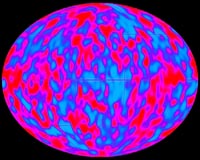 Did the Early Universe Have One Dimension
Buffalo NY (SPX) Apr 25, 2011 Did the early universe have just one spatial dimension? That's the mind-boggling concept at the heart of a theory that University at Buffalo physicist Dejan Stojkovic and colleagues proposed in 2010. They suggested that the early universe - which exploded from a single point and was very, very small at first - was one-dimensional (like a straight line) before expanding to include two dimensions ... read more |
|
|
| The content herein, unless otherwise known to be public domain, are Copyright 1995-2010 - SpaceDaily. AFP and UPI Wire Stories are copyright Agence France-Presse and United Press International. ESA Portal Reports are copyright European Space Agency. All NASA sourced material is public domain. Additional copyrights may apply in whole or part to other bona fide parties. Advertising does not imply endorsement,agreement or approval of any opinions, statements or information provided by SpaceDaily on any Web page published or hosted by SpaceDaily. Privacy Statement |


 del.icio.us
 Digg
Digg Reddit
 YahooMyWeb
 Google
 Facebook


