|
 |
 |
 |
 |
 |
 |
 |
 |
 |

| . |  |
. |
Case Astronomers Find Vast Stellar Web Spun By Colliding Galaxies
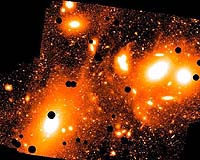
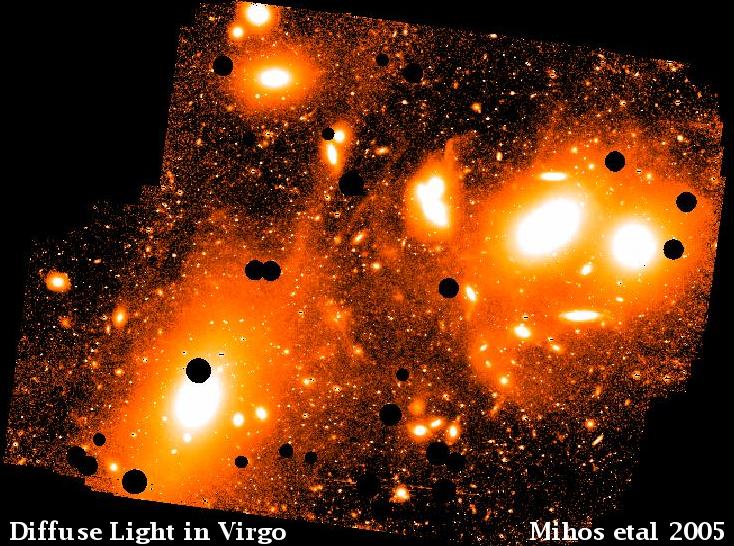
Cleveland OH (SPX) Sep 22, 2005 Case Western Reserve University astronomers have captured the deepest wide-field image ever of the nearby Virgo cluster of galaxies, directly revealing for the first time a vast, complex web of "intracluster starlight" - nearly 1,000 times fainter than the dark night sky - filling the space between the galaxies within the cluster. The streamers, plumes and cocoons that make up this extremely faint starlight are made of stars ripped out of galaxies as they collide with one another inside the cluster, and act as a sort of "archaeological record" of the violent lives of cluster galaxies. The Virgo image was captured through Case's newly refurbished 24-inch Burrell Schmidt telescope, built in the 1930s and located at the Kitt Peak National Observatory in Arizona. Over the course of 14 dark moonless nights, the researchers took more than 70 images of the Virgo Cluster, then used advanced image processing techniques to combine the individual images into a single image capable of showing the faint intracluster light. "When we saw all this very faint starlight in the image, my first reaction was WOW!," project leader Chris Mihos said. "Then I began to worry about all the things we could have done wrong." Many effects, such as stray light from nearby stars, from instruments in the observatory and even from the changing brightness of the night sky could all contaminate the image and lead to inaccurate results. "But as we corrected for each of these contaminants, not only did the faint starlight not disappear, it became even more apparent. That's when we knew we had something big." The new image gives dramatic evidence of the violent life and death of cluster galaxies. Drawn together into giant clusters over the course of cosmic time by their mutual gravity, galaxies careen around in the cluster, smashing into other galaxies, being stripped apart by gravitational forces and even being cannibalized by the massive galaxies which sit at the cluster's heart. The force of these encounters literally pulls many galaxies apart, leaving behind ghostly streams of stars adrift in the cluster, a faint tribute to the violence of cluster life. "From computer simulations, we've long suspected this web of intracluster starlight should be there," says Mihos, associate professor of astronomy at Case, "but it's been extremely hard to map it out because it's so faint." Mihos and graduate students Craig Rudick (Case) and Cameron McBride (University of Pittsburgh, and former Case undergraduate) have developed computer simulations that track how clusters of galaxies evolve over time, to study exactly how this intracluster starlight is created. "With the data from the telescope, we see how a cluster looks today," Mihos explains. "But with computer simulations, we can watch how a cluster evolves over 10 billion years of time. By comparing the simulation to the real features we now see in Virgo, we can learn how the cluster formed and what happened to its many galaxies." For example, the fact that the intracluster light in Virgo is so complex and irregular lends credence to the theory of "hierarchical assembly," where clusters grow sporadically when groups of galaxies fall into the cluster, rather than through the smooth, slow addition of galaxies one by one. To detect the faint intracluster light, upgrades were needed to Case's Burrell Schmidt telescope, originally part of the original Warner and Swasey Observatory in Cleveland until its move to Kitt Peak in 1979. The improvements included the installation of a new camera system and upgrades to the telescope to make it more structurally stable and reduce unwanted scattered light. "It's like 'The Little Engine that Could'," says Case astronomer Paul Harding, who directed the refurbishment of the telescope. "It's the smallest telescope on the mountain, but with these upgrades it's capable of some pretty incredible science." The telescope's wide field of view -- enough to fit three full moons across the image -- proved crucial to the project, allowing the team to map out the intracluster light over a much larger part of the Virgo Cluster than would be possible using larger telescopes with their much smaller fields of view. The Virgo Cluster of galaxies -- so named because it appears in the constellation of Virgo -- is the nearest galaxy cluster to the Earth, at a distance of approximately 50 million light years. The cluster contains more than 2,000 galaxies, the brightest of which can be seen with the aide of a small telescope. The Case findings are reported in the paper "Diffuse Light in the Virgo Cluster" to be published in the September 20th issue of The Astrophysical Journal Letters. Along with Mihos team researchers included Case astronomers Heather Morrison and Paul Harding, and John Feldmeier, a National Science Foundation Fellow at the National Optical Astronomy Observatory in Tucson, Ariz. (and formerly of Case). Related Links SpaceDaily Search SpaceDaily Subscribe To SpaceDaily Express  Double Star And Cluster Observe First Evidence Of Crustal Cracking
 Paris (ESA) Sep 22, 2005
On 27 December 2004, radiation from the biggest starquake on a neutron star ever recorded reached Earth. Unique data obtained by Double Star TC-2 and Cluster satellites enabled a group of European scientists to find the first observational evidence of cracks in the neutron star crust, during the initial phase of the starquake. |
|
|

| The content herein, unless otherwise known to be public domain, are Copyright 1995-2006 - SpaceDaily.AFP and UPI Wire Stories are copyright Agence France-Presse and United Press International. ESA PortalReports are copyright European Space Agency. All NASA sourced material is public domain. Additionalcopyrights may apply in whole or part to other bona fide parties. Advertising does not imply endorsement,agreement or approval of any opinions, statements or information provided by SpaceDaily on any Web page published or hosted by SpaceDaily. Privacy Statement |