
 Unexpected dynamics in Jupiter's upper atmosphere, or stratosphere, including the birth and motion of a dark vortex wider than Earth. Image credit: NASA/JPL/Southwest Research Institute. |
But the encounter with Jupiter, Saturn's gas-giant big brother, also gave the Cassini project a perfect lab for testing its instruments and evaluating its operations plans for its tour of the ringed planet, which began in 2004.
"The Jupiter flyby allowed the Cassini spacecraft to stretch its wings, rehearsing for its prime time show, orbiting Saturn," said Linda Spilker, Cassini project scientist based at NASA's Jet Propulsion Laboratory in Pasadena, Calif. "Ten years later, findings from the Jupiter flyby still continue to shape our understanding of similar processes in the Saturn system."
Cassini spent about six months - from October 2000 to March 2001 - exploring the Jupiter system. The closest approach brought Cassini to within about 9.7 million kilometers (6 million miles) of Jupiter's cloud tops at 2:05 a.m. Pacific Time, or 10:05 a.m. UTC, on Dec. 30, 2000.
Cassini captured some 26,000 images of Jupiter and its moons over six months of continual viewing, creating the most detailed global portrait of Jupiter yet.
While Cassini's images of Jupiter did not have higher resolution than the best from NASA's Voyager mission during its two 1979 flybys, Cassini's cameras had a wider color spectrum than those aboard Voyager, capturing wavelengths of radiation that could probe different heights in Jupiter's atmosphere.
The images enabled scientists to watch convective lightning storms evolve over time and helped them understand the heights and composition of these storms and the many clouds, hazes and other types of storms that blanket Jupiter.
The Cassini images also revealed a never-before-seen large, dark oval around 60 degrees north latitude that rivaled Jupiter's Great Red Spot in size. Like the Great Red Spot, the large oval was a giant storm on Jupiter. But, unlike the Great Red Spot, which has been stable for hundreds of years, the large oval showed itself to be quite transient, growing, moving sideways, developing a bright inner core, rotating and thinning over six months.
The oval was at high altitude and high latitude, so scientists think the oval may have been associated with Jupiter's powerful auroras.
The imaging team was also able to amass 70-day movies of storms forming, merging and moving near Jupiter's north pole. They showed how larger storms gained energy from swallowing smaller storms, the way big fish eat small fish. The movies also showed how the ordered flow of the eastward and westward jet streams in low latitudes gives way to a more disordered flow at high latitudes.
Meanwhile, Cassini's composite infrared spectrometer was able to do the first thorough mapping of Jupiter's temperature and atmospheric composition. The temperature maps enabled winds to be determined above the cloud tops, so scientists no longer had to rely on tracking features to measure winds.
The spectrometer data showed the unexpected presence of an intense equatorial eastward jet (roughly 140 meters per second, or 310 mph) high in the stratosphere, about 100 kilometers (60 miles) above the visible clouds.
Data from this instrument also led to the highest-resolution map so far of acetylene on Jupiter and the first detection of organic methyl radical and diacetylene in the auroral hot spots near Jupiter's north and south poles. These molecules are important to understanding the chemical interactions between sunlight and molecules in Jupiter's stratosphere.
As Cassini approached Jupiter, its radio and plasma wave instrument also recorded naturally occurring chirps created by electrons coming from a cosmic sonic boom. The boom occurs when supersonic solar wind - charged particles that fly off the sun - is slowed and deflected around the magnetic bubble surrounding Jupiter.
Because Cassini arrived at Jupiter while NASA's Galileo spacecraft was still orbiting the planet, scientists were also able to take advantage of near-simultaneous measurements from two different spacecraft.
This coincidence enabled scientists to make giant strides in understanding the interaction of the solar wind with Jupiter. Cassini and Galileo provided the first two-point measurement of the boundary of Jupiter's magnetic bubble and showed that it was in the act of contracting as a region of higher solar wind pressure blew on it.
"The Jupiter flyby benefited us in two ways, one being the unique science data we collected and the other the knowledge we gained about how to effectively operate this complex machine," said Bob Mitchell, Cassini program manager based at JPL.
"Today, 10 years later, our operations are still heavily influenced by that experience and it is serving us very well."
In celebrating the anniversary of Cassini's visit 10 years ago, scientists are also excited about the upcoming and proposed missions to the Jupiter system, including NASA's Juno spacecraft, to be launched next August, and the Europa Jupiter System Mission, which has been given a priority by NASA.
 del.icio.us del.icio.us |
 Digg Digg |
 Reddit Reddit |
 YahooMyWeb YahooMyWeb |
 Google Google |
 Facebook Facebook |

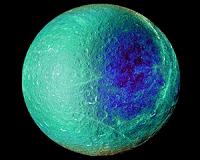 Cassini Marks Holidays With Dramatic Views Of Rhea
| The content herein, unless otherwise known to be public domain, are Copyright 1995-2010 - SpaceDaily. AFP and UPI Wire Stories are copyright Agence France-Presse and United Press International. ESA Portal Reports are copyright European Space Agency. All NASA sourced material is public domain. Additional copyrights may apply in whole or part to other bona fide parties. Advertising does not imply endorsement,agreement or approval of any opinions, statements or information provided by SpaceDaily on any Web page published or hosted by SpaceDaily. Privacy Statement |


