|
 |
 |
 |
 |
 |
 |
 |
 |
 |

| . |  |
. |
Cassini Detects Backward Electrons On Saturn
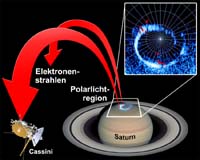
Katlenburg-Lindau, Germany (SPX) March 8, 2006 An international research team has discovered electrons in Saturn's magetic field that are accelerating backwards - moving away from the ringed planet instead of toward it. The team, led by Joachim Saur at the University of Cologne, found the anti-planetary electrons, as they are called, using the instruments on NASA's Cassini spacecraft, including the Low Energy Magnetospheric Measurement System, or LEMMS. Cassini's rotation helped the researchers determine the direction, number and strength of the electrons. They compared the results with recordings of the auroras in the polar region and a global model of Saturn's magnetic field. They found that the weakest auroras, or their absence, matched up very well with the lowest point of the magnetic field lines in which electron rays were measured. Auroras occur on Earth when electrons above the atmosphere accelerate downward toward the poles. They emit visible light - usually vivid shades of red, green, blue and yellow - when they hit the planet's upper atmosphere. Some years ago, scientists discovered that some electrons in the polar region accelerate away from Earth - or backwards. These anti-planetary electrons do not cause the sky to light up, and scientists have been puzzled about how they originate. Until recently it also has been unclear whether anti-planetary electrons occur elsewhere in the solar system. They have been discovered in Jupiter's powerful magnetic field, and now Saur's team has discovered them on Saturn. The backward electrons tend to be strongly focused, with an angle of beam spread less than 10 degrees, so the researchers were able to determine the location of their source: somewhere above the polar region, but inside a maximum distance of five radii of Saturn. Because the electron beams have been measured on Earth, Jupiter and Saturn, and because they display similar characteristics, scientists now think they must share some fundamental underlying process - something that must be researched further. Team members Norbert Krupp, and colleagues Andreas Lagg and Elias Roussos at the Max Planck Institute for Solar System Research in Katlenburg-Lindau, worked closely with scientists from the Institute for Geophysics and Meteorology at the University of Cologne, and the Applied Physics Laboratory of Johns Hopkins University in Baltimore. The APS team, led by Tom Krimigis, service and coordinate the LEMMS on Cassini. Related Links Cassini at JPL Cassini Image Team  Cassini Images Saturns Sharp Edged G Ring
 Pasadena, Calif. (SPX) March 8, 2006
This contrast-enhanced view of Saturn's faint G ring shows its extremely sharp inner edge and more diffuse outer boundary. Using its large high-gain antenna as a shield, the Cassini spacecraft flew through the region interior to the G ring during its latest flyby of the planet. |
|
|

| The content herein, unless otherwise known to be public domain, are Copyright 1995-2006 - SpaceDaily.AFP and UPI Wire Stories are copyright Agence France-Presse and United Press International. ESA PortalReports are copyright European Space Agency. All NASA sourced material is public domain. Additionalcopyrights may apply in whole or part to other bona fide parties. Advertising does not imply endorsement,agreement or approval of any opinions, statements or information provided by SpaceDaily on any Web page published or hosted by SpaceDaily. Privacy Statement |