|
 |
 |
 |
 |
 |
 |
 |
 |
 |

| . |  |
. |
Cassini Scientists Wring Out The Details On Spongy Hyperion
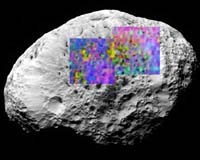
Boulder CO (SPX) Jul 10, 2007 Scientists on NASA's Cassini mission to Saturn now have a better understanding of why the odd moon Hyperion has such an unusual appearance. The crucial factor in creating the strange, sponge-like appearance of Hyperion appears to be its extremely low density, say Cassini scientists in a research paper being published in the July 5 issue of the journal Nature. The researchers examined Cassini spacecraft images and other data on the moon's mass acquired during encounters with Hyperion over the past three years. Hyperion is covered by a large number of medium-sized, well-preserved craters. "Careful mapping of features showed that its bizarre appearance probably results from a convergence of rather routine effects," said Dr. Peter Thomas, a Cassini Imaging Team member working at Cornell University in Ithaca, New York. Cassini's closest encounter with Hyperion, in September 2005, allowed accurate measurement of the moon's mass and size, which showed it is only slightly more than half as dense as water. "The close flyby produced a tiny but measurable deflection of Cassini's orbit. Therefore, the orbit determination, carried out by our Italian colleagues, allowed us to estimate the mass with fairly good accuracy," said Cassini radio science deputy team leader Nicole Rappaport of the Jet Propulsion Laboratory in Pasadena, Calif. "Combined with the determination of Hyperion's volume from imaging data, this provided an accurate computation of its density." Initial conjectures about the origin of Hyperion's strange surface invoked dark materials accumulating on crater floors that subsequently got warmed by sunlight and melted deeper into the surface. However, the new analyses have shown that the moon's low density, and therefore low surface gravity, may cause craters to form differently from those on other, denser bodies that have been explored in the Solar System. According to the researchers, impactors smacking into Hyperion's porous outer layers form craters more by compressing the surface than by blasting out material, as they do on denser bodies. Additionally, the moon's low gravity means that any material ejected from craters on Hyperion has a good chance of escaping completely and not re-impacting the surface, making Hyperion's craters look sharper and less blanketed by debris than on other bodies. These new results about Hyperion's craters accompany another paper in the same journal issue which details the moon's composition. Both are important to understanding this unique moon's history and evolution. "With time, we are coming to understand the various planetary processes that shape the bodies in our solar system," said imaging team leader Carolyn Porco. "And this latest work on Hyperion is a beautiful demonstration of that." Community Email This Article Comment On This Article Related Links Cassini at JPL Cassini images Explore The Ring World of Saturn and her moons Jupiter and its Moons The million outer planets of a star called Sol News Flash at Mercury
 Cassini Finds Saturn Moons Are Active
 Pasadena CA (JPL) Jun 15, 2007
Saturn's moons Tethys and Dione are flinging great streams of particles into space, according to data from the Cassini mission to Saturn. The discovery suggests the possibility of some sort of geological activity, perhaps even volcanic, on these icy worlds. |
|
|

| The content herein, unless otherwise known to be public domain, are Copyright 1995-2006 - SpaceDaily.AFP and UPI Wire Stories are copyright Agence France-Presse and United Press International. ESA PortalReports are copyright European Space Agency. All NASA sourced material is public domain. Additionalcopyrights may apply in whole or part to other bona fide parties. Advertising does not imply endorsement,agreement or approval of any opinions, statements or information provided by SpaceDaily on any Web page published or hosted by SpaceDaily. Privacy Statement |