|
 |
 |
 |
 |
 |
 |
 |
 |
 |

| . |  |
. |
Cassini Tastes Organic Material At Saturn's Geyser Moon
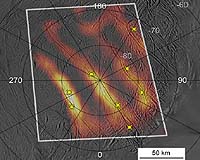
Pasadena CA (SPX) Mar 27, 2008 NASA's Cassini spacecraft tasted and sampled a surprising organic brew erupting in geyser-like fashion from Saturn's moon Enceladus during a close flyby on March 12. Scientists are amazed that this tiny moon is so active, "hot" and brimming with water vapor and organic chemicals. New heat maps of the surface show higher temperatures than previously known in the south polar region, with hot tracks running the length of giant fissures. Additionally, scientists say the organics "taste and smell" like some of those found in a comet. The jets themselves harmlessly peppered Cassini, exerting measurable torque on the spacecraft, and providing an indirect measure of the plume density. "A completely unexpected surprise is that the chemistry of Enceladus, what's coming out from inside, resembles that of a comet," said Hunter Waite, principal investigator for the Cassini Ion and Neutral Mass Spectrometer at the Southwest Research Institute in San Antonio. "To have primordial material coming out from inside a Saturn moon raises many questions on the formation of the Saturn system." "Enceladus is by no means a comet. Comets have tails and orbit the sun, and Enceladus' activity is powered by internal heat while comet activity is powered by sunlight. Enceladus' brew is like carbonated water with an essence of natural gas," said Waite. The Ion and Neutral Mass Spectrometer saw a much higher density of volatile gases, water vapor, carbon dioxide and carbon monoxide, as well as organic materials, some 20 times denser than expected. This dramatic increase in density was evident as the spacecraft flew over the area of the plumes. New high-resolution heat maps of the south pole by Cassini's Composite Infrared Spectrometer show that the so-called tiger stripes, giant fissures that are the source of the geysers, are warm along almost their entire lengths, and reveal other warm fissures nearby. These more precise new measurements reveal temperatures of at least minus 93 degrees Celsius (minus 135 Fahrenheit.) That is 17 degrees Celsius (63 degrees Fahrenheit) warmer than previously seen and 93 degrees Celsius (200 degrees Fahrenheit) warmer than other regions of the moon. The warmest regions along the tiger stripes correspond to two of the jet locations seen in Cassini images. "These spectacular new data will really help us understand what powers the geysers. The surprisingly high temperatures make it more likely that there's liquid water not far below the surface," said John Spencer, Cassini scientist on the Composite Infrared Spectrometer team at the Southwest Research Institute in Boulder, Colo. Previous ultraviolet observations showed four jet sources, matching the locations of the plumes seen in previous images. This indicates that gas in the plume blasts off the surface into space, blending to form the larger plume. Images from previous observations show individual jets and mark places from which they emanate. New images show how hot spot fractures are related to other surface features. In future imaging observations, scientists hope to see individual plume sources and investigate differences among fractures. "Enceladus has got warmth, water and organic chemicals, some of the essential building blocks needed for life," said Dennis Matson, Cassini project scientist at NASA's Jet Propulsion Laboratory in Pasadena, Calif. "We have quite a recipe for life on our hands, but we have yet to find the final ingredient, liquid water, but Enceladus is only whetting our appetites for more." At closest approach, Cassini was only 30 miles from Enceladus. When it flew through the plumes it was 120 miles from the moon's surface. Cassini's next flyby of Enceladus is in August. Community Email This Article Comment On This Article Related Links Cassini The Chinese Space Program - News, Policy and Technology China News from SinoDaily.com
 Brazil To Deepen Space Cooperation With China
 Brasilia, Brazil (XNA) Mar 27, 2008
The newly sworn-in head of the Brazilian Space Agency (BSA) Carlos Ganem said Tuesday that Brazil cherishes the ties with China and will deepen cooperation with China in the field of space technology. Ganem made the remarks during his inauguration ceremony. A technical expert who engaged in the first negotiations on the China-Brazil satellite cooperation program, he said the project is an excellent example of bilateral cooperation. |
|
|

| The content herein, unless otherwise known to be public domain, are Copyright 1995-2007 - SpaceDaily.AFP and UPI Wire Stories are copyright Agence France-Presse and United Press International. ESA Portal Reports are copyright European Space Agency. All NASA sourced material is public domain. Additional copyrights may apply in whole or part to other bona fide parties. Advertising does not imply endorsement,agreement or approval of any opinions, statements or information provided by SpaceDaily on any Web page published or hosted by SpaceDaily. Privacy Statement |