
 |
 |
 |
 |
 |
 |
 |
 |
 |
 |

| . |  |
. |

Sydney, Australia (SPX) Aug 31, 2010 Every year, the world is treated to several well-known meteor showers. The Leonids, Draconids, Perseids and others usually get mentioned in the mainstream media, giving the general public a taste of just how much material flies at our planet from space. The predictable, regular showers are produced by debris from the tails of comets, and astronomers have been able to link certain events to comets that can even be seen today. A meteor shower is a delight to astronomers and the public. We've built up a lot of legend and love for these "shooting stars", which some people even consider to be lucky. Never mind that if a falling object from space is too large, it can be anything but lucky for those on the ground! Most of the material that falls during a meteor shower is obliterated. It starts as small chunks of rock, and burns up in the atmosphere. Sometimes, small traces of fine dust end up suspended in the upper atmosphere. This presents a great opportunity for scientists to collect it. High-altitude aircraft, such as the legendary U-2 spy plane, have been modified to perform dust collection. Sample collection panels are deployed from the aircraft as it flies through the atmosphere, in the general area where a meteor shower has just taken place. Not much material is obtained this way, but it's cheaper than trying to go out and get this material in deep space. More distant retrievals of cometary material have also been tried. The NASA Stardust mission flew closely to a comet and snared tiny particles from its tail. The spacecraft returned the samples to Earth inside a small capsule. There's one intermediate step between the atmosphere and deep space that hasn't been used for sampling cometary dust. It involves trying to snare the particles in near-Earth space. Sounding rockets are often used to send small instruments above the atmosphere for short periods. They are cheaper than satellite launches and produce useful data. A sounding rocket could, in theory, be sent on a mission to fly-swat a sample of stardust. The sample could be cached inside a protective capsule and parachuted to the ground. In principle, such a mission would be difficult. The time of flight, and trajectory, would offer little chance of intercepting many particles, assuming any were caught at all. The apparatus needed to collect and safely return the samples would also be complex, and possibly difficult to place aboard a small sounding rocket. Fortunately, a new means of carrying out such a mission will soon be upon us. Manned suborbital spacecraft will make their commercial debut in the years ahead. These vehicles are mainly being targeted at space tourists, and hundreds of people have already signed up to write them. But the scientific community is ready to use them, too. The spacecraft will offer exposure to microgravity for several minutes at a price much lower than a flight to the International Space Station. Scientists are already undergoing astronaut training to fly on these vehicles and perform experiments. Atmospheric studies have often been mentioned as one broad area for experimentation on these flights. But the spacecraft could also be used to collect samples of dust in the upper atmosphere, and even outside it. It would require modifications of certain outside components, and a lot of nerve to fly through a meteor shower, but it could be done. Greater risks have been taken before with human spaceflight. In the event of a serious problem, gravity will pull the spacecraft quickly back to Earth, and the crew could even eject on some vehicles. Some would point to the risk of damaging a spacecraft's thermal protection system, or heatshield, as being a source of major risk. Changing the orientation of a spacecraft during its flight to protect the most sensitive areas could allow this problem to be reduced. Not every vehicle currently being proposed would be suitable for such a mission, but it could be achieved with some. One modified mission could see small suborbital sample rocket launched from a suborbital spacecraft, or from a carrier aircraft that normally carries a tourist spacecraft. With so many new plans being drawn for this new era of cheaper access to space, it's worth examining the possibilities of sample collection along with all the other tasks we can perform. Dr Morris Jones is an Australian space analyst and writer. Email morisjonesNOSPAMhotmail.com. Replace NOSPAM with @ to send email.
Share This Article With Planet Earth
Related Links - Asteroid and Comet Impact Danger To Earth - News and Science

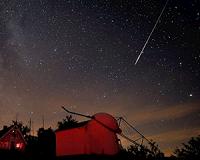 Perseid Meteors Return: Viewing Conditions Excellent
Palm Coast FL (SPX) Aug 10, 2010 The Perseid meteor shower, an annual celestial event beloved by millions of skywatchers around the world, returns to the night sky this week. And because the Moon is new, there will be no moonlight to hinder the view. Sky and Telescope magazine predicts that the Perseid shower will be at or near its peak late on Wednesday night (the night of August 11-12) and, probably even better, late on ... read more |
|
|
| The content herein, unless otherwise known to be public domain, are Copyright 1995-2010 - SpaceDaily. AFP and UPI Wire Stories are copyright Agence France-Presse and United Press International. ESA Portal Reports are copyright European Space Agency. All NASA sourced material is public domain. Additional copyrights may apply in whole or part to other bona fide parties. Advertising does not imply endorsement,agreement or approval of any opinions, statements or information provided by SpaceDaily on any Web page published or hosted by SpaceDaily. Privacy Statement |


 del.icio.us
 Digg
Digg Reddit
 YahooMyWeb
 Google
 Facebook


