
Subscribe free to our newsletters via your
. Military Space News .


FARM NEWS
Cattle flatulence doesn't stink with biotechnology
by Staff Writers
Washington DC (SPX) Jul 04, 2013


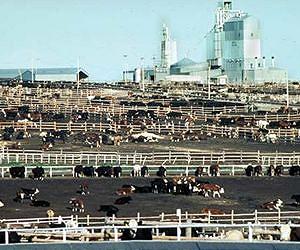
Biogas recovery systems are used in processing facilities to produce energy from animal waste. Animal waste is collected in lagoons, where the gas is captured. The gas is transported through an internal combustion area that produces energy for heat and electricity.

The agriculture industry is researching new technologies to help feed the growing population. But feeding the world without harming air quality is a challenge. According to a new article in Animal Frontiers, biotechnologies increase food production and reduce harmful gas output from cattle.

"We are increasing the amount of product with same input," said Clayton Neumeier, PhD student at University of California, Davis, in an interview.

In the Animal Frontiers paper, Neumeier describes a recent experiment using biotechnologies. In the experiment, a test group of cattle were treated with biotechnologies. Different groups of cattle received implants, Ionophores and Beta-adrenergic agonists. These biotechnologies help cattle grow more efficiently. A control group of cattle were not treated with any of these biotechnologies.

Researchers measured gas output by placing finishing steers in a special corral that traps emissions. Each treatment group was tested four times to ensure accurate results.

The researchers also tested a dairy biotechnology called rBST. This biotechnology is a synthetic version of a cattle hormone that does not affect humans. Many producers inject cows with rBST to help them produce more milk.

In their experiment, the researchers gave rBST to a test group of cows and gave no rBST to a control group of cows. They discovered that the rBST group produced more milk per cow. When cows produce more milk, greenhouse gas emissions decrease because farms need fewer cows.

Dr. Kim Stackhouse, National Cattleman's Beef Association Director of Sustainability, said animal agriculture has reduced emissions through the use of technologies. Technologies that improve animal performance, crop yields, and manure management and the installation of biogas recovery systems have all contributed to reducing the environmental impact of beef.

Biogas recovery systems are used in processing facilities to produce energy from animal waste. Animal waste is collected in lagoons, where the gas is captured. The gas is transported through an internal combustion area that produces energy for heat and electricity.

"I expect there to be more improvement as we continue be more efficient, continue to do more with less and also strive to find new improvement opportunities," Stackhouse said.

Some consumers do not like the use of biotechnology in food production. Neumeier thinks these consumers are unaware of the benefits of biotechnology. His research shows that biotechnology can produce more food and lower gas emissions.

"We need to inform them that these are valuable tools for those two reasons and not be turned off by the use of biotechnology," Neumeier said.

This article is titled "Cattle biotechnologies reduce environmental impact and help feed a growing planet."

.


Related Links
American Society of Animal Science
Farming Today - Suppliers and Technology


Comment on this article via your Facebook, Yahoo, AOL, Hotmail login.

Share this article via these popular social media networks
del.icio.usdel.icio.us DiggDigg RedditReddit GoogleGoogle


FARM NEWS
Insecticide causes changes in honeybee genes
Nottingham, UK (SPX) Jul 03, 2013
New research by academics at The University of Nottingham has shown that exposure to a neonicotinoid insecticide causes changes to the genes of the honeybee. The study, published in the scientific journal PLOS ONE, supports the recent decision taken by the European Commission to temporarily ban three neonicotinoids amid concerns that they could be linked to bee deaths. There is growi ... read more


FARM NEWS
U.S. space-based missile alert system moves forward

Lockheed Martin Delivers Third SBIRS HEO Satellite Payload To USAF

Israel gets sixth Iron Dome, awaits David's Sling

Raytheon awarded contract to keep Patriot capabilities ahead of evolving threats

FARM NEWS
Raytheon delivers first NASAMS High Mobility Launcher to Norway

BAE tests cost-saving multiservice guided projectile

U.S. seeks to buy into Israeli missile programs

Enhanced Paveway II provides improved capability, performance

FARM NEWS
US drone strike kills 17 in Pakistan: officials

Lockheed Martin Demonstrates Management of Varied Unmanned Air Vehicles from One Integrated Control System

France seeks $1.5B MQ-9 Reaper deal

UAV interest grows in Middle East, but suppliers few

FARM NEWS
Canada links up on secure U.S. military telecoms network

Lockheed Martin-Built MUOS Satellite Encapsulated In Launch Vehicle Payload Fairing

Northrop Grumman, MILSATCOM Conduct Preliminary Design Review of Enhanced Polar System Control and Planning Segment

Mutualink Unveils Man-Portable Multimedia Interoperable Ops Fusion Kit with Secure Tactical 4G LTE Bubble Capability

FARM NEWS
Northrop Grumman's Innovative Logistics Solutions Deliver Greater Affordability, Higher Mission Readiness for Global Customers

Lockheed to build technology hub in Israel

Hints of 'messy quagmire' over Israeli arms sales

Kalashnikov to be airlifted to Moscow in new health scare

FARM NEWS
Israel seeks $5B in U.S. loans to buy arms

Finland charges three with bribery in Croatian arms deal

Lakota sale to Thailand gets green light

German cabinet approves 2013, 2014 budget plans

FARM NEWS
India's defence minister in first trip to China in 7 years

Philippines accuses China of military buildup at sea

US nudges China on sea disputes

Chinese media warns of 'counterstrike' in disputed Sea

FARM NEWS
Efficient Production Process for Coveted Nanocrystals

Ingested nanoparticle toxicity

Quantum engines must break down

Nanotechnology holds big potential for NMSU faculty


The content herein, unless otherwise known to be public domain, are Copyright 1995-2014 - Space Media Network. AFP, UPI and IANS news wire stories are copyright Agence France-Presse, United Press International and Indo-Asia News Service. ESA Portal Reports are copyright European Space Agency. All NASA sourced material is public domain. Additional copyrights may apply in whole or part to other bona fide parties. Advertising does not imply endorsement,agreement or approval of any opinions, statements or information provided by Space Media Network on any Web page published or hosted by Space Media Network. Privacy Statement