|
 |
 |
 |
 |
 |
 |
 |
 |
 |

| . |  |
. |

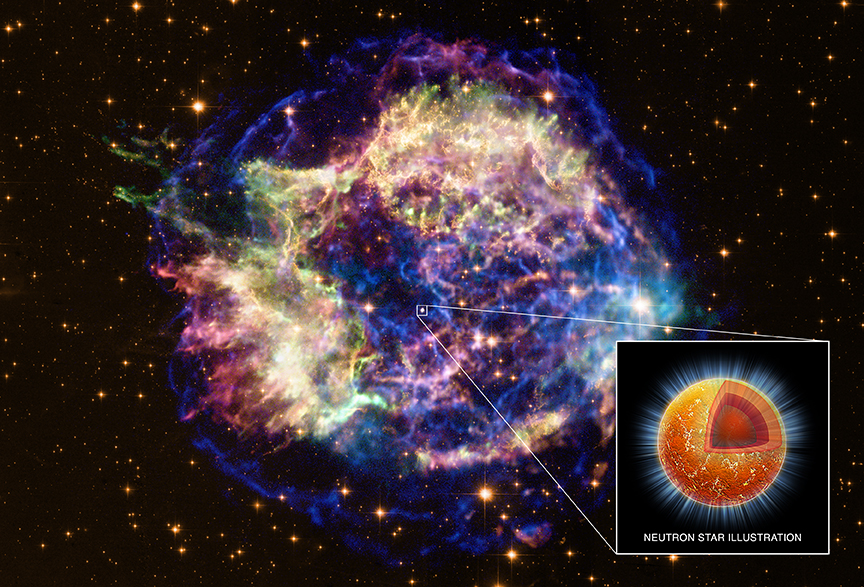
Boston MA (SPX) Feb 24, 2011 NASA's Chandra X-ray Observatory has discovered the first direct evidence for a superfluid, a bizarre, friction-free state of matter, at the core of a neutron star. Superfluids created in laboratories on Earth exhibit remarkable properties, such as the ability to climb upward and escape airtight containers. The finding has important implications for understanding nuclear interactions in matter at the highest known densities. Neutron stars contain the densest known matter that is directly observable. One teaspoon of neutron star material weighs six billion tons. The pressure in the star's core is so high that most of the charged particles, electrons and protons, merge resulting in a star composed mostly of uncharged particles called neutrons. Two independent research teams studied the supernova remnant Cassiopeia A, or Cas A for short, the remains of a massive star 11,000 light-years away that would have appeared to explode about 330 years ago as observed from Earth. Chandra data found a rapid decline in the temperature of the ultradense neutron star that remained after the supernova, showing that it had cooled by about four percent over a 10-year period. "This drop in temperature, although it sounds small, was really dramatic and surprising to see," said Dany Page of the National Autonomous University in Mexico, leader of a team with a paper published in the February 25, 2011 issue of the journal Physical Review Letters. "This means that something unusual is happening within this neutron star." Superfluids containing charged particles are also superconductors, meaning they act as perfect electrical conductors and never lose energy. The new results strongly suggest that the remaining protons in the star's core are in a superfluid state and, because they carry a charge, also form a superconductor. "The rapid cooling in Cas A's neutron star, seen with Chandra, is the first direct evidence that the cores of these neutron stars are, in fact, made of superfluid and superconducting material," said Peter Shternin of the Ioffe Institute in St. Petersburg, Russia, leader of a team with a paper accepted in the journal Monthly Notices of the Royal Astronomical Society. Both teams show that this rapid cooling is explained by the formation of a neutron superfluid in the core of the neutron star within about the last 100 years as seen from Earth. The rapid cooling is expected to continue for a few decades and then it should slow down. "It turns out that Cas A may be a gift from the Universe because we would have to catch a very young neutron star at just the right point in time," said Page's co-author Madappa Prakash, from Ohio University. "Sometimes a little good fortune can go a long way in science." The onset of superfluidity in materials on Earth occurs at extremely low temperatures near absolute zero, but in neutron stars, it can occur at temperatures near a billion degrees Celsius. Until now there was a very large uncertainty in estimates of this critical temperature. This new research constrains the critical temperature to between one half a billion to just under a billion degrees. Cas A will allow researchers to test models of how the strong nuclear force, which binds subatomic particles, behaves in ultradense matter. These results are also important for understanding a range of behavior in neutron stars, including "glitches," neutron star precession and pulsation, magnetar outbursts and the evolution of neutron star magnetic fields. Small sudden changes in the spin rate of rotating neutron stars, called glitches, have previously given evidence for superfluid neutrons in the crust of a neutron star, where densities are much lower than seen in the core of the star. This latest news from Cas A unveils new information about the ultradense inner region of the neutron star. "Previously we had no idea how extended superconductivity of protons was in a neutron star," said Shternin's co-author Dmitry Yakovlev, also from the Ioffe Institute. The cooling in the Cas A neutron star was first discovered by co-author Craig Heinke, from the University of Alberta, Canada, and Wynn Ho from the University of Southampton, UK, in 2010. It was the first time that astronomers have measured the rate of cooling of a young neutron star. Page's co-authors were Prakash, James Lattimer (State University of New York at Stony Brook), and Andrew Steiner (Michigan State University.) Shternin's co-authors were Yakovlev, Heinke, Ho, and Daniel Patnaude (Harvard-Smithsonian Center for Astrophysics.)
Share This Article With Planet Earth
Related Links Chandra at Harvard Chandra at NASA Stellar Chemistry, The Universe And All Within It

 Herschel Finds Less Dark Matter But More Stars
Paris, France (ESA) Feb 22, 2011 ESA's Herschel space observatory has discovered a population of dust-enshrouded galaxies that do not need as much dark matter as previously thought to collect gas and burst into star formation The galaxies are far away and each boasts some 300 billion times the mass of the Sun. The size challenges current theory that predicts a galaxy has to be more than ten times larger, 5000 billion sola ... read more |
|
|
| The content herein, unless otherwise known to be public domain, are Copyright 1995-2010 - SpaceDaily. AFP and UPI Wire Stories are copyright Agence France-Presse and United Press International. ESA Portal Reports are copyright European Space Agency. All NASA sourced material is public domain. Additional copyrights may apply in whole or part to other bona fide parties. Advertising does not imply endorsement,agreement or approval of any opinions, statements or information provided by SpaceDaily on any Web page published or hosted by SpaceDaily. Privacy Statement |


 del.icio.us
 Digg
Digg Reddit
 YahooMyWeb
 Google
 Facebook