|
 |
 |
 |
 |
 |
 |
 |
 |
 |

| . |  |
. |
Chaos Theory Explains Origin Of New Moons
Bristol - May 19, 2003 The ability to understand how small bodies such as moons switch from orbiting the Sun to orbiting a planet has long remained one of the outstanding problems of planetary science. A paper published in Nature on 15 May shows how this problem has been resolved using chaos theory, enabling scientists to predict where astronomers might search for new moons orbiting the giant planets. In the last couple of years many small moons have been found orbiting the giant planets in our Solar System. For example, Jupiter now has 60 moons in total and Saturn more than 30. Astronomers believe that understanding the nature of these moons can reveal important clues about the early history of the planets. Such insights into understanding our own Solar System will help us understand how other solar systems came into being, and whether they might be favourable to life. The moons can be divided into two groups - regular and irregular. Regular moons have a roughly circular orbit around their planet and are believed to have been formed there during the early history of the Solar System. Irregular moons have an orbit that is highly elliptical, orbiting the planet at a distance of many millions of miles. These are believed to have originally encircled the Sun and to have been subsequently 'captured' by the planet they now orbit. The discovery of these new moons has shaken our cherished ways of understanding our Solar System. In particular, the problem of satellite capture - the mechanism by which bodies switch from an orbit around the Sun to an orbit around the planet - remained outstanding. Secondary to this was the problem of why some moons have prograde orbits - revolving in the same direction as the planet - while the vast majority have retrograde orbits. Stephen Wiggins and Andrew Burbanks, mathematicians at Bristol University, along with David Farrelly and Sergey Astakhov, theoretical chemists at Utah State University, were using chaos theory to understand the mechanics of chemical reactions. They realised that the approach they had been using in chemistry might also be applied to the problem of 'capture'. Furthermore, they thought that if they could solve the capture problem it might give them some insight into their chemistry problems. Stephen Wiggins said: "When we started to look at the capture of irregular moons what we found was that no-one else was trying to understand this problem in three dimensions using chaos theory. Most work was focused on understanding the behaviour of these moons after they had been captured. So in an attempt to understand how a body orbiting the Sun could be brought in to an orbit around one of the giant planets we simulated the 'switching' mechanism. We found that it was chaos that allowed the capture process to take place." Using the mathematical equations they developed to explain the capture mechanism, the Bristol and Utah research groups present an explanation which not only agrees well with the observed locations of the known irregular moons, but also predicts new regions where moons could be located. The ability to predict where new moons might be found should make life much easier for astronomers who face the daunting task of searching huge regions of space for them. The joint UK/US research team also showed that the moons initially captured into prograde orbits of moons are not only chaotic, but that they have a tendency to approach the region very close to the planet. This means that they have a greater chance of being eliminated by collisions with the inner giant moons or the planet, thereby explaining the far larger number of retrograde moons, especially around Jupiter. This work shows that chaos-assisted capture may be a necessary, and quite general, predecessor of certain types of orderly and stable satellite orbits. Related Links Bristol University SpaceDaily Search SpaceDaily Subscribe To SpaceDaily Express  Reaching For The Asteroids
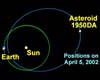 Armagh - Apr 22, 2003
Humans hopping over the surface of asteroids. Extraction of minerals from Earth-grazing chunks of rock. Sounds like science fiction, but scientists are already looking ahead and trying to identify the nearest objects whose resources may be exploited by future entrepreneurs. |
|
|

| The content herein, unless otherwise known to be public domain, are Copyright 1995-2006 - SpaceDaily.AFP and UPI Wire Stories are copyright Agence France-Presse and United Press International. ESA PortalReports are copyright European Space Agency. All NASA sourced material is public domain. Additionalcopyrights may apply in whole or part to other bona fide parties. Advertising does not imply endorsement,agreement or approval of any opinions, statements or information provided by SpaceDaily on any Web page published or hosted by SpaceDaily. Privacy Statement |