|
 |
 |
 |
 |
 |
 |
 |
 |
 |

| . |  |
. |
Checking Out New Horizons
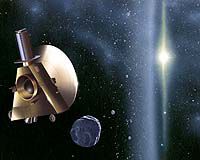
Principal Investigator New Horizons Washington DC (SPX) Oct 16, 2007 Since I last wrote here, at the start of August, New Horizons has already traveled another 100 million kilometers from the Sun, putting us more than 7.5 Astronomical Units out, roughly halfway between Jupiter and Saturn. By the middle of next year, we'll be beyond Saturn's orbit, where Cassini is. That will make New Horizons the farthest spacecraft on its way to or at its target. As New Horizons continues to journey across the great abyss of the outer solar system, we on the science and operations teams continue our work. In the past two months, this small squad has accomplished a great deal. Major events and accomplishments have included completing the planning for the first of the mission's annual spacecraft checkouts (ACO-1). These ACOs are our opportunity each year to test spacecraft systems, calibrate instruments, take cruise science data, and make course corrections, as necessary. Suffering a spacecraft prime Command and Data Handling (C and DH) computer reset on Aug. 4. Our mission ops team learned of this event by receiving a "red 2" beacon tone from the spacecraft, which triggered them into an intense three days of activity to diagnose the problem, recover the spacecraft, and return it to hibernation after determining that the reset posed no immediate danger to the mission. Taking precautions based on two shutdowns of our SWAP solar wind instrument during the Jupiter magnetotail exploration earlier this year. These precautions center on keeping SWAP turned off in our first annual checkout while a ground replica is built and tested to ensure we go forward with SWAP operations in ACO-2 and thereafter understanding what caused these shutdowns and how to avoid them in the future. Initiating ACO-1 on Aug. 16. It will continue until Nov. 16. Conducting our first trajectory correction since March 2006 - not long after launch. This 15-minute, 5-mile per hour tweak to our course occurred at 1900 UT on Sept. 27 and it went without a hitch. Our trajectory is now so close to perfect that we don't expect to have to do another course correction for three to six years! Beginning a series of instrument annual checkouts, instrument calibrations, a few final instrument commissioning (i.e., first-time checkout) activities, and cruise science. Cruise science occurring in ACO-1 includes PEPSSI measurements of the energetic particle environment between Jupiter and Saturn; imaging by Ralph and LORRI to obtain phase-curve information about Uranus, Neptune and Pluto that cannot be obtained from Earth; and, of course, interplanetary dust environment measurements by the Venetia Burney Student Dust Counter. Conducting a science team meeting in early September at Lowell Observatory in Flagstaff, Arizona, where Pluto was discovered. Appointing mission co-investigator Dr. Cathy Olkin of Southwest Research Institute to succeed Dr. Fran Bagenal as our science team Education and Public Outreach lead. After much analysis of alternatives, reaching a final decision on our Pluto aim point closest-approach distance. This decision will be ratified by the entire science team in mid-October and then publicly revealed. (Stay tuned!) Continuing to build our second ground system spacecraft simulator ("NHOPS 2"), which will be operational after a thorough series of tests by May 2008. Putting in place an ambitious plan to architect, design, and then code our detailed Pluto system encounter sequence in 2008 with a first rehearsal in 2009. And, making a series of decisions on what onboard flight software modifications are needed for the Pluto encounter, based on our bank of real-world encounter experience gained at Jupiter. We've identified about a dozen necessary software upgrades in either our C and DH or Guidance and Control (G&C) flight software. These will be uplinked to the spacecraft in late 2008 during ACO-2. So, as you can see, although New Horizons is sleeping much of the time, its ground team is not! In fact, the pace of activity is intense and will remain so until we complete our first encounter rehearsal on the spacecraft in 2009. In the next month, major activities will include more than 50 instrument and spacecraft checkouts, an update to our onboard fault detection and correction (autonomy) software code, the kickoff of Pluto far encounter planning, and the start of software design for the new C and DH and G&C software loads previously described. Keep an eye out for a Jupiter results press conference from the American Astronomical Society's Division of Planetary Sciences meeting on Oct. 9, followed by a special issue of Science magazine that week with a series of technical reports (and the cover itself) about the significant findings already gleaned from our Jupiter encounter results. Well, that catches you up with where New Horizons is and what the spacecraft and project teams have been doing. I'll be back with more news in November, as we transition back to hibernation. In the meantime, keep on exploring, just as we do! Community Email This Article Comment On This Article Related Links New Horizons The million outer planets of a star called Sol
 Pluto-Bound New Horizons Sees Changes In Jupiter System
 Laurel MD (SPX) Oct 10, 2007
The voyage of NASA's Pluto-bound New Horizons spacecraft through the Jupiter system earlier this year provided a bird's-eye view of a dynamic planet that has changed since the last close-up looks by NASA spacecraft. New Horizons passed Jupiter on Feb. 28, riding the planet's gravity to boost its speed and shave three years off its trip to Pluto. |
|
|

| The content herein, unless otherwise known to be public domain, are Copyright 1995-2006 - SpaceDaily.AFP and UPI Wire Stories are copyright Agence France-Presse and United Press International. ESA PortalReports are copyright European Space Agency. All NASA sourced material is public domain. Additionalcopyrights may apply in whole or part to other bona fide parties. Advertising does not imply endorsement,agreement or approval of any opinions, statements or information provided by SpaceDaily on any Web page published or hosted by SpaceDaily. Privacy Statement |