|
 |
 |
 |
 |
 |
 |
 |
 |
 |

| . |  |
. |
Chemical Composition Of Stars In Clusters Can Tell History Of Our Galaxy
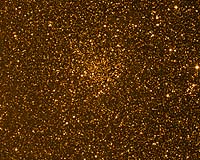
Paris, France (SPX) Mar 27, 2007 Using ESO's Very Large Telescope, an international team of astronomers has shown how to use the chemical composition of stars in clusters to shed light on the formation of our Milky Way. This discovery is a fundamental test for the development of a new chemical tagging technique uncovering the birth and growth of our Galactic cradle. The formation and evolution of galaxies, and in particular of the Milky Way - the 'island universe' in which we live, is one of the major puzzles of astrophysics: indeed, a detailed physical scenario is still missing and its understanding requires the joint effort of observations, theories and complex numerical simulations. ESO astronomer Gayandhi De Silva and her colleagues used the Ultraviolet and Visual Echelle Spectrograph (UVES) on ESO's VLT to find new ways to address this fundamental riddle. "We have analysed in great detail the chemical composition of stars in three star-clusters and shown that each cluster presents a high level of homogeneity and a very distinctive chemical signature," says De Silva, who started this research while working at the Mount Stromlo Observatory, Australia. "This paves the way to chemically tagging stars in our Galaxy to common formation sites and thus unravelling the history of the Milky Way," she adds. "Galactic star clusters are witnesses of the formation history of the Galactic disc," says Kenneth Freeman, also from Mount Stromlo and another member of the team. "The analysis of their composition is like studying ancient fossils. We are chasing pieces of galactic DNA!" Open star clusters are among the most important tools for the study of stellar and galactic evolution. They are composed of a few tens up to a few thousands of stars that are gravitationally bound, and they span a wide range of ages. The youngest date from a few million years ago, while the oldest (and more rare) can have ages up to ten billion years. The well-known Pleiades, also called the Seven Sisters, is a young bright open cluster. Conversely, Collinder 261, which was the target of the present team of astronomers, is among the oldest. It can therefore provide useful information on the early days in the existence of our Galaxy. The astronomers used UVES to observe a dozen red giants in the open cluster Collinder 261, located about 25,000 light years from the Galactic Centre. Giants are more luminous, hence they are well suited for high-precision measurements. From these observations, the abundances of a large set of chemical elements could be determined for each star, demonstrating convincingly that all stars in the cluster share the same chemical signature. "This high level of homogeneity indicates that the chemical information survived through several billion years," explains De Silva. "Thus all the stars in the cluster can be associated to the same prehistoric cloud. This corroborates what we had found for two other groups of stars." But this is not all. A comparison with the open cluster called the Hyades, and the group of stars moving with the bright star HR 1614, shows that each of them contains the same elements in different proportions. This indicates that each star cluster formed in a different primordial region, from a different cloud with a different chemical composition. "The consequences of these observations are thrilling," says Freeman. "The ages of open clusters cover the entire life of the Galaxy and each of them is expected to originate from a different patch of 'dough'. Seeing how much sodium, magnesium, calcium, iron and many other elements are present in each star cluster, we are like accurate cooks who can tell the amount of salt, sugar, eggs and flour used in different cookies. Each of them has a unique chemical signature." The astronomers will now aim to measure the chemical abundances in a larger sample of open clusters. Once the "DNA" of each star cluster is inferred, it will be possible to trace the genealogic tree of the Milky Way. This chemical mapping through time and space will be a way to test theoretical models. "The path to an extensive use of chemical tagging is still long," cautions De Silva, "but our study shows that it is possible. When the technique is tested and proven we will be able to get a detailed picture of the way our Galactic cradle formed." Email This Article
Related Links  Tokyo, Japan (SPX) Mar 27, 2007
Fantastic new images and clues about stars at different stages of their evolution, and interstellar material hosting black holes, are just a few of the latest results obtained by AKARI, the newest infrared sky-surveyor mission on the scene. |
|
|

| The content herein, unless otherwise known to be public domain, are Copyright 1995-2006 - SpaceDaily.AFP and UPI Wire Stories are copyright Agence France-Presse and United Press International. ESA PortalReports are copyright European Space Agency. All NASA sourced material is public domain. Additionalcopyrights may apply in whole or part to other bona fide parties. Advertising does not imply endorsement,agreement or approval of any opinions, statements or information provided by SpaceDaily on any Web page published or hosted by SpaceDaily. Privacy Statement |