|
 |
 |
 |
 |
 |
 |
 |
 |
 |

| . |  |
. |
Chile's Atacama Desert From Space
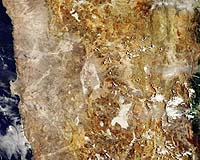
Paris (ESA) Nov 24, 2004 This Envisat image was acquired over northern Chile's Atacama Desert, the driest place on Earth outside of the Antarctic dry valleys. Bounded on the west by the Pacific and on the east by the Andes, the Atacama Desert only knows rainfall between two and four times a century. The first sight of green in this Medium Resolution Imaging Spectrometer (MERIS) image occurs some 200 kilometres west of the coast, at the foothills of the Western Cordillera, where wispy white clouds start to make an appearance. There are some parts of the desert where rainfall has never been recorded. The only moisture available comes from a dense fog known as camanchaca, formed when cold air associated with ocean currents originating in the Antarctic hits warmer air. This fog is literally harvested by plants and animals alike, including Atacama's human inhabitants who use 'fog nets' to capture it for drinking water. The landscape of the Atacama Desert is no less stark than its meteorology: a plateau covered with lava flows and salt basins. The conspicuous white area below the image centre is the Atacama Salt Flat, just to the south of the small village San Pedro de Atacama, regarded as the centre of the desert. The Atacama is rich in copper and nitrates � it has been the subject of border disputes between Chile and Bolivia for this reason - and so is strewn with abandoned mines. Today the European Southern Observatory (ESO) has located in high zones of the Atacama, astronomers treasuring the region's remoteness and dry air. The Pan-American Highway runs north-south through the desert. Along the Pacific coast, the characteristic tuft-shape of the Mejillones peninsula is visible, where the town of Antofagasta lies just south of Moreno Bay on the southern side of the formation. This MERIS full resolution image was acquired on 10 January 2003 and has a spatial resolution of 300 metres. Related Links Envisat SpaceDaily Search SpaceDaily Subscribe To SpaceDaily Express  TerraSAR-X - New Quality Of Earth Observation
 Cologne, Germany (SPX) Nov 23, 2004
TerraSAR-X, the German all-weather satellite project, has entered its decisive phase. At the Friedrichshafen-based space company EADS Astrium, the final spurt for the development team has now begun with the start-up of the integration activities. |
|
|

| The content herein, unless otherwise known to be public domain, are Copyright 1995-2006 - SpaceDaily.AFP and UPI Wire Stories are copyright Agence France-Presse and United Press International. ESA PortalReports are copyright European Space Agency. All NASA sourced material is public domain. Additionalcopyrights may apply in whole or part to other bona fide parties. Advertising does not imply endorsement,agreement or approval of any opinions, statements or information provided by SpaceDaily on any Web page published or hosted by SpaceDaily. Privacy Statement |