
 |
 |
 |
 |
 |
 |
 |
 |
 |
 |

| . |  |
. |

Sydney, Australia (SPX) Oct 31, 2010 As China's second Moon probe continues its mission, more information is being disclosed about China's ambitions for worlds beyond. China has made no secret of its plans to explore Mars, but we are getting a firmer indication of what to expect. Vague statements in the Chinese media have suggested that China could launch a mission to Mars in 2013. This is an interesting suggestion for a program that's still largely unknown to us. How does this add to our knowledge of China's Mars program? China's first planned step to Mars is very well known. In 2011, the Yinghuo 1 orbiter will be launched to Mars in tandem with Russia's Phobos-Grunt mission. We know a lot about Yinghuo 1 already, thanks to some fairly open publicity about the mission. Yinghuo 1 is a small orbiter, which will enter a highly elliptical orbit around Mars. Its main role is to study the tenuous Martian atmosphere, and help to answer one of the greatest mysteries surrounding the planet. Long ago, the atmosphere of Mars was much thicker, helping to produce almost Earthlike conditions on the surface. Why did Mars change into the barren world of today, and why did most of the atmosphere disappear? Roughly two years after Yinghuo 1 is launched, a new "launch window" will open between Earth and Mars, as the position of the planets becomes favourable again. NASA plans to send an orbiter during this window, and it will also study the Martian atmosphere. Could China be ready to fly again so soon? There are plenty of reasons to believe that China could do it. Consider recent events. China has successfully carried out a long mission in deep space. The Chang'e 1 mission was China's first lunar orbiter. Launched in 2007, the spacecraft performed well in mapping the entire Moon. China has followed this with the launch of Chang'e 2 just a few weeks ago. This spacecraft is essentially a copy of Chang'e 1, with different instruments and some improvements to its sub-systems. Chang'e 2 is performing very well, and has navigated successfully into a low lunar orbit. Chinese space engineers must feel pleased. They've developed a generic spacecraft design and proven that it works well, on two flights out of two. China has also openly discussed the possibility of sending Chang'e 2 beyond the Moon once its primary mission is complete. While the spacecraft will not be sent to Mars, it has been suggested that Chang'e 2 could be sent into heliocentric orbit, to test communications and control at vast distances from Earth. This is another hint at what China is planning. This author suggests that the basic spacecraft bus used for the Chang'e lunar orbiters could be modified for use as a Chinese Mars probe. The Chang'e bus, or main spacecraft body, is itself derived from a geostationary communications satellite. Engineers love evolution, taking something that works and modifying it for other purposes. From Earth orbit, to the Moon, to Mars, is the steady path of this robust spacecraft design. A dedicated Mars mission would require further modifications to the design of the spacecraft. There would need to be changes to the antennas and telemetry systems used, to compensate for the greater distance. One of the changes in Chang'e 2 over its predecessor is the use of a new, advanced radio system with different frequencies. Could this be a precursor of something designed to work at Mars? Flying to the Moon is, technically speaking, a trip into deep space. But a flight all the way to Mars could expose a spacecraft to even more hazards. The spacecraft could probably use some additional hardening of some of its key components, even if this is just placing extra cosmic ray shielding on the computer. Getting to Mars requires more energy than a mission to the Moon. China used the Long March 3A for the first Chang'e launch, and then switched to the more powerful Long March 3C for the second. But even this rocket would struggle to send a Chang'e-type probe to Mars. It's entirely possible, however, that the Long March 3B could do it. Despite its lower alphabetical rank, this rocket is more powerful than the 3A or 3C, and draws much of its extra force from the use of four strap-on rocket boosters. If China really wanted a big boost, it could use the stretched variant of this rocket, the Long March 3B/E. Right now, this is the most powerful booster in China's fleet. More powerful boosters will be available to China when the Long March 5 family of boosters makes its debut, but this is unlikely to happen before 2014. If China wants to fly to Mars in 2013, the well-tested Long March 3B will be the best choice. So, we have a rocket that can reach Mars and a spacecraft design that can fly there. What else needs to be addressed? China has a large stable of scientific instruments at its disposal. Some have been tested on the Chang'e missions. Some are already going to Mars on board Yinghuo. A large Mars orbiter will need a high-resolution camera (currently on Chang'e 2), spectrometers (Chang'e 1 and 2) and some particles and fields instruments (Yinghuo 1 and various Chinese scientific satellites). China just needs to pick and choose. Then there's the tracking and support. China has already demonstrated the ability to track and communicate with spacecraft at the Moon. Through its co-operation with the European Space Agency, it has access to a global deep space network, and can also tap European experience in tracking planetary missions. Control and navigation of both Chang'e missions was impressive. When all the recent progress in China's unmanned space program is considered, the idea of launching an advanced Mars mission within three years does not sound farfetched. But China could elect to wait for another launch window, and refine some of its mission goals and hardware. There are also ambitious feats in the works for China's lunar program, with a robot lunar landing expected in 2012. China is also planning its first small manned space laboratory, which should also receive its first crew in 2012. There's plenty of activity in the near future without going to Mars. Even if China does not launch its second Mars mission in 2013, the very fact that it can be considered is instructive. It points to a growing confidence in China's spaceflight capabilities, and also gives hints to the type of hardware that would probably be used. As usual, time will reveal the answers to these questions. Dr Morris Jones is an Australian space analyst, writer and lecturer. Email morrisjonesNOSPAMhotmail.com. Replace NOSPAM with @ to send email.
Share This Article With Planet Earth
Related Links the missing link The Chinese Space Program - News, Policy and Technology China News from SinoDaily.com

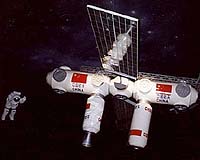 China Kicks Off Manned Space Station Program
Beijing (XNA) Oct 28, 2010 China has formally begun its manned space station program, aiming to complete construction of a "relatively large" manned space laboratory around 2020, said a spokesman for the national manned space program. China was aiming to develop and launch the first part of a space laboratory before 2016, focusing on breakthroughs in living conditions for astronauts and research applications, the sp ... read more |
|
|
| The content herein, unless otherwise known to be public domain, are Copyright 1995-2010 - SpaceDaily. AFP and UPI Wire Stories are copyright Agence France-Presse and United Press International. ESA Portal Reports are copyright European Space Agency. All NASA sourced material is public domain. Additional copyrights may apply in whole or part to other bona fide parties. Advertising does not imply endorsement,agreement or approval of any opinions, statements or information provided by SpaceDaily on any Web page published or hosted by SpaceDaily. Privacy Statement |


 del.icio.us
 Digg
Digg Reddit
 YahooMyWeb
 Google
 Facebook


