|
 |
 |
 |
 |
 |
 |
 |
 |
 |

| . |  |
. |
Chinese Astronauts Test Traditional Chinese Medicines In Space
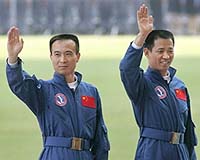
Beijing (XNA) Aug 29, 2007 China's astronauts have been testing new varieties of traditional Chinese medicine that could help treat osteoporosis, insomnia and improve immunity. Doctors with the China Astronaut Research and Training Center say the new remedies will be prepared for sale after further tests during the country's third manned space program in 2008. The medicines have been packaged in pill and capsule forms for the first time so astronauts will be able to take them in space. The medicines were intended to improve cardiovascular and heart and blood vessel functions during short space flights or space walks, said Li Yongzhi, doctor with the center. "We have finished human trials and the results were satisfactory," said Li. The center has been working with a pharmaceutical factory to produce the medicine, which would undergo clinical tests by the end of the year, said the doctor, but she declined to elaborate. "The medicine is expected to be on the market in the next two years and we hope they will not only benefit the space elite, but also the general public," she said. Living in zero gravity could lead to cardiovascular problems, lower immunity and bone mineral loss, said Li. "We can't say the astronauts would be ill as it is the normal physical reaction of a healthy body to an abnormal environment," said Li. "Western medicine lacks effective remedies with no side effects, but traditional Chinese medicine offers good over-all recuperation," she added. Li's center has applied traditional Chinese medicine to the health care of astronauts since 1997. "Our astronauts are very healthy, so the Chinese medicine they have taken is used to improve their adaptability and endurance," said Li. China has a team of 14 astronauts. Li and her colleagues have spent 10 years collating their physical indices during training and space flights, on which the doctors have composed different recipes for each astronaut. "The astronauts only take traditional Chinese medicines when needed," said Li. "The astronauts began to drink what we call 'medical tea' 90 days before the Shenzhou VI space mission in 2005. It's herbal soup," she said. "They all love it and said they slept better and were more energetic after drinking the tea." Li said Russia and other European countries had begun research into traditional Chinese medicine for space programs.
Source: Xinhua News Agency Community Email This Article Comment On This Article Related Links Rocket Science News at Space-Travel.Com
 Analysis: Hitting Iran where it hurts
 Washington (UPI) Aug 28, 2007
 Amid continuing speculation of a pending U.S. attack on Iran's nuclear facilities or possible raids targeting Iran's Revolutionary Guards Corps, a group of activists is asking Washington to consider "terror-free investment" -- a non-violent tool -- as a means of pressuring Iran. |
|
|

| The content herein, unless otherwise known to be public domain, are Copyright 1995-2006 - SpaceDaily.AFP and UPI Wire Stories are copyright Agence France-Presse and United Press International. ESA PortalReports are copyright European Space Agency. All NASA sourced material is public domain. Additionalcopyrights may apply in whole or part to other bona fide parties. Advertising does not imply endorsement,agreement or approval of any opinions, statements or information provided by SpaceDaily on any Web page published or hosted by SpaceDaily. Privacy Statement |