|
 |
 |
 |
 |
 |
 |
 |
 |
 |

| . |  |
. |
Clues To Planet Formation Revealed
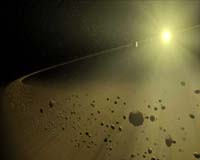
Ann Arbor MI (SPX) May 24, 2005 The most detailed measurements to date of the dusty disks around young stars confirm a new theory that the region where rocky planets such as Earth form is much farther away from the star than originally thought. These first definitive measurements of planet-forming zones offer important clues to the initial conditions that give birth to planets. Understanding planet formation is key to understanding Earth's origins, yet this remains a mysterious process, said John Monnier, assistant professor of astronomy at the University of Michigan and lead author on the paper, "The near-infrared size luminosity relations for Herbig Ae/Be disks" in a recent edition of Astrophysical Journal. Very young stars are surrounded by thick, rotating disks of gas and dust, which are expected to eventually disappear as material is either pulled into the star, is blown from the disk, or collects into larger pieces of debris. This transition marks the leap from star formation to planet formation. The scientists examined the innermost region of such disks where the star's energy heats the dust to extremely high temperatures. These dusty disks are where the seeds of planets form, where dusty particles stick together and eventually grow to large masses. However, if the dust orbits too close to the star, it evaporates, shutting off any hope of planet formation. It's important to know where the evaporation begins since it has a dramatic effect on planet formation, Monnier said. The initial temperature and density of dust surrounding young stars are critical ingredients for advanced computer models of planet formation. For the study, scientists looked at young stars that are about one and a half times the mass of the sun. "We can study these stars more in-depth because they are brighter and easier to see," Monnier said. In the last decade or so, beliefs about the systems that build planets have changed drastically with the onset of powerful observatories that can take more precise measurements, Monnier said. They found that measurements thought to be accurate were actually very different than originally thought. For this work, scientists used the two largest telescopes in the world linked together to form the Keck Interferometer. This ultra-powerful duo acts as the ultimate zoom lens allowing astronomers to peer into planetary nurseries with 10X the detail of the Hubble Space Telescope. By combining the light from the two Keck Telescopes, researchers were able to achieve the capabilities of a single telescope that spans a football field, but for a fraction of the cost, Monnier said. Other key authors were Rafael Millan-Gabet and Rachel Akeson of the Michelson Science Center. Other key institutions included the Caltech-run, NASA Jet Propulsion Laboratory and the W.M. Keck Observatory in Kamuela, Hawaii. The Keck Interferometer was funded by NASA and developed and operated by Jet Propulsion Lab, W.M. Keck Observatory, and the Michelson Science Center. Related Links Monnier U-M Department of Astronomy Keck Observatory SpaceDaily Search SpaceDaily Subscribe To SpaceDaily Express  Most Space Telescope Sees "Tail Wagging Dog" In Star - Exoplanet System
 Montreal QC (SPX) May 17, 2005
Canadian astronomers using the MOST space telescope have observed a remarkable planetary system where a giant close-in planet is forcing its parent star to rotate in lock-step with the planet's orbit. |
|
|

| The content herein, unless otherwise known to be public domain, are Copyright 1995-2006 - SpaceDaily.AFP and UPI Wire Stories are copyright Agence France-Presse and United Press International. ESA PortalReports are copyright European Space Agency. All NASA sourced material is public domain. Additionalcopyrights may apply in whole or part to other bona fide parties. Advertising does not imply endorsement,agreement or approval of any opinions, statements or information provided by SpaceDaily on any Web page published or hosted by SpaceDaily. Privacy Statement |